
An overweight French Bulldog is easy to miss. The breed is meant to look compact and muscular, so a few extra pounds can hide behind that barrel chest until your dog starts puffing on short walks. Most dogs can get back into shape with a careful plan: a vet check, the right calorie target, weighed food, fewer extras and gentle activity. This guide walks through how to tell whether your Frenchie is carrying too much weight, why it matters so much for this breed, and how to help your French Bulldog lose weight safely.
Key takeaways
- Judge weight by body condition: ribs easy to feel, a visible waist, a tucked-up belly.
- See your vet first to rule out medical causes like an underactive thyroid.
- Aim for slow, steady loss of about 1-2% of body weight per week.
- Weigh food on a kitchen scale and keep treats under 10% of daily calories.
- Choose short, cool, gentle walks and sniffing games over hard exercise.
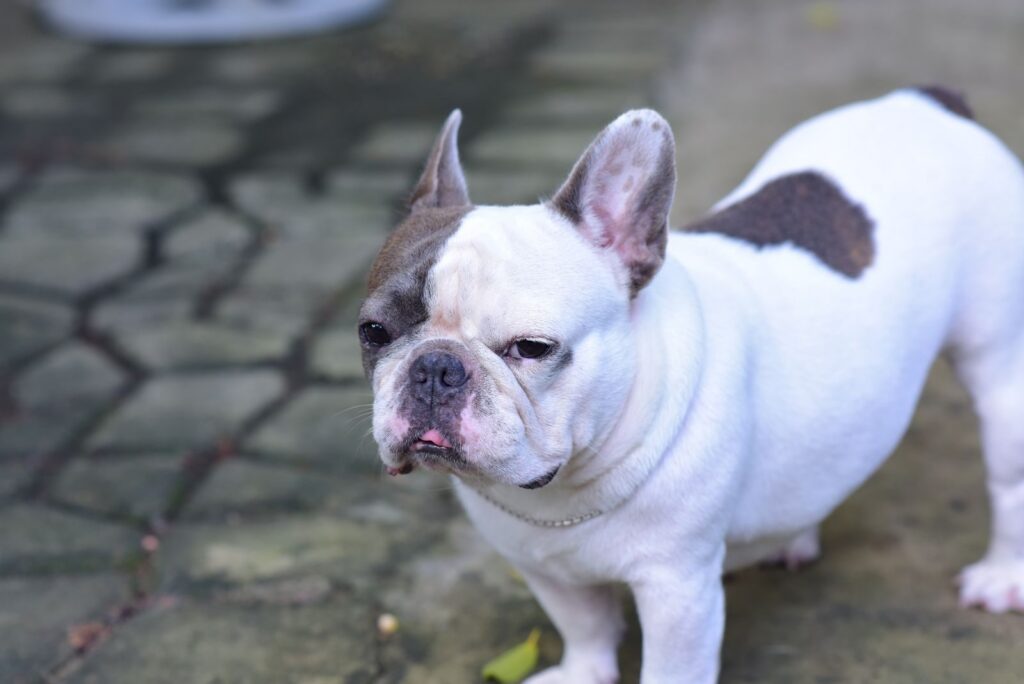
Is my French Bulldog fat? How to check at home
The number on the scale only tells part of the story, because Frenchies vary a lot in frame and muscle. Vets use a body condition score (BCS), a hands-on check of fat cover. On the 9-point scale published by the World Small Animal Veterinary Association (WSAVA), 4 and 5 are ideal. Here is how the scores compare:
| Score | Ribs | Waist and belly |
|---|---|---|
| 4-5 (ideal) | Easy to feel with minimal fat covering | Waist visible behind the ribs from above; belly tucked up from the side |
| 6 (above ideal) | Can be felt, with slight excess fat | Waist visible but not prominent; tuck still there |
| 7 (overweight) | Felt only with difficulty under heavy fat | Fat over the lower back and base of the tail; waist absent or barely visible |
| 8-9 (obese) | Not felt, or only with firm pressure | No waist, no tuck; belly may sag; heavy fat on the back, tail base, and at 9 the neck and limbs |
To check your dog, run your hands along the sides: the skin should move freely over ribs that are easy to feel. Then look from above for a waist and from the side for a tummy that goes in rather than bulges out. The PDSA also suggests gently feeling the base of the tail, where there should be no build-up of fat. Frenchies’ wide chests can fool the eye, so trust your hands. Our French Bulldog weight chart explains typical weights and why body condition matters more than a single figure.
Why an overweight French Bulldog is at extra risk
Extra fat is hard on any dog. VCA Animal Hospitals lists higher risks of diabetes, heart disease, high blood pressure, osteoarthritis, bladder stones, cancer and complications under anesthesia, and notes that being even moderately overweight can shorten life expectancy by nearly two years. For a flat-faced, compact breed, several of these problems stack up:
- Breathing. In a University of Cambridge study of 604 pugs, French Bulldogs and Bulldogs, pugs and Bulldogs with higher body condition scores had a higher risk of brachycephalic obstructive airway syndrome (BOAS), and in French Bulldogs a thicker neck relative to the chest was linked with the condition. The researchers noted that a thick neck could reflect fat or muscle, but extra fat around the neck and chest is the last thing an already narrow airway needs. See our guide to BOAS and French Bulldog breathing problems.
- Heat. The PDSA notes that obese dogs find it harder to exercise and to cope with hot weather, a serious concern for a breed that already struggles to cool down.
- Spine and joints. Frenchies are prone to back problems, and every extra pound adds load to the spine, hips and knees.
Step 1: See your vet before you start
Weight gain usually comes from eating more calories than the body uses, but not always. VCA points out that obesity can be a sign of conditions such as hypothyroidism (an underactive thyroid) or Cushing’s disease (overactive adrenal glands), and the PDSA advises starting with a vet visit so other causes can be ruled out. Your vet can also:
- Record a starting weight and body condition score.
- Agree on a realistic target weight for your individual dog.
- Set a daily calorie target and say whether a weight-loss diet is needed.
- Advise on safe exercise if your Frenchie has breathing, back or joint problems.
Step 2: Set a safe rate of French Bulldog weight loss
Crash diets are not the goal. The PDSA says that about 1-2% of starting weight per week is a good target, and a WSAVA World Congress lecture on canine obesity by a University of Minnesota veterinary internist describes the same 1-2% range as safe. For a 14 kg (about 31 lb) Frenchie, that works out to roughly 140-280 g (about 5-10 oz) a week. At that pace, losing 2 kg typically takes a few months, not a few weeks.
Slow progress is normal. If your dog is losing much faster, or not losing at all after several weeks, check in with your vet rather than cutting food further on your own.
Step 3: Work out calories for the target weight
A common veterinary starting point for weight loss is to base calories on the dog’s target weight, not current weight. In one published weight-loss study, daily energy was calculated as 70 × (target weight in kg) to the power of 0.75, which is the resting energy requirement (RER) at the goal weight. Some vets start lower than this, and your vet may choose a different starting point depending on your dog’s history and diet.
As an example only: if your vet sets a target of 12 kg, the RER at that weight is about 450 kcal a day. Our French Bulldog food calculator has a “weight loss, with your vet (enter target weight)” option that does this math and converts calories into grams of your dog’s food. Treat the result as a starting point to confirm with your vet.
If your dog needs to lose a lot of weight, your vet may recommend a dedicated weight-loss diet. Simply feeding much less of a regular food can mean missing out on nutrients, as the PDSA warns.
Step 4: Measure every meal and count every treat
Small errors add up fast in a 12 kg dog. A few habits make the biggest difference:
- Weigh food on a kitchen scale instead of using a scoop, and split the daily amount into two meals.
- Keep treats under 10% of daily calories. VCA gives the example that a dog on 1,000 calories a day would get 900 from the diet and 100 from treats. Better still, use some of the daily kibble as training rewards.
- Cut out table scraps. The PDSA notes that to a medium-sized dog, a cube of cheese is like a person eating two scones.
- Keep a food diary for a week. The PDSA suggests writing down everything your dog eats, and why, to find hidden calories.
Step 5: Get the whole household on board
Weight-loss plans often fail at home. In a study of dogs on supervised weight-loss programs, owners not following the diet and exercise advice was the main reason for poor results, including giving unprescribed food and snacks. Practical ways to keep everyone consistent:
- Agree on one person who measures and serves meals.
- Put the daily treat allowance in a jar each morning; when it is empty, treats are done.
- Tell visitors, grandparents and dog walkers about the plan.
- Swap food rewards for attention, play and short training games.
Step 6: Add gentle, Frenchie-friendly exercise
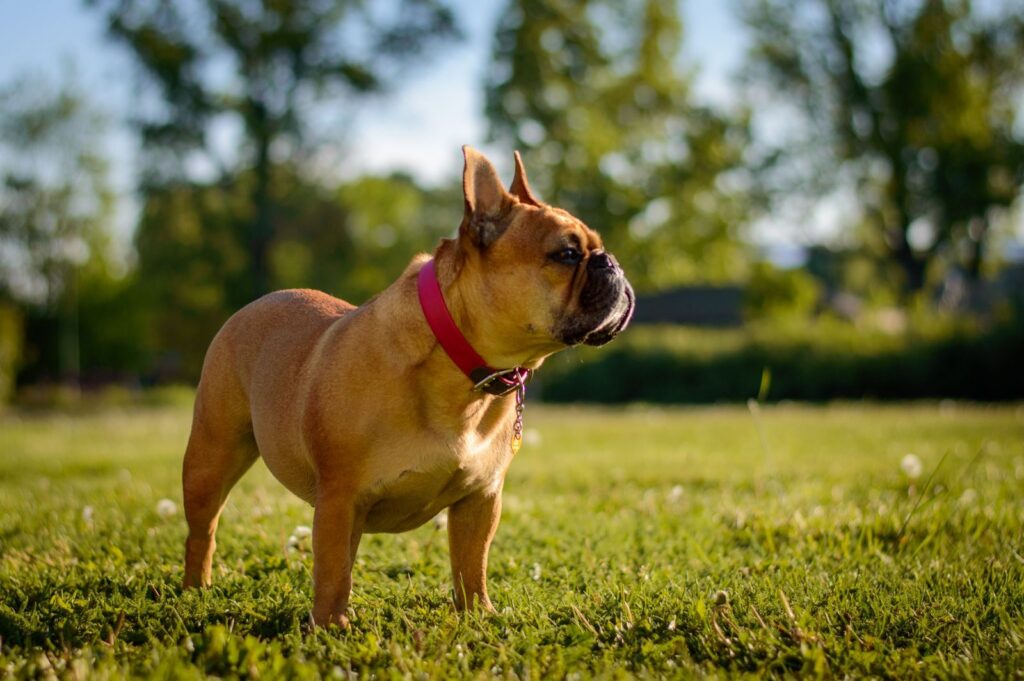
Exercise supports weight loss, but this breed needs a careful approach. The PDSA recommends building up activity gradually over a few weeks and discussing an exercise program with your vet. Good options for an overweight French Bulldog include:
- Short, frequent walks at an easy pace, in the cool parts of the day.
- Sniff walks and scent games, which are mentally tiring without heavy breathing.
- Food puzzles using part of the daily ration, so meals last longer.
- Gentle indoor play on non-slip floors.
Avoid exercise in heat or humidity, long or fast walks, repeated jumping on and off furniture, and anything that leaves your dog struggling for breath. Stop and rest if breathing becomes noisy or labored. Our guide to French Bulldog exercise needs has more ideas.
Step 7: Track progress and adjust
Weigh your dog regularly on the same scale. VCA calls monthly weigh-ins important for success, and in the weight-loss study above, dogs that lost weight successfully had been rechecked roughly every three weeks, compared with about every five weeks for those that did poorly. Ask your vet how often to come back for rechecks. Small dogs are easy to weigh at home: weigh yourself, then weigh yourself holding your dog, and subtract.
Recheck body condition at the same time and share the numbers with your vet. Once your Frenchie reaches the target, your vet can help you raise portions slightly to a maintenance level so the weight stays off.
Vet note: Do not start a strict diet without talking to your vet, especially if your Frenchie is very overweight, a senior, a puppy, or has breathing, heart, back or joint problems. See your vet promptly if your dog gains weight while eating less, loses weight faster than planned, seems unusually tired, drinks or urinates more than usual, or has noisy or difficult breathing.
FAQ
How can I tell if my French Bulldog is overweight?
Feel for the ribs, look for a waist from above and check for a tucked-up belly from the side. If you need firm pressure to feel the ribs, or the waist and tuck have gone, your Frenchie is likely carrying extra weight. Your vet can confirm with a body condition score.
How fast should my French Bulldog lose weight?
About 1-2% of body weight per week is a commonly recommended safe target. For a 14 kg dog, that is roughly 140-280 g a week, so expect the process to take months rather than weeks.
How much should I feed my Frenchie to lose weight?
That depends on your dog’s target weight and food. A common starting point is calories based on the target weight rather than current weight. Ask your vet for a target, then use our food calculator to turn it into grams of food.
Can I just feed less of my dog’s normal food?
For mild weight gain, slightly smaller portions may be enough. For bigger reductions, ask your vet about a weight-loss diet, since cutting a regular food a lot can leave your dog short of nutrients.
Sources
- Body Condition Score (Dog) — World Small Animal Veterinary Association (WSAVA)
- Getting your dog into shape — PDSA
- Obesity in Dogs — VCA Animal Hospitals
- Factors associated with failure of dog’s weight loss programmes — Porsani et al., Veterinary Medicine and Science (2020)
- Conformational risk factors of brachycephalic obstructive airway syndrome (BOAS) in pugs, French bulldogs, and bulldogs — Liu et al., PLoS One (2017)
- Canine Obesity: Disease Associations and Management — P. J. Armstrong, WSAVA World Congress Proceedings (2011)