

The best food for French Bulldog puppy growth isn’t one particular brand. It’s a complete, balanced growth diet from a company you can trust, in a form your flat-faced puppy can eat comfortably, fed in amounts that keep them lean. This guide shows you how to check any bag or can for those things.
Quick answer: Choose a food labeled complete and balanced for “growth” or “all life stages” (AAFCO), from a company that can answer WSAVA’s questions about nutritionists and quality control. Keep your puppy lean, keep treats under 10% of daily calories, and skip extra calcium. Small breeds usually switch to adult food around 7 to 9 months; ask your vet.
Key takeaways
- Look for an AAFCO statement saying the food is complete and balanced for growth or all life stages.
- Frenchies grow up far below 70 lb, so the large-breed growth rules aren’t the deciding factor.
- Ask the manufacturer WSAVA’s questions about nutritionists, formulation and quality control.
- A complete puppy food needs no extra calcium or vitamins unless your vet advises it.
- Keep your puppy lean, keep treats under 10% of daily calories, and ask your vet when to switch.
What to look for in the best food for French Bulldog puppy growth
Puppies need more than a smaller portion of adult food. The Merck Veterinary Manual notes that diets for growing puppies should contain at least 22.5% protein on a dry-matter basis. Merck adds that puppy diets usually contain 8% to 20% fat (dry-matter basis) and that calcium and phosphorus requirements are higher during growth than for adult maintenance. A label stating that the food is formulated for growth is how you know the manufacturer designed it with those needs in mind.
For the general rules that apply to any Frenchie food, such as ingredient lists, calorie density and grain-free or raw diets, see our main guide to the best food for French Bulldogs.
Step 1: Read the AAFCO nutritional adequacy statement
AAFCO, the Association of American Feed Control Officials, calls the nutritional adequacy statement “perhaps the most important part of a label.” It tells you whether the food is complete and balanced and which life stage it covers. For a puppy, you want one of these:
- “Growth”: designed for growing puppies.
- “All life stages”: WSAVA explains that these diets are formulated for reproduction and growth, so they are also suitable for puppies.
Foods labeled only for “maintenance” are for adults, and foods “intended for intermittent or supplemental feeding only” are not designed to be fed as the whole diet. The statement may also say whether the food meets AAFCO profiles by formulation or by animal feeding tests; both are acceptable.
The large-breed wording, and why it rarely matters for a Frenchie
Tufts University’s Petfoodology team explains that AAFCO now requires growth foods to state whether they meet extra limits for large-breed puppies. You’ll see either “including growth of large-size dogs (70 lbs or more as an adult)” or “except for growth of large-size dogs (70 lbs or more as an adult).” Tufts notes the rule started in 2016. The difference matters for big puppies because their bones are more sensitive to too much or too little calcium, so large-breed growth foods have a narrower calcium range.
French Bulldogs are nowhere near that size. The French Bull Dog Club of America breed standard says weight should not exceed 28 pounds, and a dog over 28 pounds is disqualified in the show ring. So for a typical Frenchie puppy:
| Label wording | OK for a typical Frenchie puppy? |
|---|---|
| Growth (or all life stages) “except for growth of large-size dogs” | Yes. That exclusion is for dogs expected to reach 70 lb or more. |
| Growth (or all life stages) “including growth of large-size dogs” | Yes. It still meets the growth profile; it’s simply also suitable for big breeds. |
| Adult maintenance only | No. It isn’t designed for growth. |
| Intermittent or supplemental feeding only | Not as the main diet. |
If your puppy is a mix, or is expected to be much larger than a standard Frenchie, ask your vet which wording to look for.
Step 2: Ask the manufacturer WSAVA’s questions
The WSAVA (World Small Animal Veterinary Association) Global Nutrition Committee points out that labels carry marketing as well as nutrition information, and that terms such as “holistic” or “premium” are of little practical value. Its guidelines suggest asking the company:
- Do you employ a nutritionist? WSAVA considers a PhD in animal nutrition, or board certification in veterinary nutrition (ACVN or ECVCN), the appropriate qualifications.
- Who formulates your diets? An experienced formulator or qualified nutritionist, rather than an owner, breeder or trainer.
- What quality control do you use? For example, checks on ingredients and nutrient analysis of the finished product.
- What research have you done? Companies don’t have to carry out nutrition studies, but WSAVA says doing so shows a commitment to animal health.
WSAVA also suggests checking that the company can tell you the calorie content and a typical nutrient analysis, and who actually makes the food. If a company can’t or won’t answer, WSAVA advises caution about feeding that brand.

Step 3: Choose a kibble your flat-faced puppy can actually eat
Frenchie puppies have short muzzles and small mouths, and some find certain kibbles awkward to pick up or chew. Watch how your puppy eats rather than relying on what the bag promises:
- A good kibble is one your puppy can pick up easily and actually chews, rather than gulping it whole, gagging or leaving it scattered.
- Use a shallow, wide bowl so your puppy doesn’t have to push their face into a deep dish.
- For fast eaters, a slow feeder with shallow sections a flat face can reach can help.
- If your puppy struggles, try soaking the kibble briefly in water or mixing in a complete wet food. Ask your vet if eating seems difficult or keeps causing gagging or regurgitation.
Wet vs dry French Bulldog puppy food
Both can be complete and balanced, so the AAFCO statement matters more than the format. The American Kennel Club notes that canned food is the most expensive way to feed a puppy and dry food the most economical. Wet food contains more water, and Merck notes that dogs eating mostly canned food generally drink less water than those on dry food. Many owners mix the two. If you do, count the calories from both so the total doesn’t creep up.
Avoid overfeeding, and skip extra supplements
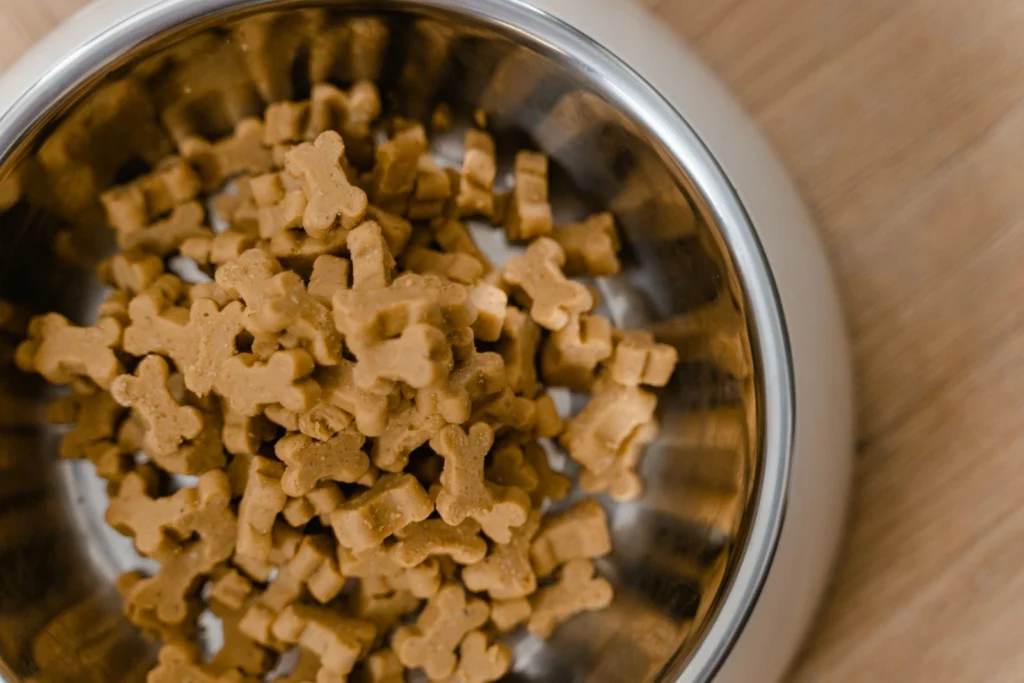
A round puppy is not a healthier puppy. AKC warns that a young dog carrying too much weight has a higher risk of orthopedic problems, and advises basing portions on body condition rather than on how much your puppy eats or leaves in the bowl. Puppy foods are calorie-rich, so the feeding guide on the bag is only a starting point. For meals per day, calorie estimates by weight and body condition checks, use our French Bulldog feeding schedule by age instead of guessing.
No extra calcium. Merck notes that calcium and phosphorus deficiencies are uncommon in dogs eating complete and balanced diets, and that indiscriminate mineral supplementation should be avoided because it is likely to cause a mineral imbalance. A complete growth food already contains the calcium your puppy needs. AKC also advises talking to your vet and breeder before adding any vitamin or mineral supplement.
Treats count. A widely used veterinary guideline is to keep treats to less than 10% of daily calories. Puppies get a lot of training rewards, so use very small pieces, use some of the daily kibble as rewards, and reduce meal portions slightly on heavy training days.
When to switch to adult food
AKC says small-breed puppies can usually move to adult food at around 7 to 9 months, while larger breeds may stay on puppy food until 12 to 14 months. It advises erring on the side of caution: staying on puppy food a little too long is better than switching too early. AKC also notes that spaying or neutering lowers energy needs slightly, which is another reason to move to an adult maintenance food.
Ask your vet where your Frenchie fits in that range, especially if your puppy looks set to be on the larger side. Our guide to French Bulldog puppy growth milestones explains when rapid growth slows. Make the change gradually over about a week; our guide to switching your French Bulldog’s food has sample mixing schedules. The same approach applies when you move a new puppy off the breeder’s food.
Vet note: Bring the food’s label, or a photo of it, to your puppy’s early vet visits so your vet can confirm it suits growth and help set a calorie target. See your vet promptly if your puppy has vomiting or diarrhea that doesn’t settle, refuses food, coughs or gags often while eating, isn’t gaining weight, or seems lethargic. Ask before adding any supplement.
FAQ
Does my French Bulldog puppy need a large-breed puppy food?
Usually not. The large-breed growth rules apply to dogs expected to reach 70 pounds or more, and the French Bull Dog Club of America standard sets a 28-pound maximum. A food labeled for growth or all life stages is suitable either way. Ask your vet if your puppy is a mix or unusually large.
Can I feed an “all life stages” food to my Frenchie puppy?
Yes. WSAVA explains that all life stages foods are formulated for reproduction and growth, so they meet a puppy’s needs. Because they are designed to meet growth needs, they can be calorie-rich for a dog that has stopped growing, so watch portions closely as growth slows.
Should I give my Frenchie puppy calcium or vitamin supplements?
Not with a complete and balanced puppy food, unless your vet recommends one. Merck warns that indiscriminate mineral supplementation can cause a mineral imbalance.
How much should I feed my French Bulldog puppy?
Start with the feeding guide on the label for your puppy’s weight, split across three or four meals depending on age, then adjust by body condition. The feeding schedule linked above gives calorie estimates by weight.
Sources
- Reading Labels — Association of American Feed Control Officials (AAFCO)
- WSAVA Global Nutrition Committee: Guidelines on Selecting Pet Foods — World Small Animal Veterinary Association (WSAVA)
- Confused About What to Feed Your Large Breed Puppy? New Rules May Help! — Petfoodology, Cummings School of Veterinary Medicine at Tufts University
- Puppy Feeding Fundamentals: Timeline for Puppy Feeding — American Kennel Club (AKC)
- Nutritional Requirements of Small Animals — Merck Veterinary Manual
- French Bulldog Breed Standard — French Bull Dog Club of America