
If you have noticed damp fur under the eyes, crusty “goop” in the corners or reddish-brown streaks down the face, you are not alone: French Bulldog watery eyes are a very common reason owners start asking questions. Sometimes the cause is minor; sometimes it is an early sign of a painful corneal ulcer that needs a vet the same day. This guide explains why flat-faced dogs are prone to eye trouble, what different kinds of discharge may mean, and when to stop watching and start calling.
Key takeaways
- Flat faces, bulging eyes and nose folds make French Bulldogs prone to tearing and eye injuries.
- Clear tears with a happy, open-eyed dog are often minor; colored discharge needs a vet check.
- Squinting, pawing at the eye or a cloudy eye can mean a corneal ulcer: see a vet today.
- Thick yellow or gray goop with red eyes can signal dry eye, a lifelong but manageable condition.
- Wipe the outside of the eye gently with a damp pad; never use human eye drops without vet advice.
Why French Bulldogs get watery eyes
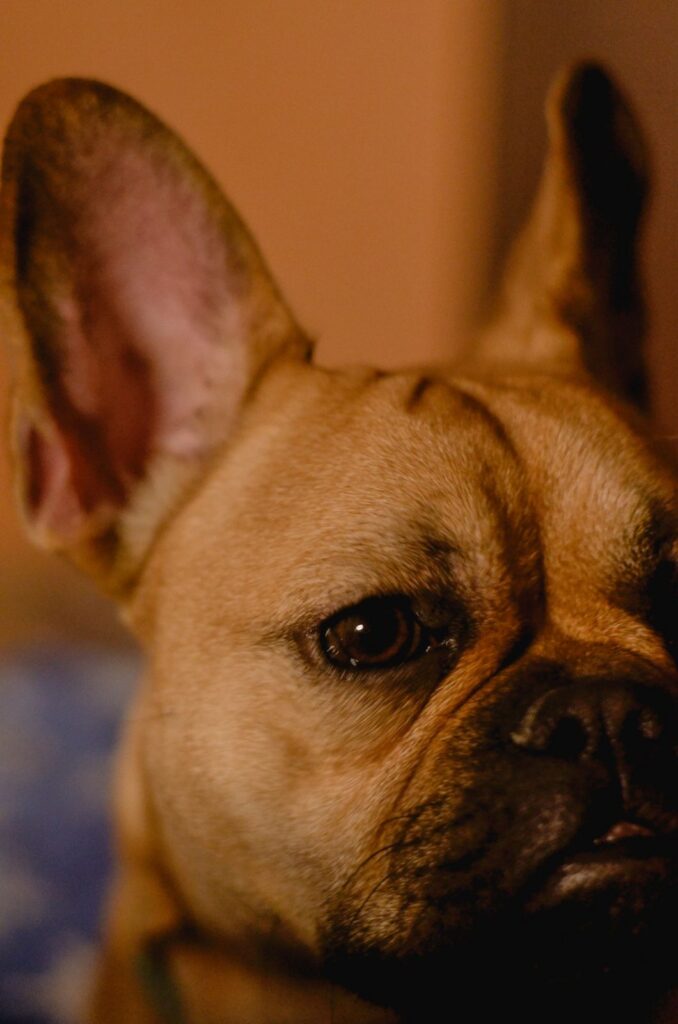
Watery eyes (vets call it epiphora) happen for one of two reasons: the eye is making too many tears, or the tears are not draining away properly. According to VCA Animal Hospitals, common causes include conjunctivitis, allergies, eye injuries, abnormal eyelashes, corneal ulcers, eyelid problems, glaucoma and blocked tear ducts. French Bulldogs’ flat (brachycephalic) faces set them up for several at once.
Prominent eyes and eyelids that don’t fully close
The American College of Veterinary Ophthalmologists (ACVO) describes a group of problems it calls brachycephalic ocular syndrome. Shallow eye sockets make the eyes bulge forward, the eyelid openings are often larger than normal so more of the eye is exposed, and in many dogs the eyelids cannot close completely. An exposed eye dries out and gets bumped more easily, so it waters.
Inward-rolling eyelids and nose-fold rubbing
ACVO also lists entropion (an eyelid that rolls inward) and trichiasis (hair, often from the nose fold, touching the eye) as part of the syndrome. Constant brushing against the cornea irritates it and can cause ulcers. A UK study of French Bulldogs cites earlier research in which dogs with nasal folds had nearly five times the odds of corneal ulcers compared with dogs without them.
Abnormal eyelashes
Extra eyelashes growing from the eyelid edge (distichia) or through the inside of the lid (ectopic cilia) can rub the eye. VCA notes these can cause redness, tearing, discharge and squinting, and that untreated cases can lead to corneal ulcers.
Tears that can’t drain
Tears normally drain through small openings in the inner eye corner into a duct leading to the nose. VCA explains that in many flat-faced dogs the facial shape stops tears from reaching the duct, so the tear film “simply rolls off the face.” Blocked tear ducts are another possible cause. The result is a permanently damp face and tear staining.
French Bulldog eye discharge: what the color may tell you
Discharge color is a clue, not a diagnosis, and a dog can have more than one problem at once.
| What you see | What it may mean | What to do |
|---|---|---|
| Clear, watery tears; dog otherwise comfortable | Poor tear drainage, mild irritation (dust, wind), allergies, nose-fold hair touching the eye | Keep the face clean and dry; book a routine check if it persists or keeps coming back |
| White or gray, sticky or stringy mucus | Dry eye (KCS), allergic conjunctivitis, chronic irritation | Vet visit within 24 hours; same day if the eye is red or sore |
| Yellow or green discharge | Infection, conjunctivitis, dry eye, or a corneal ulcer | Vet visit within 24 hours; same day if your dog is squinting |
| Red eye with squinting, pawing or a cloudy/blue look | Corneal ulcer or another painful eye problem | Same-day vet visit |
| Eyeball pushed forward out of the lids | Proptosis | Emergency: go to a vet immediately |
Corneal ulcers: the urgent one
A corneal ulcer is a wound on the clear front surface of the eye. It is the main reason any watery eye with pain should be taken seriously in this breed. A large UK VetCompass study found French Bulldogs had about 4.4 times the odds of a corneal ulcer diagnosis compared with other dogs, and the authors described the breed as having an “ultra-predisposition” to the condition. They noted an earlier UK study that put the breed at around 7 times the odds of crossbred dogs.
PDSA explains that short-nosed dogs are at much higher risk because their eyes bulge forward and are very exposed. A cat scratch, a poke from a stick, grit in the eye, a stray eyelash or dry eye can all start one.
Signs to watch for, from PDSA and ACVO:
- Squinting, holding the eye partly or fully closed, or blinking more than usual
- Pawing at the eye or rubbing the face on the floor or furniture
- A red, bloodshot eye with tears or discharge
- A cloudy, hazy or bluish look to the eye, or a visible dent on the surface
- Avoiding bright light
There is a catch with flat-faced dogs. ACVO warns that brachycephalic pets often have less feeling on the eye surface and may not show signs of pain even when a serious injury is present. So a Frenchie that only seems “a bit weepy” in one eye can still have an ulcer. PDSA is blunt: leaving an ulcer untreated can result in loss of the eye. If you see squinting or pawing, call your vet the same day. Meanwhile, stop your dog rubbing the eye and don’t put anything in it.
Conjunctivitis
Conjunctivitis is inflammation of the pink tissue lining the eyelids and covering the white of the eye. VCA lists signs as cloudy, yellow or greenish discharge, squinting or extra blinking, and redness or swelling around the eyes. Causes include viral and bacterial infections, allergies, dry eye and eyelid problems such as entropion. VCA also warns that medication that helped a previous bout “may not help or may be harmful,” which is a good reason not to reach for leftover drops.
Allergies and itchy, watery eyes
Allergic conjunctivitis is common in dogs with seasonal or environmental allergies, according to VCA. You may see clear tears, red-rimmed eyes and face rubbing, often alongside itchy paws, ears or skin. If eye symptoms flare at the same time as other itching, our guide to French Bulldog allergies explains how vets work out the trigger.
Dry eye (KCS): when goop means too few tears
It sounds backward, but a goopy eye can be a dry eye. In keratoconjunctivitis sicca (KCS), the eye doesn’t make enough of the watery part of the tear film. ACVO says the most common signs are mucus from the eyes and redness, and the discharge may be gray, white, green or yellow. Dogs may squint or rub, and the cornea can become cloudy or pigmented over time.
Your vet can measure tear production with a simple paper-strip test (the Schirmer tear test) held in the eyelid for one minute. ACVO notes that treatment usually means lifelong eye medication, typically twice daily, and that untreated chronic dry eye can lead to blindness. Dogs that have had a cherry eye (a red lump in the inner corner of the eye, often with mucky discharge) are more likely to develop dry eye later, especially if the gland was removed.
Gentle cleaning and tear stains
For a healthy eye that simply waters, keeping the face clean and dry helps prevent sore skin and staining. VCA notes that persistent wetness under the eyes can lead to reddish-brown staining, odor, skin irritation and skin infection. As general guidance:
- Use a soft cotton pad or gauze dampened with lukewarm water, and a fresh pad for each eye.
- Wipe the fur and skin around the eye, from the inner corner outward. Don’t touch the eyeball itself.
- Pat the area and the nose fold completely dry afterward. Our skin fold care guide covers the nose fold routine.
- Don’t use human eye drops, leftover medication, or hydrogen peroxide products near the eyes. VCA advises not using any tear-stain product without checking with your vet first.
Tear stains are mostly a sign of poor drainage, not a disease. If staining appears suddenly, worsens, smells, or comes with redness or discharge, have your vet look for a cause.
When to see the vet about watery eyes
ACVO recommends that flat-faced dogs have a veterinary eye exam at least once a year, even when nothing seems wrong. Between checks, contact your vet:
- Same day: squinting, pawing or rubbing at an eye, a cloudy or blue eye, a visible dent or mark on the eye, sudden heavy discharge, or a red, painful eye
- Immediately (emergency): an eye that has popped forward out of the lids, or an injury such as a scratch from a cat or a stick
- Within 24 hours: yellow, green, gray or thick discharge without obvious pain, a new red lump in the corner of the eye, or watering in only one eye that doesn’t settle within a day
- At a routine visit: long-standing clear tearing and tear stains in a comfortable dog
Vet note: Many eye problems look alike from the outside. Your vet may use a fluorescent dye to check for ulcers, measure tear production and look closely at the eyelids and lashes. Because flat-faced dogs can hide eye pain, it is safer to have a new or one-sided watery eye checked early than to wait and see.
FAQ
Is it normal for my French Bulldog’s eyes to water?
A small amount of clear tearing and a little morning crust is common in the breed, mainly because tears drain poorly from flat faces. It is not normal if the discharge is colored, the eye is red or cloudy, or your dog is squinting or rubbing.
Why does my Frenchie have eye goop every morning?
Tear residue collects overnight and dries in the corners. If it is small, clear or light and wipes away easily, it is usually fine. Thick, sticky, yellow, green or gray goop, especially with red eyes, should be checked for dry eye or infection.
Can I use human eye drops on my French Bulldog?
No, not without your vet’s advice. Some products can sting or make problems such as ulcers worse, and drops that suited a previous problem may be wrong for this one. Your vet can recommend a suitable product if your dog needs one.
Why is only one of my French Bulldog’s eyes watery?
Watering in one eye more often points to a local problem, such as a scratch, ulcer, foreign body, stray eyelash or cherry eye. If it doesn’t settle within a day, or if there is any squinting, see your vet.
Sources
- Eye Discharge (Epiphora) in Dogs — VCA Animal Hospitals
- Conjunctivitis in Dogs — VCA Animal Hospitals
- Eye ulcers (corneal ulcers) in dogs — PDSA
- Understanding Brachycephalic Ocular Syndrome (BOS) — American College of Veterinary Ophthalmologists
- Dry Eye Disease or Keratoconjunctivitis Sicca (KCS) — American College of Veterinary Ophthalmologists
- French Bulldogs differ to other dogs in the UK in propensity for many common disorders: a VetCompass study — Canine Medicine and Genetics (O’Neill et al., 2021)