
A French Bulldog may be small, but one that pulls, zigzags or plants its feet can still turn a short walk into a tug-of-war. The good news is that leash training a French Bulldog doesn’t need force, special gadgets or a “firm hand”. It needs a comfortable harness, good treats, short sessions and a clear rule your dog can understand: a loose leash keeps the walk going. This guide walks you through a step-by-step plan, explains why Frenchies need a slightly different approach from other breeds, and covers what to do when your dog pulls, lunges or simply sits down and refuses to move.
Key takeaways
- Clip the leash to a well-fitted harness, never a collar, to protect a Frenchie’s airway.
- Pulling should never pay: stop or change direction, then reward a loose leash.
- Keep sessions to a few minutes and skip training in warm or humid weather.
- Choke, prong and shock collars and leash jerks are not recommended by veterinary behavior experts.
- A Frenchie that sits and refuses to walk may be hot, sore or tired, not stubborn.
Why leash training a French Bulldog is a little different
The basic method is the same for every dog: reward walking near you on a slack leash, and make sure pulling doesn’t get your dog where it wants to go. Three Frenchie traits shape how you apply it.
- The airway. French Bulldogs are brachycephalic (flat-faced), with narrowed nostrils, a long soft palate and often a small windpipe. Pressure on the throat from a collar adds strain to an airway that is already working hard. Our guide to BOAS and breathing problems explains the anatomy.
- Heat. Frenchies cool themselves poorly, so a training walk on a warm day can become dangerous quickly. Training happens in cool, short bursts.
- The “stubborn” label. Frenchies are often called stubborn, but a dog that stops cooperating is usually unmotivated, distracted, uncomfortable or tired. That’s something you can work with.
Harness, not collar: choosing and fitting the right gear
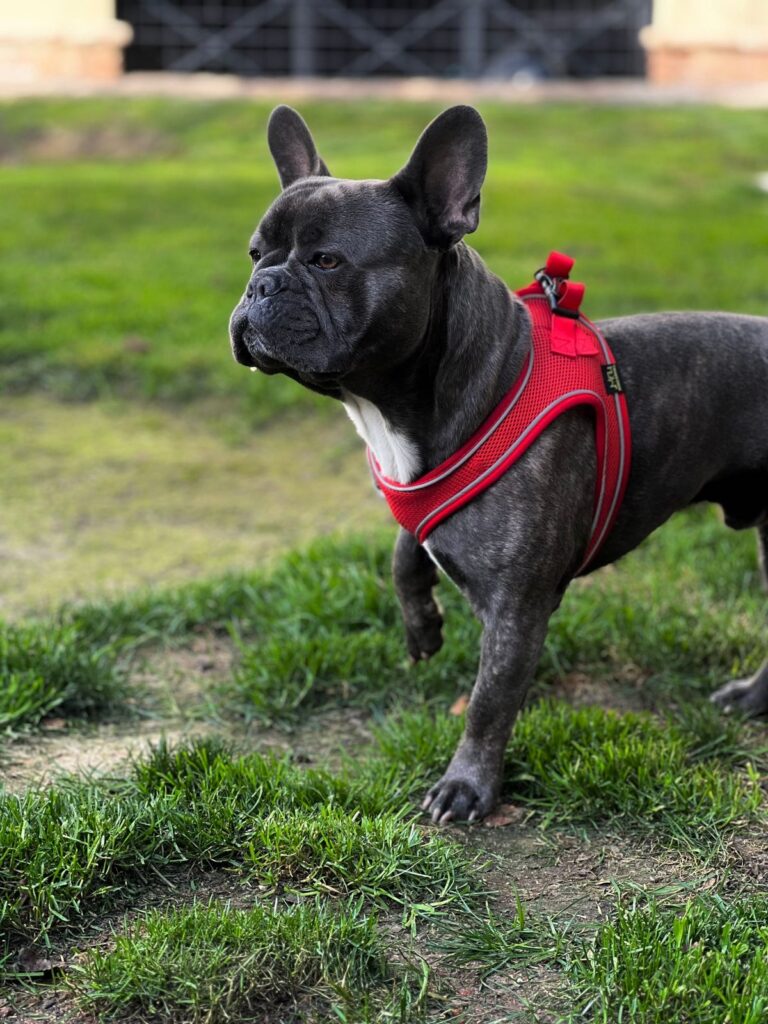
Animal welfare scientists at Purdue University advise that, because a regular collar adds strain to the windpipe, flat-faced dogs should be walked with a harness instead. A well-fitted harness keeps pressure off the throat. The RSPCA also recommends a harness for walking and training dogs in general, since it stops a dog pulling on and potentially hurting its neck. For dogs that pull, the RSPCA suggests a front-attach harness (with a clip on the chest), ideally with a double-ended leash: you walk your dog from the back clip and use the front clip to turn them if they start to pull.
You don’t need a particular brand. Look at fit and design:
| Check | What you want |
|---|---|
| Neck opening | Sits low, closer to the top of the breastbone than around the throat |
| Snugness | You can slide about two fingers under each strap, and your dog can’t back out |
| Girth strap | Sits on the rib cage, not back toward the belly and not rubbing behind the elbows |
| Shoulders | Front legs can reach forward and out to the side freely |
| Material | Lightweight and comfortable, so it doesn’t add bulk or heat on warmer days |
| Skin | No rubbed or bald patches after walks; check the armpits and chest |
Pair the harness with a standard leash of about 6 feet. Both the AKC and RSPCA advise against retractable (extendable) leashes for training, because they give you less control and can tangle. Many places require dogs to wear ID in public, so your Frenchie can still wear a light, loose collar for tags. Just don’t attach the leash to it.
Avoid choke (check) chains, slip collars, prong (pinch) collars and electronic shock collars. The RSPCA notes that check chains and prong collars cause pain and distress and can damage the neck, and the American Veterinary Society of Animal Behavior (AVSAB) says trainers should avoid tools that rely on pain, such as choke chains, prong collars and electronic shock collars, as well as physical corrections like leash jerking.
Step-by-step: how to leash train a French Bulldog puppy (or adult)
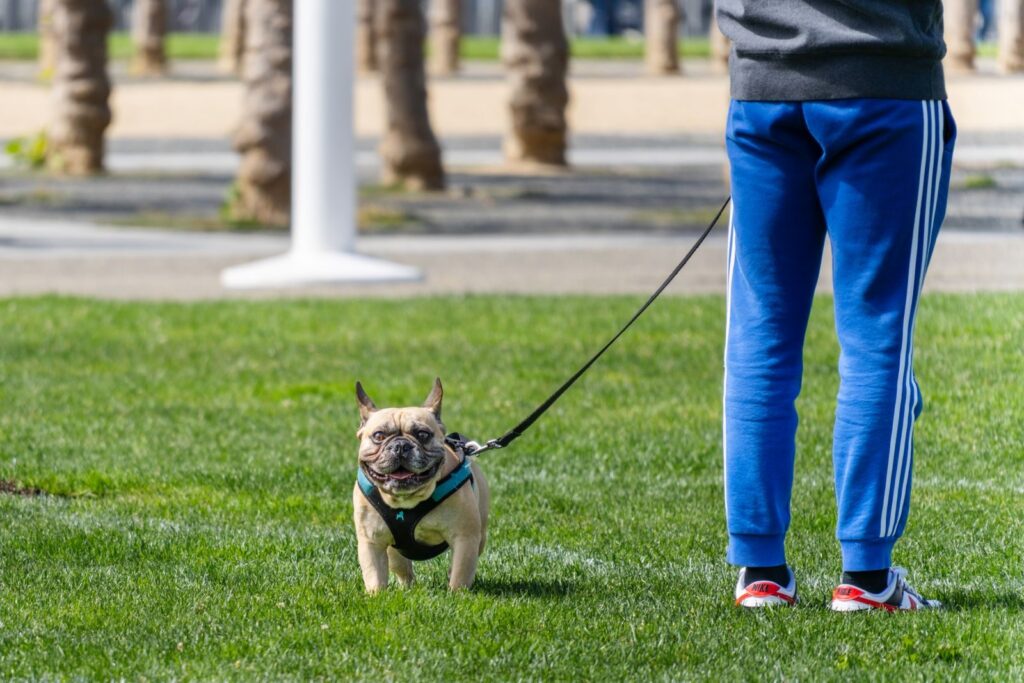
This plan works for puppies and adult dogs. Adults with a long history of pulling just need more repetitions. Keep each session to a few minutes and stop while your dog is still keen.
Step 1: Make the harness a good thing
Dogs Trust recommends introducing a harness in small stages. Put it on the floor and scatter treats around it. Then hold it up and feed treats through the head hole, so your dog chooses to push its nose through. Next, let it rest loosely over the neck without fastening it, then let your dog hear the clips before you do them up, rewarding at each stage. Finally, play a game or practice a trick while the harness is on. If your dog backs away or looks worried at any point, take the harness off and go back a step.
Step 2: Teach a marker and a reward spot indoors
Choose a marker, a clicker or a short word such as “yes”, and pair it with a treat until your dog brightens up when it hears it, as the AKC describes. Then, with the leash attached, practice in a quiet room. Mark and reward whenever your Frenchie stands or walks next to your leg, always delivering the treat right at your side. That spot becomes the place where good things happen.
Step 3: Walk a few steps on a loose leash
Take one or two steps. If your dog moves with you on a slack leash, mark and reward at your side. Gradually ask for more steps between treats. Reward generously at first; you can thin out the treats later.
Step 4: Teach that pulling stops the walk (“be a tree”)
The moment the leash goes tight, stop and stand still. Wait. When your dog turns back or the leash slackens, mark, reward at your side and walk on. The RSPCA describes this as the core of loose leash walking: when a dog pulls, it doesn’t get to go forward. The AKC also suggests a variation: when your dog reaches the end of the leash, say its name, and mark and reward when it looks back and returns. With repetition, that check-in becomes automatic.
Step 5: Change direction
If standing still isn’t working, calmly turn and walk the other way, cheerfully encouraging your dog to follow, and reward when it catches up beside you. No jerk on the leash is needed. Just turn and walk. Over time your dog learns that keeping an eye on you pays off.
Step 6: Add distractions slowly
Once your dog walks nicely indoors, move to the yard, then a quiet street, then busier areas. Every new place is harder, so expect to go back to rewarding often. Bring higher-value treats outdoors, and reward any attention your dog offers you. Let your Frenchie sniff as a reward too: “go sniff” after a stretch of loose-leash walking is a powerful, calorie-free payoff.
Treats, motivation and the 10% rule
Many Frenchies are strongly food-motivated, which makes training easier, but this breed also gains weight easily, and extra weight strains the airway and joints. Keep treats to no more than 10% of your dog’s daily calories. Use tiny, pea-sized pieces, set aside part of the daily kibble for walks, and trim meal portions on heavy training days. Praise, play and sniffing time are rewards too.
Heat and timing: keep training short and cool
Leash training is mental work, and a Frenchie concentrating on new skills can tire quickly. Train in the cool morning or evening, keep outdoor sessions short, and take breaks in the shade. On hot or humid days, practice indoors instead. Our too-hot-to-walk checker helps you decide, and the heat safety guide covers warning signs and first aid. For how much walking your dog needs overall, see French Bulldog exercise needs.
Troubleshooting French Bulldog pulling on the leash
My Frenchie sits down and refuses to walk
Before you assume stubbornness, rule out the common reasons:
- Heat or breathing effort: noisy breathing, heavy panting or a wide, flat tongue mean stop, find shade and rest.
- Pain: a sore back, joints, paws or a rubbing harness can all make a dog stop. Frenchies are prone to back problems, so a sudden reluctance to walk deserves a vet check.
- Tiredness: puppies especially need short outings and lots of rest.
- Fear: traffic, other dogs or new places can make a dog freeze.
If none of these apply, make walking more rewarding: walk toward home or a favorite sniffing spot, use better treats, and shorten the walk. Never drag a Frenchie that has stopped.
Pulling only in exciting places
That usually means the step was too big. Go back to a quieter area, reward more often, and build up gradually.
Lunging, barking or reacting to dogs or people
Lunging on the leash is often driven by fear, frustration or overexcitement, and punishment can make it worse. AVSAB notes that the documented fallout of aversive methods includes increased anxiety, fear-related aggression and avoidance. Keep more distance from triggers, reward calm looks, and get help from your vet and a qualified reward-based trainer or veterinary behaviorist.
Vet note: If your Frenchie suddenly stops wanting to walk, struggles to breathe on short walks, walks stiffly or yelps when the harness goes on, see your vet before continuing training. Pain and airway problems can look like “bad behavior” on the leash.
FAQ
How long does it take to leash train a French Bulldog?
It varies with age, history and practice. Many dogs pick up the idea indoors within a few short sessions, but walking politely around distractions can take weeks or months of consistent practice. Patience and short, frequent sessions work better than long ones.
When can I start leash training my Frenchie puppy?
You can start indoors as soon as your puppy comes home, with harness games and a few steps in the house. Ask your vet when it’s safe to walk in public areas based on vaccinations.
Is a front-clip harness good for a French Bulldog?
For many Frenchies that pull, yes, as long as it fits well and keeps the straps off the throat. It’s a training aid, not a replacement for teaching loose leash walking with rewards.
Should I use a collar for walks if my Frenchie doesn’t pull?
Even dogs that walk nicely can lunge suddenly at a squirrel. For a flat-faced breed, clipping the leash to a harness is the safer default. Keep the collar for ID tags only.
Sources
- Position Statement on Humane Dog Training — American Veterinary Society of Animal Behavior
- How to Teach a Puppy to Walk on a Leash — American Kennel Club
- The Importance of a Well-Fitting Dog Harness — American Kennel Club
- What equipment should I use when teaching my dog or puppy to walk on a leash? — RSPCA Australia
- Teach Your Dog To Wear A Harness — Dogs Trust
- Respiratory Function in Brachycephalic Dogs — Purdue University Canine Welfare Science (Croney Research Group)