
When your vet confirms a disc problem, the hard part often moves home. French Bulldog IVDD recovery depends a great deal on what happens in the weeks after diagnosis or surgery: strict rest, careful toilet trips, clean bedding and close watching for changes. This guide covers the practical side of home care. If you want to understand the condition itself, including symptoms, grading and how vets choose between rest and surgery, start with our main guide to IVDD and back problems in French Bulldogs. For the breed’s other common conditions, see our overview of French Bulldog health.
Quick answer: French Bulldog IVDD recovery usually means strict crate rest for several weeks (one vet school cites 4-6 weeks for conservative care), with short leashed toilet trips on a harness and no stairs, jumping or running, even if your dog seems better. Your vet sets the length. Worsening weakness, inability to walk or inability to urinate is an emergency.
Key takeaways
- Conservative care usually means strict crate rest for several weeks; one vet school cites 4-6 weeks. Your vet sets the length.
- Even if your Frenchie seems better, keep rest strict until your vet says otherwise.
- Toilet trips should be short, on a harness and leash, with no stairs, jumping or running.
- Some dogs can’t urinate on their own after a disc injury. Your vet will show you how to help.
- Recurrence is common in Frenchies, so a lean weight, ramps and a harness matter for life.
What crate rest for IVDD actually means
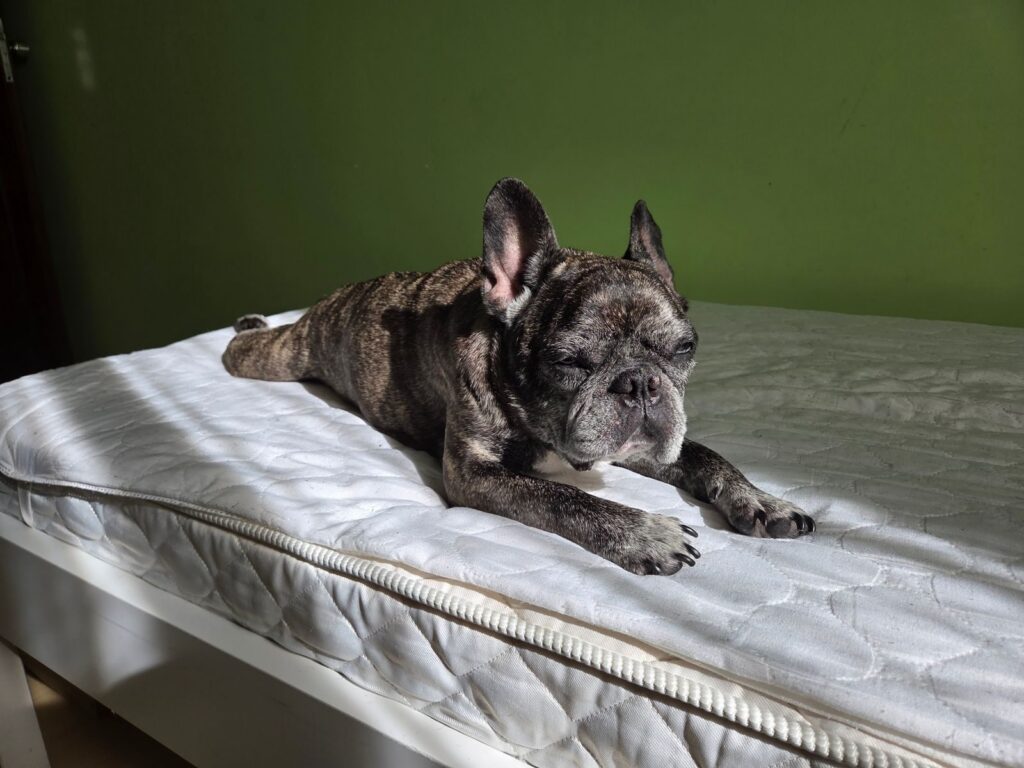
For dogs with a first episode and mild signs, vets may offer conservative management: confinement, rest and medication. The American College of Veterinary Surgeons (ACVS) describes this as cage rest, confinement and pain medication, usually reserved for dogs with a first episode and mild neurological deficits. The University of Saskatchewan’s veterinary teaching hospital describes conservative management as strict cage rest for 4-6 weeks, with or without pain medication, and states that running, jumping, climbing and playing must not be permitted.
That range is a common starting point, not a rule. Your vet or neurologist will set the length based on your dog’s grade and how they respond, and they may extend it. During this time your Frenchie will usually be given pain relief and anti-inflammatory medication your vet prescribes. Give it exactly as directed, and never use human painkillers.
The most common mistake is easing off too early. Medication can make a dog feel much better long before the disc has stabilized, and a dog who feels good wants to run and jump. Strict rest really does mean strict, for the whole period your vet sets.
Setting up the crate or pen
- Size: big enough to stand up, turn around and lie stretched out, but small enough that your dog can’t run, leap or pace. Ask your vet whether a crate or a small pen suits your dog better.
- Footing: PDSA advises non-slip surfaces and avoiding bare hard floors. Use a rubber-backed mat under soft bedding.
- Padding: a soft, well-padded bed helps prevent pressure sores, especially for a dog who can’t shift position easily.
- Location: place it where the family spends time, in a cool, draft-free spot away from direct sun. Frenchies handle heat poorly, so keep airflow in mind.
- Water: a spill-resistant bowl your dog can reach without twisting or straining.
If your Frenchie already enjoys their crate, rest is much easier. If not, our crate training guide explains how to build positive associations with treats and calm praise. During crate rest, though, the vet’s timings come first.
Toilet trips without risking the spine
Toilet breaks are the only time your dog should leave the crate unless your vet says otherwise. PDSA recommends keeping them very short and on a leash. A few practical points:
- Carry rather than walk to the toilet spot if your vet advises it, supporting the chest and hindquarters so the back stays level.
- Use a harness, not a collar. ACVS suggests owners consider a body harness instead of a neck lead. A well-fitted harness also gives you something to steady your dog with. See our harness guide for fit tips.
- Support weak back legs. PDSA suggests a sling or a towel under the belly to help a wobbly dog up and keep them steady.
- No stairs, no jumping, no free running. Go straight out, toilet, and straight back in. No sniffing laps of the yard.
Home care after IVDD surgery
ACVS notes that most dogs go home 3-7 days after spinal surgery, that pain is usually managed with medication given at home, and that exercise is restricted to bed rest for at least 4 weeks. The crate setup and toilet-trip rules above still apply.
Incision care
VCA’s surgical discharge advice for dogs is to keep the incision dry, skip baths, and check it every day. Mild redness and swelling can be normal for the first few days, but moderate swelling or any discharge should be reported to your vet. Stop licking with a cone (Elizabethan collar) or a recovery suit, and don’t put anything on the wound unless your vet tells you to. VCA specifically warns against hydrogen peroxide and rubbing alcohol, which damage healing tissue.
Bladder care
Disc injuries can affect the nerves that control urination. ACVS explains that dogs who can’t walk may not urinate well and may need their bladder expressed several times a day, typically 3-4 times daily if necessary. Bladder control may return as nerve function improves. If your dog needs this, your vet or vet nurse will show you how to do it. Don’t try to learn the technique from videos or guess. ACVS also notes these dogs have a higher risk of urinary tract infections and urine scald, so tell your vet about any change in urine color or smell, straining, or dribbling.
Pressure sores and keeping clean
A dog who can’t turn over easily is at risk of bedsores. ACVS and PDSA both recommend soft, well-padded bedding. PDSA also suggests absorbent pads for incontinence, regular gentle bed baths with warm soapy water followed by thorough rinsing and drying, and brushing if your dog struggles to groom. In a Frenchie, check skin folds and the area around the tail, where moisture collects. Change wet bedding promptly, and ask your vet how often to help your dog change position.
Rehabilitation and physiotherapy
ACVS recommends physical rehabilitation after disc surgery to rebuild muscle strength and flexibility, and PDSA lists hydrotherapy and physiotherapy as possible additional treatments. Rehab should only be done under the guidance of your vet or a qualified veterinary rehabilitation therapist, who will choose exercises that suit your dog’s stage of healing. Don’t start exercises you’ve seen online on your own.
It’s honest to say the evidence is still developing. A small randomized trial of 30 dogs after surgery for thoracolumbar disc herniation found early postoperative rehabilitation was safe, but an intensive program did not speed up recovery compared with a basic one. Rehab may still help your individual dog with comfort, muscle tone and confidence, so follow the plan your vet suggests.
Keeping a resting Frenchie’s mind busy
Weeks of rest are hard on a sociable breed. Calm mental work helps a lot:
- Sniff mats and food puzzles that can be used lying down, using part of the daily food allowance.
- Long-lasting chews your vet approves, with all treats kept within 10% of daily calories. Resting dogs burn less energy, so ask your vet whether meal sizes should change.
- Calm training: eye contact, “touch” to your hand, or a settle cue, rewarded with tiny treats and praise. Avoid anything involving jumping, spinning or sitting up.
- Company: talk to your dog, sit by the crate and hand-feed some meals.
Frenchie IVDD recovery timeline: what to expect
There is no single timeline. ACVS says recovery typically takes weeks to months, and medical management usually takes longer than surgical recovery. The biggest factor is deep pain perception, the dog’s ability to feel a firm pinch to the toes, which your vet checks.
| Situation | Regain use of limbs (ACVS figures) |
|---|---|
| Deep pain present, surgery | About 90%, though some keep a wobbly gait |
| Deep pain present, strict medical management | 60-80% |
| Deep pain lost, surgery | 50-60% |
| Deep pain lost, medical management | Less than 10% |
For context, in the rehabilitation trial above, dogs that could not walk but still had pain perception took a median of 7.5 days to walk after surgery, with a range of 2 to 37 days. Your own dog may be faster or slower. Ask your vet what milestones to look for and when rechecks are due.
Warning signs: call your vet straight away
- Weakness, wobbliness or knuckling that is getting worse
- Your dog can no longer walk or stand
- Loss of bladder or bowel control, or no urine passed
- Crying, trembling or yelping in pain that medication isn’t controlling
- Swelling, discharge or an opened wound at the incision
Don’t wait for the next scheduled check. Any decline during rest can change the treatment plan.
Frenchie IVDD flare-ups and recurrence
Unfortunately, one disc episode raises the chance of another. In a retrospective study of 127 French Bulldogs treated surgically for a first episode of IVDD, 52.7% later showed signs of recurrence. Dogs whose first episode happened at 3 years old or younger were more prone, and about half of the recurrences happened within 12 months. That doesn’t mean your dog will relapse, but it does mean the prevention habits below are worth keeping for life. If signs return, contact your vet promptly rather than restarting crate rest on your own.
Long-term prevention at home
- Keep your dog lean. ACVS lists weight loss as part of aftercare. Our weight-loss guide explains safe calorie cuts.
- Use ramps or steps for sofas, beds and the car, and gate off stairs.
- Limit jumping off furniture, which ACVS specifically mentions.
- Stick with a harness for every walk.
- Return to exercise gradually on the plan your vet gives you, favoring steady walks over high-impact games.
Vet note: This article is general education, not a treatment plan. Rest length, medication, bladder care and rehab should all come from the vet or neurologist treating your dog. Any worsening weakness, inability to walk or to urinate is an emergency.
FAQ
How long is crate rest for IVDD in a French Bulldog?
Commonly several weeks. One veterinary teaching hospital cites 4-6 weeks for conservative management, and ACVS cites at least 4 weeks of rest after surgery. Your vet decides the exact length.
My Frenchie seems fine after a week. Can we stop crate rest?
No. Medication can hide pain while the disc is still healing. Keep rest strict until your vet rechecks your dog and gives the go-ahead.
Can I treat IVDD at home without seeing a vet?
No. Home care supports treatment your vet has planned, but a neurological exam is needed to grade the problem and decide whether surgery is needed. Some cases are emergencies.
Will my Frenchie walk again after IVDD?
Many do, especially when deep pain perception is still present. ACVS figures show lower odds when it is lost. Your vet can give you a more specific outlook.
Sources
- Intervertebral Disc Disease — American College of Veterinary Surgeons (ACVS)
- IVDD/slipped disc in dogs — PDSA
- Invertebral disk disease (IVDD) and seizures — Veterinary Medical Centre, University of Saskatchewan
- Surgical Discharge Instructions for Dogs — VCA Animal Hospitals
- Recurrence rate of intervertebral disc disease in surgically treated French Bulldogs: a retrospective study (2009-2019) — Acta Veterinaria Scandinavica (2023)
- A randomized, blinded, prospective clinical trial of postoperative rehabilitation in dogs after surgical decompression of acute thoracolumbar intervertebral disc herniation — Journal of Veterinary Internal Medicine (2018)