
Finding the best harness for a French Bulldog has little to do with brand names. What matters is shape, fit and comfort. Frenchies have a short muzzle, a narrow airway and a neck that is almost as wide as their head. That combination makes a well-fitted harness the safer way to walk them, and a poorly fitted one a source of rubbing, escapes and awkward movement. Here’s why a harness beats a collar, what to look for, and how to measure, fit and introduce one.
Key takeaways
- Clip the leash to a harness, not a collar, to keep pressure off a Frenchie’s throat and airway.
- Choose a harness with straps that stay clear of the throat, armpits and front of the shoulders.
- Measure the neck base and widest part of the chest before buying.
- Aim for a snug fit: two fingers under each strap, and no backing out.
- Keep an ID tag on your dog, either on a light collar or on the harness.
Why a harness is better than a collar for French Bulldogs
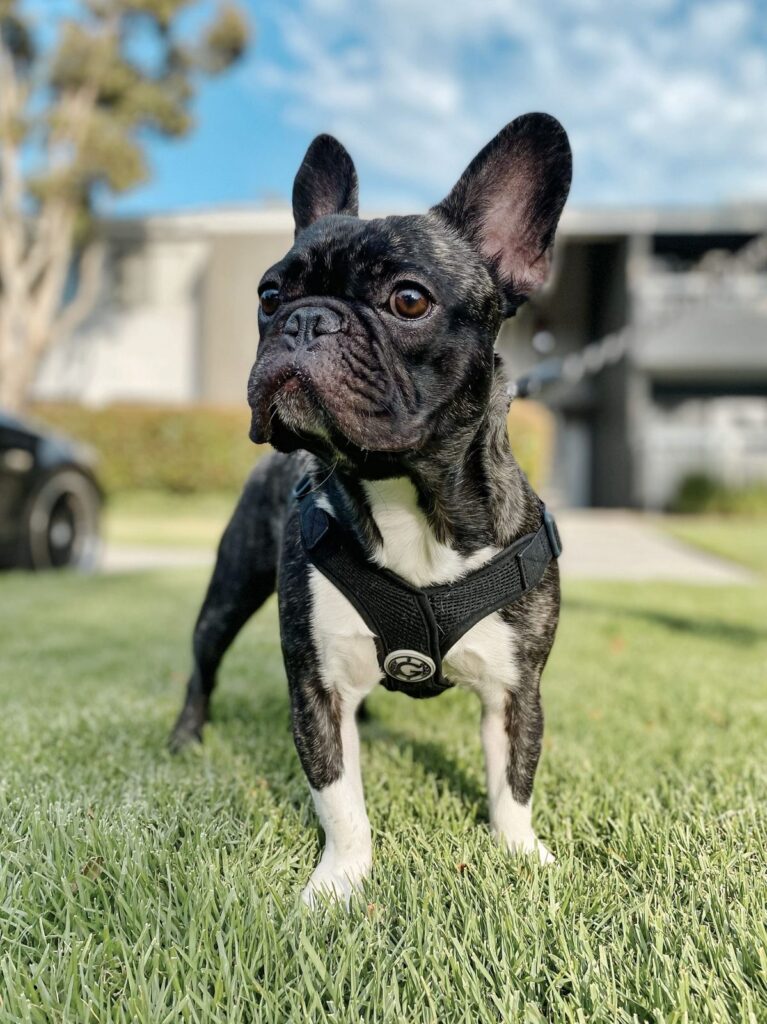
French Bulldogs are a brachycephalic (flat-faced) breed, and many have some degree of brachycephalic obstructive airway syndrome (BOAS). Their airway is already working hard, so anything that presses on the throat during a walk adds strain. MSPCA-Angell’s advice for brachycephalic dogs is simple: use a harness instead of a collar, and avoid heat and stress.
The research points the same way. A small 2025 study in Veterinary Medicine and Science recruited 24 healthy dogs of several breeds and analyzed data from 20 of them (10 flat-faced and 10 long-nosed), each tested standing still and exercising in a collar and in a harness. Simply wearing a collar while standing still raised eye pressure in the brachycephalic dogs, and exercising in a collar raised it in both groups, while exercising in a harness did not. Breathing rate rose with exercise in the flat-faced dogs whichever restraint they wore, which is a reminder that a harness protects the neck but doesn’t fix the airway.
There is a practical reason too. Dr. Amy Attas, a veterinarian quoted by the American Kennel Club (AKC), recommends harnesses for Bulldogs, French Bulldogs and Pugs because their necks are nearly as wide as their heads, which makes it easy for them to slip out of a collar.
Harness types compared for Frenchies
A 2025 review of collars, harnesses and head collars in the journal Animals concluded that there is no one-size-fits-all option. For brachycephalic breeds, or dogs that don’t pull, the authors considered back-clip harnesses suitable, especially chest-strap or Y-shaped designs. For dogs that pull, non-tightening front-clip harnesses seemed to offer the best balance between comfort and less pulling.
| Harness type | Pros for a Frenchie | Cons for a Frenchie |
|---|---|---|
| Back-clip | Easy to clip on; no pressure on the throat; suits dogs that already walk nicely | Does little to discourage pulling |
| Front-clip | Turns a pulling dog back toward you; useful during leash training | The clip sits under the chest, so it’s fiddlier to attach; some designs affect front-leg movement more |
| Dual-clip (front and back) | Flexible: start on the front clip, move to the back as walking improves; works with a double-ended leash | More straps and hardware to fit correctly |
| Step-in | Nothing goes over the head, helpful for head-shy dogs; hard to back out of when fitted well | Some designs affect front-leg movement; need careful sizing |
| Over-the-head (vest or strap) | Often padded and simple to adjust | Less pleasant for dogs that dislike things near their face; vests can trap heat |
| Tightening “no-pull” styles | Designed to tighten and discourage pulling | The Animals review flags tightening designs as more likely to cause discomfort; use with caution |
If your Frenchie pulls, pair the harness with reward-based training rather than relying on the gear alone. Our leash training guide walks through the steps.
What to look for in a French Bulldog harness
Straps that stay off the throat and shoulders
The neck opening should sit low, closer to the top of the breastbone than around the throat, according to the AKC. Dogs Trust advises avoiding harnesses that cross directly in front of the shoulders, because they can prevent natural movement. The AKC adds that the girth strap should sit on the rib cage, not back toward the belly, and shouldn’t squeeze into the back of the front legs (the elbows).
You’ll often see Y-shaped harnesses described as the “non-restrictive” choice. The research is less tidy than that. The Animals review summarizes several small gait studies. In one treadmill study of nine dogs, every harness restricted shoulder extension compared with no harness, and the Y-shaped design (labeled “non-restrictive”) limited it more than the chest-strap one. In another study of 30 dogs, a front-clipped Y-shaped harness affected front-leg movement most, while chest-strap and H-shaped harnesses changed elbow movement no more than a collar. A study of 66 dogs that included French Bulldogs found that the effects varied widely between breeds and concluded that no harness appears to be best for every dog. Fit on your dog matters more than the label.
Adjustability
Look for adjustment at both the neck and the girth. A Frenchie’s deep chest and broad neck mean a harness cut for a slimmer breed may gape in one place and pinch in another.
Padding and material
Padding at the chest spreads pressure, but the material affects heat and chafing. The AKC notes that nylon is cheap, light and durable but not breathable; mesh is breathable and light but less durable and less padded, so it can chafe; and neoprene is padded but not breathable. Frenchies overheat easily, so a light, breathable harness is worth prioritizing for warm months. See our heat safety guide for walking times and warning signs.
Clips, hardware and visibility
Check that buckles are secure and the leash ring is sturdy. Reflective stitching or trim helps drivers see your dog on early-morning or evening walks; the AKC suggests adding reflective tape if a harness doesn’t have it.
How to measure your Frenchie for a harness
- Neck: measure around the base of the neck, where it meets the shoulders, not high up behind the ears.
- Chest girth: measure around the widest part of the chest, usually just behind the front legs.
- Use a soft tape: a cloth measuring tape, or string held against a ruler.
- Compare with the size chart: if your dog falls between sizes, check which size gives more adjustment room at the chest, where Frenchies tend to be broadest.
If you buy online, the AKC suggests choosing a company with clear written and video fitting instructions.
How to fit a dog harness: a checklist
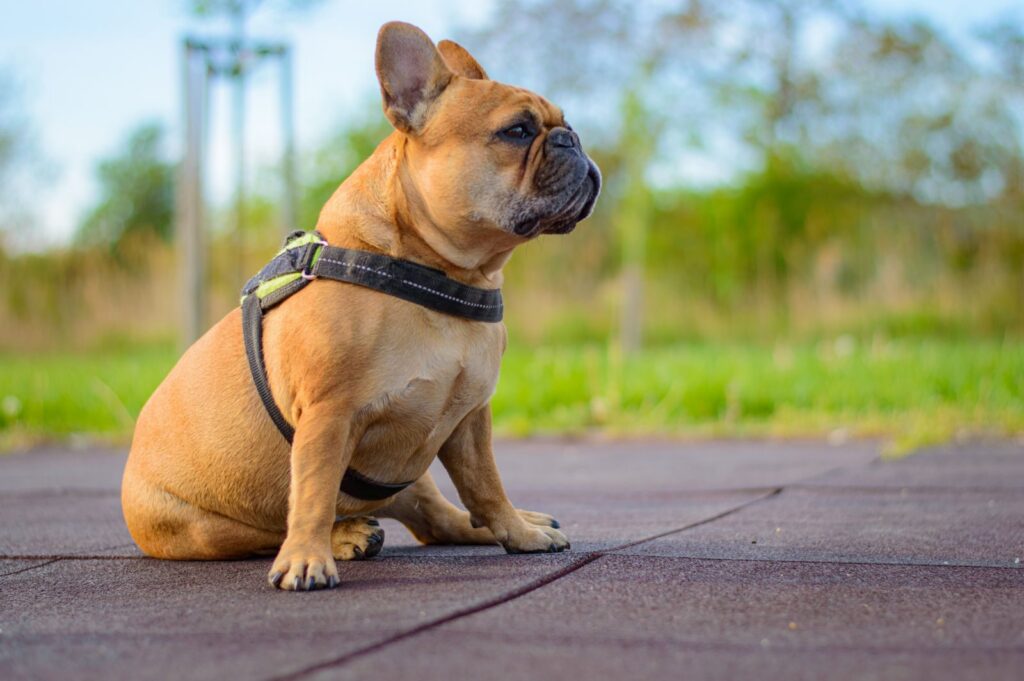
- Start loose, then tighten each strap gradually.
- Finger check: you should be able to slide one or two fingers under each strap. A veterinarian quoted by the AKC suggests two fingers should be a squeeze, not a loose fit.
- Neck opening rests near the breastbone, not on the windpipe.
- Front legs move freely: watch your dog walk and trot, as an expert quoted by the AKC advises. The front legs should reach forward and out to the side without the harness limiting them.
- Escape test: gently tug the harness in different directions and encourage your dog to step backward. It should stay put.
- Recheck often: after grooming, weight changes and, for puppies, as they grow. The AKC notes that you may need to adjust the harness or move up a size as a puppy develops.
Signs the harness doesn’t fit
- Red, rubbed or bald patches, especially in the armpits, behind the front legs or across the chest
- An odd or shortened stride, or reluctance to move normally
- The harness twisting to one side or riding up toward the throat
- Your dog backing or wriggling out of it
Getting a puppy used to a harness
Dogs Trust recommends introducing a harness in small stages, using treats so it becomes something your dog looks forward to:
- Put the harness on the floor and scatter treats around it so your puppy can sniff it.
- Hold the harness up and feed treats through the head opening, so your puppy chooses to put their nose through.
- Let it rest over the head without fastening it, then remove it and reward.
- Click the buckles near your puppy (without fastening them on the dog) so they get used to the sound, rewarding each time.
- Fasten the harness, give treats and keep the first sessions short.
- Play a game or practice a trick while it’s on, then try a short walk.
If your puppy backs away or looks worried, take the harness off and go back a step. A clip-around style that doesn’t go over the head may suit a head-shy dog better. A harness belongs on the essentials list in our puppy supplies checklist.
Don’t forget ID
A harness for walking doesn’t replace identification. In the UK, Dogs Trust points out that the law requires a dog in a public place to wear a collar with an ID tag, even when walked on a harness. In the US, ID, rabies tag and licensing rules vary by state, county and city, so check what applies where you live. Many owners keep a light, loose-fitting collar on for tags only, with the leash always clipped to the harness. Others attach the tag to the harness itself. Either way, make sure your dog’s microchip details are up to date too.
Vet note: A harness reduces strain on the neck, but it doesn’t treat breathing problems. If your Frenchie struggles for breath on short walks, snores or gasps heavily, tires very quickly, limps, or flinches when the harness goes on, see your vet before increasing walks or switching gear.
FAQ
What is the best harness for a French Bulldog?
There is no single best model. Look for a non-tightening, adjustable harness with a neck opening that sits low on the chest, straps that clear the armpits and shoulders, breathable padding and a sturdy clip. A back clip suits a calm walker; a front or dual clip helps with pulling during training.
Can my Frenchie wear a collar at all?
A light collar to carry ID tags is commonly used, fitted loosely enough to slide two fingers underneath. The leash should go on the harness so a sudden lunge never puts pressure on the throat.
Should my French Bulldog wear a harness all day?
Generally, put it on for walks and outings and take it off at home, so the skin gets a break and you can check for rubbing.
How often should I check the fit on a growing puppy?
Check it often, ideally several times a week while your puppy grows quickly, and readjust whenever the straps feel tight. Expect to size up at least once.
Sources
- The Importance of a Well-Fitting Dog Harness — American Kennel Club
- Choosing the Right Dog Harness — American Kennel Club
- Teach Your Dog To Wear A Harness — Dogs Trust
- Caring for Brachycephalic Dogs — MSPCA-Angell
- Review of Collars, Harnesses, and Head Collars for Walking Dogs — Animals (MDPI), Cavalli and Protopopova, 2025
- Effect of a Collar and Harness on Intraocular Pressure and Respiration Rate of Brachycephalic and Dolichocephalic Dogs — Veterinary Medicine and Science, Bailey et al., 2025