
A crate can be one of the best things you ever buy for your Frenchie, or an expensive plastic box they refuse to go near. The difference is almost entirely in how you introduce it. Done well, French Bulldog crate training gives your dog a quiet den of their own, makes house training faster, keeps a curious puppy away from cables and shoes when you can’t watch them, and makes car journeys and vet visits far less stressful. Done in a rush, it can teach a dog that the crate means being shut away. This guide walks you through a calm, reward-based plan, with the extra care a flat-faced breed needs around heat, airflow and time limits.
Key takeaways
- Go slowly. Training takes anything from a day to several months, depending on your dog’s age, temperament and history.
- The crate should only ever mean good things: meals, chews, treats and rest. Never use it as a punishment.
- Choose a crate your Frenchie can stand up in, turn around in and stretch out in. A divider lets a puppy’s crate grow with them.
- Frenchies overheat easily, so put the crate somewhere cool and out of direct sun, and make sure air can move through it.
- Crate time has limits. Puppies need potty breaks every few hours, and no dog should spend most of the day in a crate.
Why crate train a French Bulldog?
Veterinary and welfare organizations point to the same benefits: it supports house training, because most dogs avoid soiling the place they sleep; it stops a young dog chewing things that could hurt them while you’re not watching; it gives a safe way to travel in the car; and it offers a calm retreat during busy times like parties and holidays.
For Frenchies in particular, a crate the dog is happy in is useful at the vet. After surgery, including airway surgery for BOAS or rest for a back problem, vets often ask for a period of restricted activity. A dog who already relaxes in a crate copes with that much better than one meeting it for the first time while sore.
Choosing the right crate for a Frenchie
Size
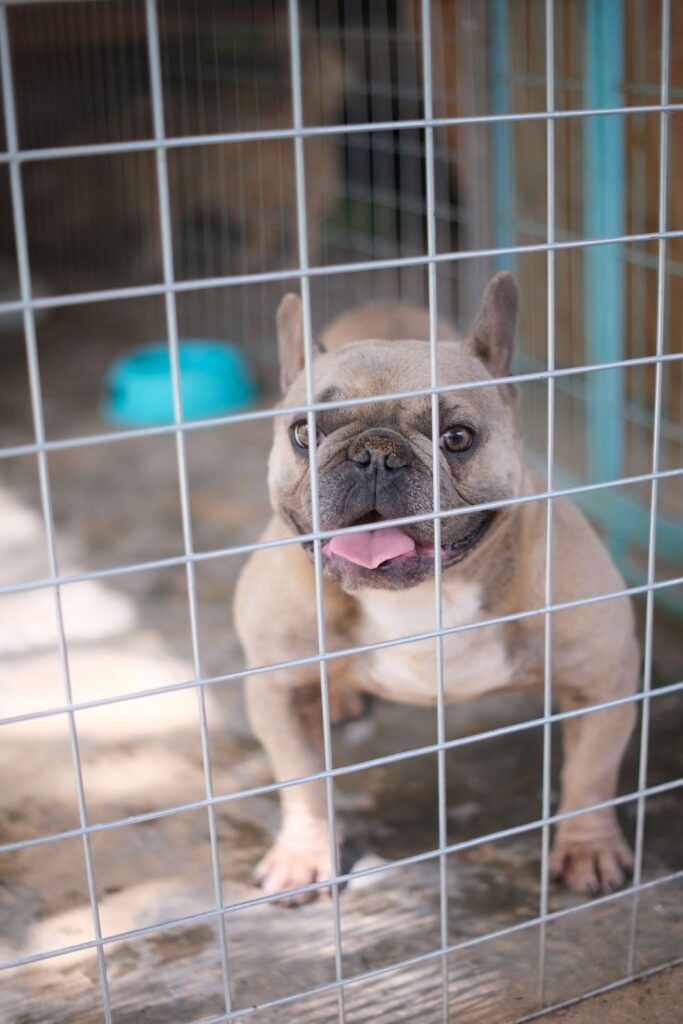
Guidance varies a little. The Texas A&M vet school says the crate should be just big enough for the dog to stand up, turn around and lie down comfortably. The Dogs Trust guide says your dog should be able to stand at full height, turn around and stretch out fully when lying down. For a stocky, deep-chested breed that likes to sprawl, follow the Dogs Trust version. For a puppy, buy the adult-sized crate and use a divider to block off the extra space. This stops them using one end as a bathroom, and you move the divider back as they grow. If you’re unsure what size your puppy will end up, a breeder or your vet can give you a rough idea of adult size.
Type and ventilation
Crates come as wire, plastic “flight” style, or fabric on a folding frame. Because brachycephalic dogs cool themselves less well, many Frenchie owners use an open wire crate at home, since air can get in on every side. Plastic crates are more enclosed and are handy for travel, but at home in warm weather check that air can actually move through them.
Where to put it
At first, put the crate where your dog can see and hear the family. Dogs Trust suggests a calm spot rather than a busy hallway or kitchen with people constantly walking past. For a Frenchie, add one more rule: keep it away from heat. That means not in a sunny conservatory, not next to a radiator or wood burner, and not where afternoon sun comes through a window. Many owners cover part of the crate with a blanket to make it more den-like. If you do, leave the front and at least one side uncovered so air can flow.
The step-by-step plan
This plan follows the gradual, reward-based approach recommended by the AKC, Dogs Trust and Humane World for Animals. Move on only when your dog is relaxed at the current step. If they seem worried, go back a step for a few sessions.
- Make the crate interesting. Fix the door open so it can’t swing shut and startle your dog. Put a comfy bed inside and leave a few tasty treats just inside the entrance, then further in. Let your Frenchie explore at their own pace. Don’t push or lift them in.
- Feed meals in the crate. Put the food bowl near the entrance, then gradually move it toward the back over several meals. Meals are a powerful daily reward and quickly build a happy association. Your puppy’s usual feeding times make natural training sessions.
- Add a cue. Once your dog walks in happily, say a word like “bed” or “crate” just before you toss a treat in, and praise them when they go in. Over time they’ll go in on the word alone.
- Close the door briefly. While your dog is eating or chewing something long-lasting, close the door for a few seconds, then open it before they finish. Build up slowly from seconds to a few minutes. Stay close by at this stage.
- Build duration with you nearby. Give a stuffed food toy or a safe chew, close the door and sit quietly in the room. Gradually extend the time, then start moving around the room and briefly stepping out of sight.
- Leave the room, then the house. When your dog settles calmly for longer stretches with you out of sight, try short real absences. Keep goodbyes and greetings low-key.
- Introduce nights. Many owners start with the crate in or near their bedroom so a puppy feels less alone and you can hear when they need to go potty. You can move it gradually later if you want to.
What about whining?
The AKC advises against letting a dog out of the crate because they are whining, as it teaches them that crying opens the door. The exception is a young puppy who may genuinely need to go potty. Take them straight outside, calmly, then back to the crate with no playtime. If your dog is crying a lot, it usually means you’ve moved too fast, so go back a step. For potty routines, see our guide to house training a French Bulldog puppy.
How long can a Frenchie stay in a crate?
This is the question owners ask most, and the honest answer is less than you might think. Texas A&M suggests roughly one hour per month of age for puppies. Humane World for Animals says puppies under six months shouldn’t stay in a crate for more than three or four hours at a time, and adds that a dog shouldn’t spend most of their life in a crate, just as you wouldn’t spend yours in one room. The AKC is clear that crating shouldn’t be all day, every day.
| Stage | Daytime guide (maximum, once fully trained) | Notes |
|---|---|---|
| 8–10 weeks | Up to about 2 hours | Potty break straight after waking, eating and playing |
| 3–4 months | About 3–4 hours | Expect at least one potty trip at night |
| 5–6 months | No more than 3–4 hours | Upper limit for puppies under six months |
| Adult | A few hours at a time | Overnight sleep is fine; long daytime crating isn’t |
These are upper limits, not targets. If you work long hours, a dog walker, a puppy-proofed room or a pen with a crate inside works better than a closed crate. Before any longer crate time, make sure your Frenchie has had a potty break, a play session and some gentle exercise.
Keeping crate time safe for a flat-faced breed
French Bulldogs struggle to get rid of heat because they have much less space inside their nose. PDSA warns that flat-faced dogs can overheat even on cool days. A crate is somewhere your dog can’t move away from a warm spot, so the setup is your job:
- Check the crate’s spot at different times of day. Sun moves.
- Give water for longer crate periods, using a clip-on bowl or bottle that won’t tip over.
- In warm weather, use a cooling mat or a thinner bed rather than a thick fleece, and don’t fully cover the crate.
- Take off collars in the crate, as tags can catch on the bars. Most Frenchies are better in a harness anyway.
- Never leave a crated dog in a parked car, even briefly.
Learn the early signs of overheating: heavy panting, fast or noisy breathing, drooling and sluggishness. Our French Bulldog heat safety guide explains what to do.
When the crate isn’t working
Some dogs never love being shut in, and that’s useful information, not failure. Signs of real distress include frantic scratching or chewing at the door, drooling, constant howling, soiling the crate in a trained adult, or injuries to the mouth or paws from trying to get out. Humane World for Animals notes that a crate won’t fix separation anxiety, and a dog in that state may hurt themselves trying to escape. If this sounds familiar, stop closing the door and read our guide to French Bulldog separation anxiety.
Vet note: If your Frenchie pants hard, breathes noisily or seems unsettled in the crate even when the room is cool, mention it to your vet. Breathing effort at rest can be a sign of airway disease rather than a training issue. And if your vet has recommended crate rest after surgery or for a back problem, follow their timings exactly, as they take priority over any training schedule.
FAQ
How long does French Bulldog crate training take?
The AKC says it can take as little as a day or as long as several months. Puppies with no bad experiences often settle within a week or two of short daily sessions. Rescue or adult dogs may need longer. Let your dog’s relaxed body language set the pace, not the calendar.
Should I put water in my Frenchie’s crate?
For short naps it isn’t usually needed. For longer periods, and always in warm weather, give water in a spill-proof clip-on bowl or bottle. Because of their heat sensitivity, Frenchies shouldn’t be left for long periods without water.
Should I cover the crate at night?
A partial cover can help some dogs settle, and Dogs Trust mentions using blankets to keep out drafts and noise. For a Frenchie, cover only the top and back, and keep the front and at least one side open for airflow. Remove the cover if the room is warm.
Sources
- Safe and Stress-Free Crate Training: A Step-by-Step Guide — American Kennel Club
- How to crate train your dog or puppy — Humane World for Animals (formerly The Humane Society of the United States)
- Guide to crate training your dog — Dogs Trust Dog School with Petplan
- The Benefits of Crate Training — Texas A&M College of Veterinary Medicine & Biomedical Sciences
- Heatstroke in dogs — PDSA