
Can you keep a French Bulldog with other dogs, a cat, or even a rabbit? Often, yes. But a good relationship usually comes from a slow, planned introduction, not luck. Frenchies are bred to be companions, and the breed standard describes a friendly, even-tempered dog. This guide covers how to introduce a French Bulldog to another dog, how to bring a Frenchie and a cat together safely, how to protect small pets, and the extra care a flat-faced, long-backed breed needs during play.
Quick answer: Many French Bulldogs get along with other dogs and cats, since the breed is described as friendly and even-tempered, but each pairing needs a slow, planned introduction. Dogs should meet on neutral ground on loose leashes, with separate food, beds and toys at home. Cat introductions take a week or more, and big dogs should not body-slam a Frenchie’s back.
Key takeaways
- The AKC standard calls Frenchies affectionate, even-tempered and playful, but each dog still needs a careful introduction.
- Have dogs meet on neutral ground, on loose leashes, with short sessions and parallel walks.
- Prevent resource guarding: separate food bowls, beds and toys, and remove prized items at first.
- Cat introductions take a week or more: scent swaps, baby gates, a dog on a loose leash and high escape spots for the cat.
- Keep rough play short and cool. Big dogs body-slamming a Frenchie’s back is worth avoiding.
Are French Bulldogs good with other dogs?
The French Bull Dog Club of America standard, which the AKC uses, describes the breed as “well behaved, adaptable, and comfortable companions with an affectionate nature and even disposition; generally active, alert, and playful, but not unduly boisterous.” But a standard describes the ideal, not a promise about one dog.
In real homes, how a French Bulldog gets along with other dogs depends mostly on the individual: early socialization, past experiences, health and the other dog’s temperament. If you have wondered whether a male or female pairs better, our male vs. female French Bulldog guide looks at what research says about sex and behavior.
Puppies who meet calm, vaccinated adult dogs during the socialization window tend to cope better later. Our guide to socializing a French Bulldog covers that period and how to read stress signals.
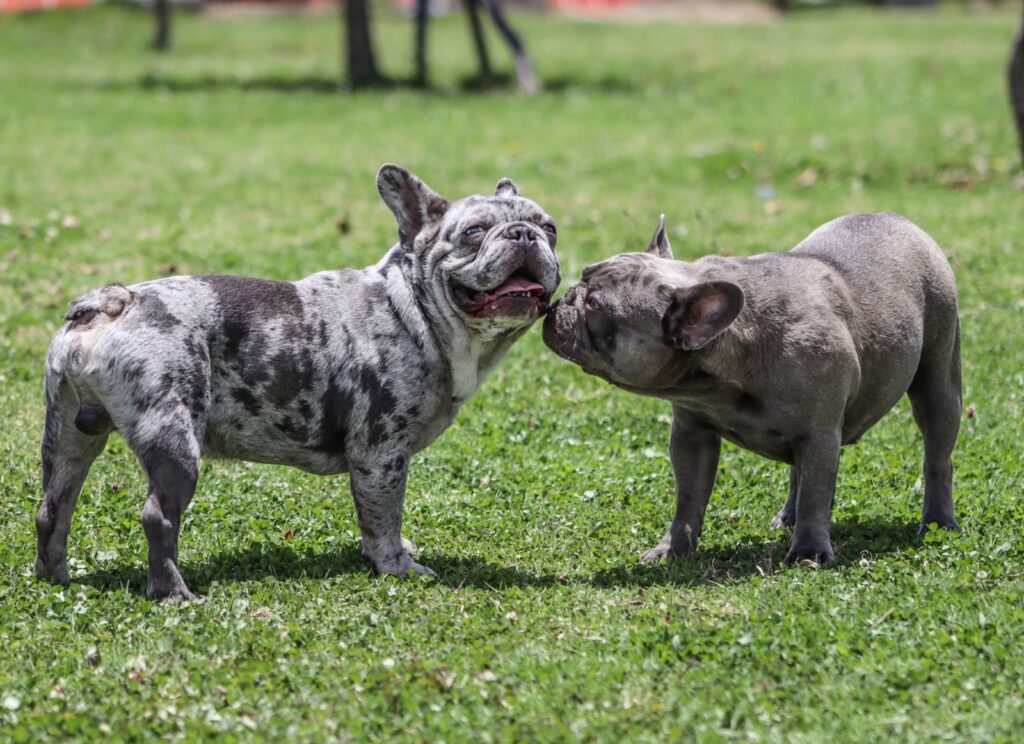
How to introduce a French Bulldog to another dog
The ASPCA advises preparing before the new dog arrives and keeping the first meetings away from home. If either dog has a history of fighting with other dogs, the ASPCA recommends talking to a veterinary behaviorist or certified professional dog trainer before any introduction.
- Prepare the house. Pick up food bowls, bones, chews, toys and beds that your resident dog might guard.
- Meet on neutral territory. Choose a quiet park or street rather than your house or yard. Use one handler per dog and walk to the spot separately.
- Keep leashes loose. A tight leash adds tension. Let the dogs sniff briefly with leashes as slack as possible, then call them away and reward them.
- Walk in parallel. Take a walk together with some distance between the dogs. The ASPCA says parallel walking lowers the pressure. Reward each dog with a treat when it looks calmly at the other.
- Keep sessions short. End while both dogs are still relaxed.
- Move inside gradually. The ASPCA suggests bringing the new dog inside first on leash to explore, then the resident dog on leash, and dropping leashes only once both stay friendly.
Body language to watch
| Usually fine | Pause and add distance |
|---|---|
| Loose, wiggly body; sniffing and circling | Raised hackles, stiff body or stiff-legged walk |
| Play bows, taking turns chasing | Prolonged hard stares |
| Calmly ignoring each other | Growling, showing teeth, snapping |
| Short breaks in play, then rejoining | One dog constantly pinned, trying to escape or hiding |
The ASPCA notes that adult dogs may push each other a bit, growl or even try to stand on each other’s shoulders during a normal greeting, so try not to step in too early. If tension builds, call the dogs apart in a relaxed voice or lure each one away with a treat held near its nose. The ASPCA warns against yanking leashes, because that tension can tip a stiff moment into a fight.
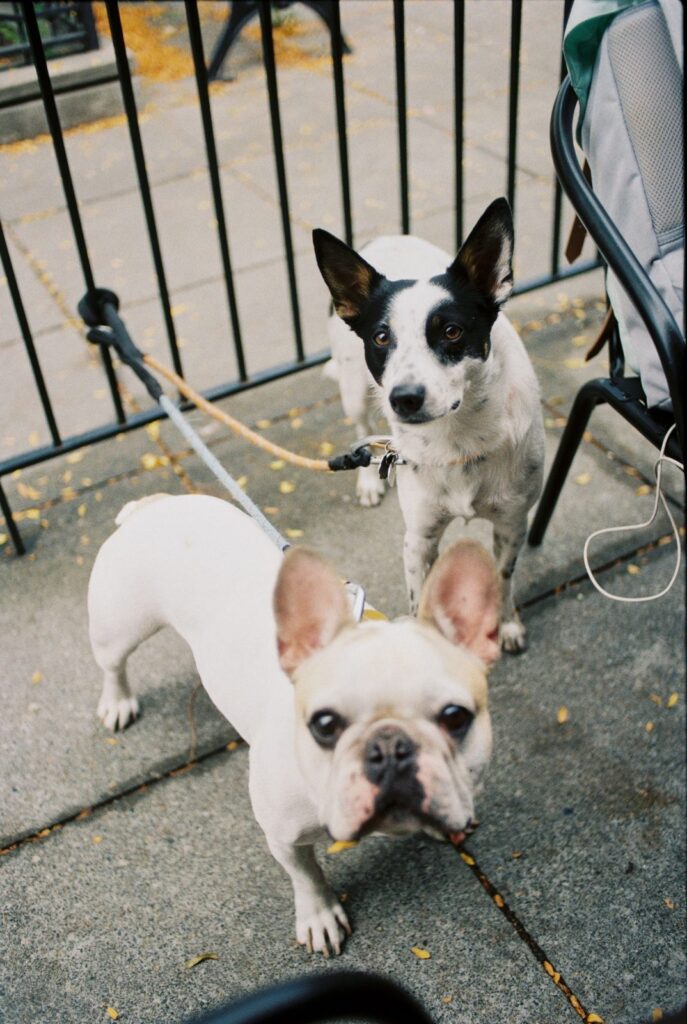
Managing food, toys and beds
Resource guarding is when a dog tries to keep hold of something it values. Humane World for Animals (formerly the Humane Society of the United States) lists toys, beds, treats, a shared water bowl and even a favorite person as common triggers. Warning signs include:
- Sudden, obvious stiffness in the body
- Fixating on an item, another dog or a person, or paying unusual attention to other dogs
- Ears pinned back, lip licking or growling
Prevention is easier than repair. Humane World for Animals recommends giving each dog its own bed, toys and food, feeding dogs separately in different rooms, and removing any item that keeps causing trouble. The ASPCA adds: give each dog its own bowl, crate and bed, never crate dogs together, and don’t let one dog push the other off its food.
Don’t punish guarding. Humane World for Animals advises consistently rewarding good behavior and never punishing dogs for “bad” behavior, and notes that guarding is typically rooted in anxiety. Instead, reward calm behavior near the other dog’s bowl, teach “leave it” and “give” with rewards, and always offer a trade when you take something away.
The ASPCA advises supervising all interactions until the dogs have gone at least a week with no tense or negative moments, and longer for some pairs. Be especially watchful at mealtimes, doorways, guest arrivals and when leashing up.
French Bulldogs and cats
Many Frenchies live peacefully with cats, but cats are easily stressed by a new dog. RSPCA Australia’s step-by-step guide suggests planning for the process to take at least a week and possibly several weeks. Never force contact, and never punish a stressed or overexcited animal.
- Set up separate spaces. Before the dog arrives, move the cat’s food, water and litter box to a dog-free area, and make sure the cat has high resting places. RSPCA Australia suggests a solid barrier between the animals at first.
- Swap scents. Rub a cloth on each animal and place it in the other’s area, away from the cat’s food, litter box and hiding spots. Repeat for several days.
- Take turns exploring. Let each animal explore the other’s part of the house while the other is in its own retreat with a treat.
- Use a see-through barrier. Use a baby gate, with your Frenchie in a comfortable harness on a loose leash. Choose a time when your dog is calm, such as after a walk. Start far apart, and give the cat easy access to a high perch or tall cat tree.
- Reward calm. Treat and praise your dog for looking at the cat and then looking away or settling. RSPCA Australia suggests sessions of about five minutes or less, several times a day, ending while both are relaxed.
- Move to leashed contact, then a trailing leash. Only remove the gate once both are consistently calm. Later, let the leash trail so you can pick it up quickly.
Stop and block the animals’ view of each other if you see hissing, flattened ears, growling or a dog fixating on the cat. Once everyone has calmed down, which can take hours, RSPCA Australia advises restarting from the scent-and-space stage. Even when things go well, keep a dog-proof retreat for the cat and feed the two animals apart. Peaceful sharing of the home is a fine outcome.
Rabbits, guinea pigs and birds
Small pets are prey animals, and a dog’s interest can be frightening for them even through a cage. Prey drive varies between dogs. The Rabbit Welfare Association & Fund notes that some breeds are easier to train around rabbits than others, and that many adult dogs may never be fully trustworthy. Its advice:
- Before any meeting, the dog should reliably sit, lie down and “leave” food or a toy.
- Keep the rabbit behind a secure barrier or in its enclosure during early sessions.
- Keep sessions to about five minutes, reward calm, and calmly take the dog out of the room if it tenses, stares, whines, barks or lunges.
- Never leave a dog alone with rabbits.
The same caution makes sense for guinea pigs, hamsters and birds. Keep cages sturdy, ideally in a room your Frenchie can’t enter. Supervise any time they share a room. The Rabbit Welfare Association & Fund also notes that dogs can pass tapeworms to rabbits, so keep all pets regularly treated for fleas and worms.
Frenchie-specific safety during play
- Breathing and heat. Frenchies are brachycephalic, so they don’t cool themselves as well as many other dogs. Vigorous play and excitement both add to heat risk. Keep play sessions short, offer water and shade, call breaks often, and skip wrestling on warm days. Learn the warning signs in our French Bulldog heat safety guide.
- Protect the back. The breed is prone to intervertebral disc disease (IVDD). Avoid letting a much larger dog body-slam, pounce on or roll a Frenchie, and limit jumping during play. See our French Bulldog IVDD guide for early signs of back pain.
- Match play partners. Similar-sized dogs with a gentle, polite play style usually make the best playmates.
When to get professional help
Get help early if there has been a fight, an injury, repeated guarding, a dog that won’t take food around the other animal, or a dog fixated on a cat or small pet. The ASPCA advises keeping fighting dogs completely apart, using crates or secure gates, until you have professional guidance.
The American Veterinary Society of Animal Behavior (AVSAB) says reward-based methods should be used for all dog training, and that aversive methods relying on force, pain or discomfort should not be used. Look for a veterinary behaviorist, a certified applied animal behaviorist or a certified trainer who uses positive reinforcement only.
Vet note: A sudden change in how your Frenchie treats other pets, such as new grumpiness, guarding or snapping, can be a sign of pain, including back or ear pain. Ask your vet to check for medical causes before starting behavior work. If your vet thinks medication could help, they will discuss options with you.
FAQ
How long does it take for a French Bulldog and a cat to get along?
Plan on at least a week and possibly several weeks, following RSPCA Australia’s guidance. Move on only when both are calm at the current step.
My Frenchie growls at our other dog over toys. What should I do?
Put the toys away when the dogs are together, give each dog its own bed and bowl, and feed them separately. Don’t punish the growl, since it is a warning. If guarding continues or gets worse, contact a positive-reinforcement behavior professional.
Can a French Bulldog live with a rabbit?
Some can, with careful training and permanent safeguards. The dog must stay calm and respond to “leave it,” the rabbit needs a secure space the dog can’t reach, and the two should never be left alone together.
Sources
- Introducing Dogs to Each Other — ASPCA
- Resource Guarding in Dogs — Humane World for Animals
- How should I introduce my new dog or puppy to my existing cat? — RSPCA Australia
- Rabbits living with other pets — Rabbit Welfare Association & Fund
- Official Standard of the French Bulldog — American Kennel Club / French Bull Dog Club of America
- Position Statement on Humane Dog Training — American Veterinary Society of Animal Behavior