
Bonfire Night, Diwali, New Year’s Eve and July 4th bring bangs and flashes that many dogs find frightening. This French Bulldog fireworks guide covers how to spot fear, what to prepare in the days before, what to do on the night, and how sound training and your vet can help long term.
Quick answer: To keep a French Bulldog calm during fireworks, walk them in daylight, shut windows and curtains, play music or TV, and stay with them in a cool, secure safe space. Comfort them if they want it, never punish fear, and let them hide. Talk to your vet ahead of time, and get urgent help for any breathing difficulty.
Key takeaways
- In one large survey, about half of dogs were at least partly affected by fear of fireworks.
- Set up a den, walk before dark, and check that doors, fences and microchip details are secure and current.
- Comforting a scared dog is fine. Punishing fear only makes it worse.
- Stress panting in a flat-faced dog can lead to overheating, so keep the room cool.
- Talk to your vet weeks ahead. Many medications need to be given before fireworks start.
Signs of French Bulldog fireworks fear
Dogs Trust lists signs that include whining, whimpering, barking, growling, clinginess, panting, drooling, a low tail, hiding, trembling, pacing, loss of appetite and dilated pupils. The RSPCA adds that subtler stress signs include excessive panting and yawning.
Not every dog shows fear in the same way. A video study of pet dogs on New Year’s Eve, published in Scientific Reports in 2020, found that ears pulled back was the sign most strongly linked to fireworks. Moving around more and panting were also higher than on a quiet evening, while most dogs did not vocalize or hide at all. A quiet Frenchie with flattened ears who keeps pacing and panting may be just as frightened as one who barks.
Some of these signs can also point to a health problem, so check with your vet if you’re unsure. Our guide to why your French Bulldog is panting so much can help you tell stress panting apart from other causes.
Preparing for fireworks season
Start days or weeks before the big nights. Dogs Trust advises preparing ahead to help your dog cope this season and beyond.
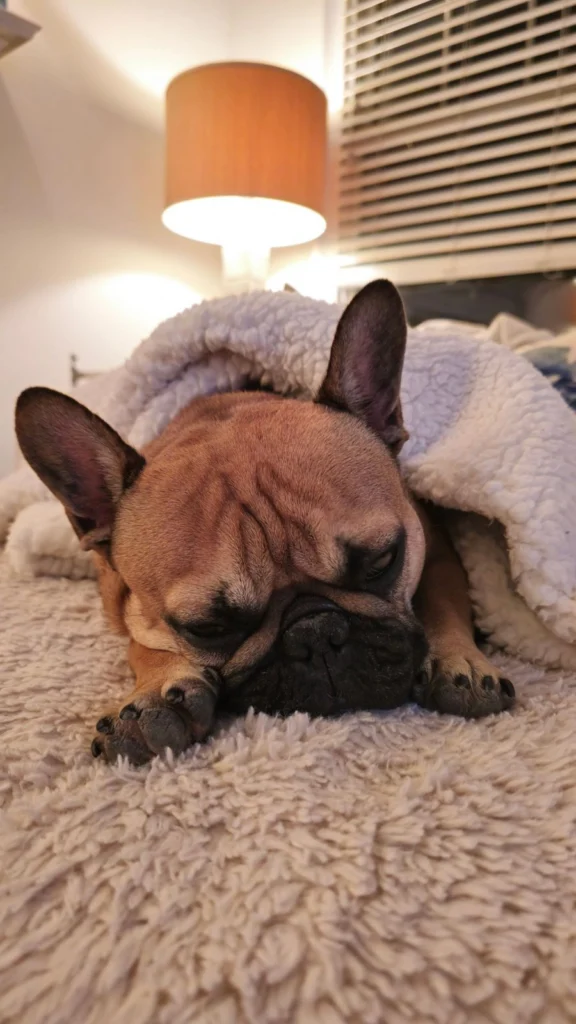
- Build a safe den. The RSPCA suggests a den with favorite toys and familiar items, available at all times, even when you’re out. A covered crate, a bed behind the sofa or a quiet inner room all work. Darken it if you can so flashes aren’t visible.
- Escape-proof your home and yard. Dogs Trust advises checking doors, windows and fences. Frightened dogs can bolt: the RSPCA tells of a dog who escaped her yard after being startled by fireworks and was killed by a train.
- Update ID. Make sure your Frenchie is microchipped and that the microchip details are up to date. A collar tag with your current phone number helps too. If your dog does get out, a well-known breed like the French Bulldog is also a target for theft, so see our theft prevention guide.
- Talk to your vet early. If your dog has been frightened before, book that conversation now rather than the week of the fireworks.
On the night: how to calm a dog during fireworks
Before dark
Walk your dog in daylight, before fireworks usually start, and give them a chance to go potty before dark. Dogs Trust advises against going out after dark. Keep your Frenchie on a secure harness and leash for any late potty trip, even in your own yard, because a sudden bang can send a dog through a gap you didn’t know was there. Our harness guide covers a good, secure fit.
Then settle in for the evening. Close windows and curtains, turn the lights on, and play music or TV to help mask the bangs. Never force your dog outside during fireworks. The RSPCA also warns against tying a dog up outside, leaving them in a car, or leaving them outside a shop.
Stay with your dog, and yes, comfort them
Many owners worry that comforting a scared dog will “reward” the fear. Leading welfare charities say otherwise. Dogs Trust says dogs who come to you for reassurance can be given calm attention and comfort, adding that “research shows that ignoring them won’t help.” The RSPCA also says to comfort a frightened dog instead of punishing them. Fear is an emotion, not a behavior your dog chooses.
- Stay with them. Your dog could panic if left alone. Dogs Trust notes that having you or someone they trust for company will help them relax.
- Stay calm and act normally. Dogs pick up on your mood. If your dog doesn’t seem worried, Dogs Trust suggests keeping them busy with favorite toys or activities.
- Let them hide. If your Frenchie crawls under the bed or into their den, let them stay there. The RSPCA advises: “Don’t try to coax them out, they’re just trying to find safety.”
- Never punish or scold. That goes for accidents or chewing caused by fear, too. Punishment only adds to the fear.
Keep the room cool
Keeping the room cool matters more for Frenchies than for most dogs, because dogs cool themselves mainly by panting. The Cambridge BOAS research group explains that in flat-faced dogs with obstructed airways, the airway becomes inflamed and swollen during panting, which causes greater obstruction and further overheating. A Frenchie panting hard from fear in a warm, closed room or a blanket-covered crate can overheat.
Keep the den well ventilated and cool, leave fresh water out, and keep an eye on your dog. Very noisy or labored breathing, gums that look pale, blue or gray, collapse or a dog who can’t settle their breathing after the noise stops all need a vet straight away. Learn more in our guide to BOAS and French Bulldog breathing problems.
How common is fireworks fear, and how long does it last?
Very common. A 2019 online survey led by Stefanie Riemer at the University of Bern found that 52% of 1,225 dogs were at least partially affected by firework fears. Most of them developed the fear in their first year of life. Fear of fireworks was strongly linked with fear of gunshots and thunder, so a Frenchie who hates fireworks may struggle during thunderstorms too. Most of the advice above works for both.
The same survey found that almost three-quarters of fearful dogs had recovered by the next morning. Recovery took up to a day for about 10%, up to a week for about 12%, and several weeks or even months for more than 3%. In the UK, the RSPCA reports that almost two-thirds of dog owners in a 2025 poll said fireworks had a negative effect on their dog.
Long-term help: desensitization and counter-conditioning
The best time to work on French Bulldog fireworks fear is long before the next season. The RSPCA describes a sound-based approach: play firework audio, raise the volume gradually, vary it during training, and give treats after each loud noise. In practice, that usually looks like this:
- Start by playing recorded firework sounds very quietly, at a level where your dog stays relaxed.
- Give a treat after each bang, so the sound starts to predict something good.
- Very slowly raise the volume over many sessions, varying the levels. As a general rule, if your dog shows any fear, go back to a quieter level.
Starting early works best. Riemer’s survey found that training puppies or non-fearful adult dogs to link the noise with good things was highly effective at preventing firework fear later on. Riemer also reports that owners rated giving a high-value treat right after a bang, and training their dog to relax on cue, as the most effective techniques for easing existing firework fear, working in more than two-thirds of cases.
Use positive reinforcement only. For a dog who is already very frightened, it’s best to follow a plan from a qualified professional. Your vet can refer you to a clinical animal behaviorist.
When to talk to your vet
Dogs Trust advises speaking to your vet as soon as possible if your dog shows fear of fireworks or loud noises. Your vet can:
- Check for medical problems. In Riemer’s survey, health problems were one of the factors linked to firework fear.
- Prescribe medication if it’s right for your dog. Dogs Trust notes that many need to be given before the fireworks begin, so read the label carefully and plan your timing.
- Discuss other options, such as pheromone diffusers, and refer you to a behaviorist.
Be realistic about calming products. In Riemer’s survey, owners did not rate pheromones, nutraceuticals or herbal products as working better than you would expect from a placebo effect. Some owners also use snug wraps or vests. No product is a guaranteed fix, so treat them as possible extras alongside the steps above, not instead of them.
Vet note: Fear of fireworks is a welfare issue, not just a bad night. If your French Bulldog panics, hurts themselves trying to escape, or stays anxious for days afterward, speak to your vet before the next fireworks season. Treat any breathing difficulty, collapse or blue or gray gums as an emergency.
FAQ
Should I comfort my French Bulldog during fireworks?
Yes, if your dog comes to you for reassurance. Dogs Trust says ignoring a frightened dog won’t help, and the RSPCA advises comforting rather than punishing. If your Frenchie would rather hide, let them.
Will my Frenchie grow out of fireworks fear?
Some dogs do improve. In Riemer’s survey, both improvement and worsening were common, with over 10% of fearful dogs improving greatly and almost a fifth tending to get worse. Training and vet support give you the best chance.
Does this advice work for thunderstorms too?
Mostly, yes. Fear of fireworks is strongly linked with fear of thunder. A safe den, background sound, a cool room and gradual sound training all help. Storms are harder to plan for, so keep the den available all year.
Can I leave my French Bulldog alone on fireworks night?
It’s best not to. Dogs Trust says dogs may panic if left alone during fireworks. If you have to go out, plan for someone your dog knows to stay with them.
Sources
- Keeping dogs, cats and other small pets safe during fireworks — RSPCA
- Fireworks — RSPCA
- Helping your dog cope with fireworks — Dogs Trust
- Not a one-way road: Severity, progression and prevention of firework fears in dogs — Riemer, PLOS ONE (2019)
- Fear expressions of dogs during New Year fireworks: a video analysis — Gähwiler et al., Scientific Reports (2020)
- Pathophysiology of BOAS — University of Cambridge, Department of Veterinary Medicine