
Both are small, flat-faced, people-loving companions with wrinkled faces and a famous snore, so the French Bulldog vs Pug choice is a common one for first-time owners. This guide compares them side by side using American Kennel Club (AKC) breed standards, the UK vet charity PDSA and large UK veterinary studies, without promoting either breed.
Quick answer: Pugs are smaller, with an AKC desirable weight of 14 to 18 pounds, a curled tail and large, prominent eyes, while French Bulldogs are heavier-boned, capped at 28 pounds, with upright bat ears. Both are brachycephalic breeds with high risks of breathing problems, overheating, eye ulcers and skin fold infections. Pugs shed more heavily.
Key takeaways
- The AKC prefers Pugs at 14 to 18 pounds; French Bulldogs must not exceed 28 pounds.
- Pugs have large, prominent eyes and, in UK vet records, about 13 times other dogs’ odds of corneal ulcers.
- Both breeds had very high BOAS odds in VetCompass studies: about 54 times for Pugs and 31 times for Frenchies.
- A 2024 UK study estimated median lifespans of 11.6 years for Pugs and 9.8 years for French Bulldogs.
- Pugs shed heavily; Frenchies are lighter shedders. Neither breed copes well with heat or long hours alone.
French Bulldog vs Pug at a glance
Weight, ears, tail, coat and colors come from the AKC breed standards; height and care details come from PDSA.
| Feature | French Bulldog | Pug |
|---|---|---|
| Origin (PDSA) | Thought to descend from small bulldogs kept as lap dogs by English lace makers; bred as a companion | An ancient breed from China, bred for emperors |
| Weight (AKC standard) | Must not exceed 28 lb; over 28 lb is a disqualification | 14 to 18 lb desirable (dogs and bitches) |
| Height | Not set by the AKC; PDSA gives about 30 cm (roughly 12 in) on average | Not set by the AKC; PDSA gives 25 to 33 cm (roughly 10 to 13 in) |
| Ears and tail | Upright “bat ears”; short tail, straight or screwed but not curly | Small, soft “rose” or “button” ears; tail curled tightly over the hip, with a double curl the ideal |
| Coat and colors (AKC) | Brilliant, short and smooth; white, cream or fawn, with brindle, piebald, black mask and white markings allowed; solid black disqualifies | Fine, smooth, soft and short; fawn (with a black mask and markings) or black only |
| Shedding (PDSA) | Not a heavy shedder; weekly brushing | Sheds heavily despite the short coat; brush at least weekly |
| Exercise (PDSA) | Up to 1 hour per day, split into shorter walks | Up to 1 hour per day, split into shorter walks |
| Trainability (PDSA) | Eager to please, but sensitive and can be strong-willed | Clever but strong-willed; training needs to be ongoing |
| Breathing noise | Flat-faced; PDSA advises taking breathing concerns to a vet | Flat-faced; PDSA advises a vet check for snorting, snoring or loud breathing |
| Lifespan | PDSA: over 10 years; 2024 UK study median 9.8 years | PDSA: over 10 years; 2024 UK study median 11.6 years |

Size, build and looks
The Pug is the smaller dog. The AKC Pug standard calls it “multum in parvo” (a lot in a little), square and cobby, with a desirable weight of 14 to 18 pounds. The French Bulldog standard describes a muscular, heavy-boned dog whose weight must not exceed 28 pounds. In UK VetCompass studies, median bodyweights were about 8.95 kg (20 pounds) for Pugs and 12.45 kg (27 pounds) for Frenchies.
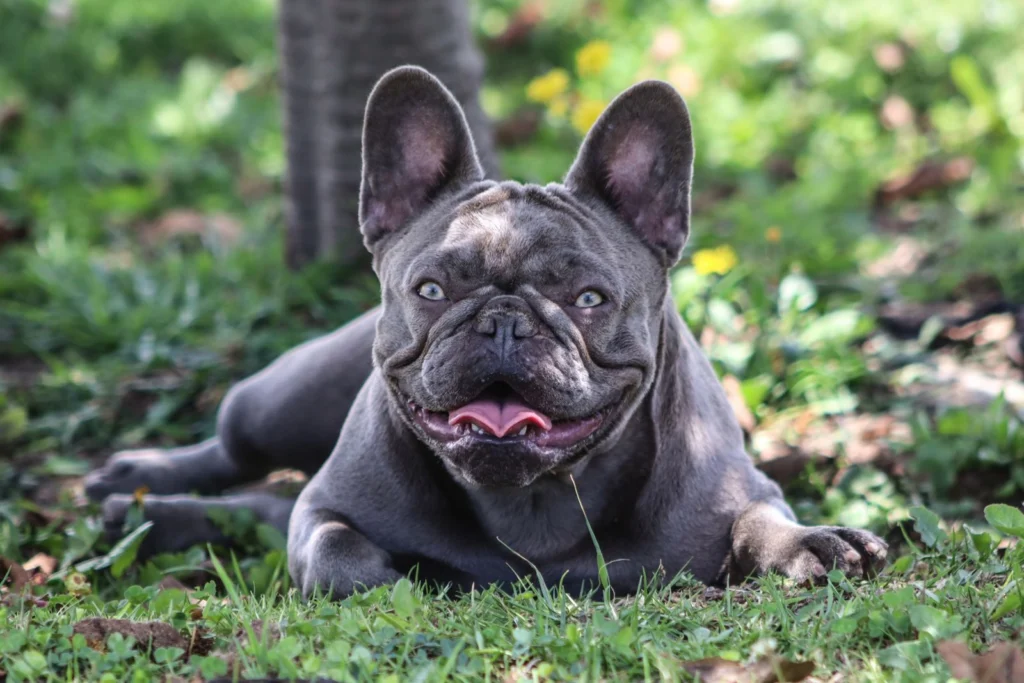
Ears and tails are the quickest way to tell them apart. A Frenchie’s large bat ears stand upright; a Pug’s small, soft ears fold as a “rose” or “button.” The Pug’s tail curls tightly over the hip, while the Frenchie’s is short and never curly.
The eyes differ too. The French Bulldog standard asks for round eyes of moderate size, “neither sunken nor bulging.” The Pug standard asks for eyes that are “very large, bold and prominent, globular in shape.” That difference matters for health, as you’ll see below.
Temperament and lifestyle fit
Both breeds were developed as companions, and their standards describe them in warm terms. The AKC calls French Bulldogs well behaved, adaptable and affectionate, “active, alert, and playful, but not unduly boisterous.” It describes the Pug as even-tempered, with “great charm, dignity, and an outgoing, loving disposition.”
PDSA describes Pugs as affectionate dogs with big personalities that usually get along well with other pets, and notes they “will often eat anything and everything,” so treats need limiting. It calls Frenchies loving and laid-back, though they can put on weight easily too. Neither breed likes being alone: PDSA advises not leaving either for more than four hours, and notes Frenchies can develop separation anxiety. Both can be strong-willed, so short, reward-based training sessions in a cool room work best.
Health: two brachycephalic breeds, different weak spots
Both breeds are brachycephalic, meaning they have a shortened skull and muzzle. PDSA warns that in both breeds this flat-faced shape can cause severe breathing problems, and that Pugs can tire easily on walks because of their breathing. This is brachycephalic obstructive airway syndrome (BOAS).
VetCompass studies compared each breed with all other dogs under UK veterinary care in 2016. Pugs had increased odds for 23 of 40 common disorders, and French Bulldogs for 20 of 43. The figures below are odds compared with other dogs, not with each other, so they show each breed’s weak spots rather than which breed is “healthier.”
| Disorder (2016 UK vet records) | French Bulldog vs other dogs | Pug vs other dogs |
|---|---|---|
| BOAS | About 31 times the odds | About 54 times the odds |
| Narrowed nostrils (stenotic nares) | About 42 times | About 51 times |
| Corneal ulceration | About 4.4 times | About 13 times |
| Skin fold dermatitis | About 11 times | About 11 times |
| Obesity | Lower odds (about 0.3 times, in a young study group with a median age of about 1.5 years; weight still needs watching) | About 3.9 times (17.4% of Pugs were recorded as obese) |
| Other notable predispositions | Ear discharge (about 14 times), difficult birth (about 9 times) | Overgrown nails, patellar luxation, anal sac impaction (each about 2 to 2.5 times) |
The Pug study’s authors concluded that the breed “has diverged substantially from mainstream dog breeds,” and the French Bulldog study called for a more moderate build. Both study populations were young (median ages about 2.4 and 1.5 years), so later-life conditions may be underrepresented.
Eyes: the Pug’s biggest extra risk
The Pug’s large, prominent eyes sit in shallow sockets, which PDSA links to eye trauma. PDSA lists dry eye, eye infections, corneal ulcers and eye trauma among common Pug conditions. Frenchies are at risk too (about 4.4 times other dogs’ odds of corneal ulcers), but the Pug’s odds were roughly three times higher again.
Spine and hemivertebrae
Both are “screw-tailed” breeds, which are prone to malformed vertebrae. A University of Glasgow study found hemivertebrae in 93.5% of neurologically normal French Bulldogs but only 17.6% of neurologically normal Pugs. Even so, the authors concluded that these malformations appear to be of greater clinical importance in Pugs: 4.7% of the Pugs in the study had clinically relevant thoracic vertebral malformations.
Pug dog encephalitis
Pug dog encephalitis (PDE) is an inflammatory brain disease that, according to PDSA, causes blindness, seizures and difficulty walking, worsens over time and can be fatal.
Skin folds
Both breeds had about 11 times other dogs’ odds of skin fold dermatitis, and PDSA notes that Pug skin infections are common in the folds around the face and tail. Clean and dry the folds regularly, especially after baths.
Heat sensitivity
PDSA says Pugs are at higher risk of heatstroke and that Frenchies “can overheat and struggle to breathe really quickly, especially in warmer weather.” Both need a cool home, early or late summer walks and no hard exercise on warm days. If either dog overheats, start cooling right away, then go to the vet.
Lifespan
PDSA lists both breeds as living over 10 years. A 2024 study of 584,734 UK dogs estimated a median lifespan of 11.6 years for Pugs and 9.8 years for French Bulldogs, compared with 12.7 years for purebred dogs overall. Breeding, weight and care matter more for any individual dog.
Cost: plan for vet bills
Neither breed is cheap to keep well. In its UK estimates of minimum upkeep after purchase, PDSA puts the French Bulldog somewhat higher than the Pug, and neither estimate includes vet treatment when the dog is ill. Specialist care such as airway or eye surgery can add much more. Our French Bulldog cost guide covers what to budget for, including insurance.
Frenchie or Pug: which is right for you?
- A Pug may suit you if you want a smaller, lighter dog that is easy to carry, and you can commit to daily eye checks, weight control (Pugs love food) and frequent vacuuming.
- A French Bulldog may suit you if you prefer a sturdier dog with less shedding, and you are ready for the breed’s airway, ear, skin and spinal risks and higher typical costs.
- Either breed needs a cool home, gentle exercise, a harness, company most of the day, and a puppy whose parents have had relevant health screening.
Some people look at a French Bulldog x Pug cross (sometimes called a “Frug”) hoping for the best of both. Because both parents are flat-faced, the cross keeps the brachycephalic risks; our guide to French Bulldog mixes explains what the research does and doesn’t show.
Vet note: In either breed, noisy breathing at rest, struggling with mild exercise, collapse or blue-tinged gums are not “normal for the breed,” so ask your vet to assess the airway. A squinting, watering or cloudy eye, or an eye that looks pushed forward, needs a vet the same day. Seizures, circling or sudden blindness in a Pug also need urgent veterinary care.
FAQ
What is the difference between a Pug and a French Bulldog?
Pugs are smaller (14 to 18 pounds is the AKC ideal), with folded ears, a curled tail, prominent eyes and a coat that sheds heavily. French Bulldogs are heavier-boned, up to 28 pounds, with upright bat ears, a short straight or screwed tail and lighter shedding.
Which is healthier, a Pug or a French Bulldog?
Neither can be called healthy compared with longer-muzzled dogs. Both have very high odds of BOAS and skin fold dermatitis. Pugs carry a higher risk of corneal ulcers and obesity, while French Bulldogs stand out for ear discharge and difficult births. A 2024 UK study gave Pugs a longer median lifespan (11.6 vs 9.8 years).
Are Pugs or French Bulldogs better for apartments?
Either can suit an apartment. Both are small, and PDSA suggests up to an hour of exercise a day for each. What matters more is a home that stays cool and someone around most of the day, since PDSA advises not leaving either breed alone for more than four hours. A Pug is lighter to carry up stairs.
Is a Pug or a French Bulldog easier to train?
PDSA lists French Bulldogs as easy to train, describing them as eager to please and sensitive, though strong-willed at times. It calls Pugs clever but very strong-willed. Both respond best to positive, reward-based training started early, in short sessions in a cool room.
Sources
- Official Standard of the Pug — American Kennel Club
- Official Standard of the French Bulldog — American Kennel Club
- Pug — PDSA
- French Bulldog — PDSA
- Health of Pug dogs in the UK: disorder predispositions and protections — Canine Medicine and Genetics (Royal Veterinary College VetCompass), via PMC
- French Bulldogs differ to other dogs in the UK in propensity for many common disorders: a VetCompass study — Canine Medicine and Genetics (Royal Veterinary College VetCompass), via PMC
- Longevity of companion dog breeds: those at risk from early death — Scientific Reports, via PMC
- Prevalence of thoracic vertebral malformations in French bulldogs, Pugs and English bulldogs with and without associated neurological deficits — The Veterinary Journal, via University of Glasgow