
Ask around about male vs. female French Bulldog differences and you will hear confident claims: boys are clingier, girls are moodier, one sex is “easier” to train. Some of it reflects real averages; much of it is folklore. This guide sticks to what breed standards and veterinary research actually show about size, behavior and health, and where the evidence runs out. The short version: the individual dog in front of you matters far more than its sex.
Quick answer: The main male vs. female French Bulldog difference is size: UK data put adult males at about 13.7 kg and females at about 11.5 kg, with lots of overlap. Surveys find only small average behavior gaps between the sexes. Intact females face heat cycles and pyometra risk, while intact males mark more, so choose on temperament and health, not sex.
Key takeaways
- Males are usually a little heavier: UK data put adult males at about 13.7 kg vs. 11.5 kg for females.
- The US standard sets one limit for both sexes (28 lb); the UK standard gives males a higher ideal weight.
- Large surveys find small average behavior gaps between sexes, but they cannot predict any single dog.
- Intact females face heat cycles and pyometra risk; intact males are more likely to urine-mark.
- Choose on temperament, health screening and fit with your home, not on sex alone.
Male vs. female French Bulldog: size and weight
Size is the most reliable difference, but it is smaller than many people expect, and the breed standards do not even agree on how to handle it.
The French Bull Dog Club of America standard, which the AKC uses, sets one rule for both sexes: weight must not exceed 28 pounds, and a dog over 28 pounds is disqualified in the show ring. It does add an “Influence of Sex” note, saying judges should make “due allowance” for bitches, which do not show the breed’s characteristics “to the same marked degree” as males. In plain terms, males are expected to show the breed’s typical features a little more strongly.
The Royal Kennel Club standard in the UK is more specific. It gives an ideal weight of 12.5 kg (28 lb) for males and 11 kg (24 lb) for females, and adds that “soundness” should not be sacrificed to smallness.
Real pet dogs don’t always match the show-ring ideal. A 2018 VetCompass study of more than 2,200 French Bulldogs under UK veterinary care found that adult males (18 months and older) averaged 13.7 kg (about 30 lb) and adult females 11.5 kg (about 25 lb). The difference was statistically significant, but the ranges overlapped a lot, so a large female can easily outweigh a small male.
| Source | Males | Females |
|---|---|---|
| FBDCA / AKC standard | Not over 28 lb | Not over 28 lb |
| Royal Kennel Club ideal | 12.5 kg (28 lb) | 11 kg (24 lb) |
| VetCompass 2018, mean adult weight | 13.7 kg (about 30 lb) | 11.5 kg (about 25 lb) |
For either sex, body condition tells you more than the number on the scale. Our French Bulldog weight chart explains how to check whether your dog is lean, ideal or carrying extra weight.
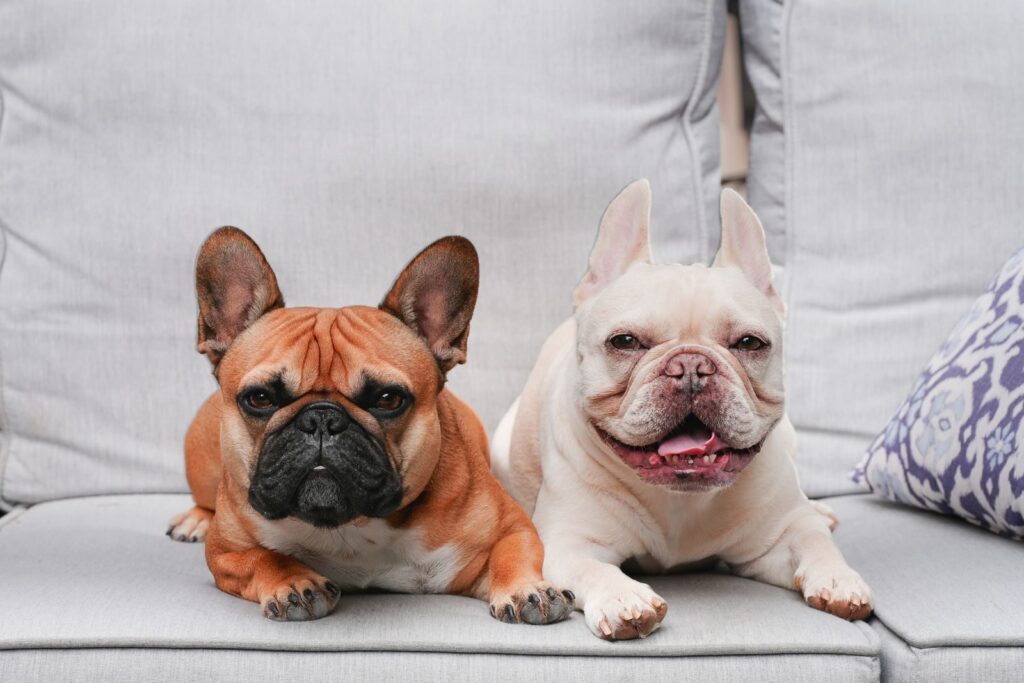
Behavior: what research does and doesn’t say
This is where stereotypes take over. Both breed standards describe the French Bulldog’s temperament without reference to sex: affectionate, intelligent, adaptable, playful but “not unduly boisterous.” Nothing in either standard says one sex makes the better companion.
The best large-scale data on sex and behavior come from the Dog Aging Project, which analyzed owner-completed behavior questionnaires for 47,444 dogs of many breeds (published in PLoS One in 2025). On average, the researchers found that:
- males were rated as slightly less fearful than females
- males scored slightly higher on aggression
- females were rated as slightly more trainable and as needing less attention
Before you take these as a buying guide, keep three caveats in mind:
- These are averages across tens of thousands of dogs. The reported gaps were fractions of a point on the study’s scoring scale, and they say little about the puppy you are looking at.
- It was not a French Bulldog study. Results across all breeds may not hold within one breed.
- Owners did the rating. The authors themselves note that “gendered” perceptions of personality could bias how people describe male and female dogs. They also point out that other studies have found sex explains little of the variation in behavior.
The same study found that spayed and neutered dogs scored differently from intact dogs on some traits. Because the dogs were not randomly assigned to surgery, this kind of data cannot show that neutering caused those differences.
In everyday life, a Frenchie’s behavior is shaped mostly by genetics, early socialization, training and the home it lives in. A well-socialized female and a well-socialized male are likely to be more alike than a well-socialized dog and a poorly socialized one of the same sex. Positive, reward-based training works equally well for both.
Health differences by sex
What the French Bulldog data show
The 2018 VetCompass study is one of the few that looked at sex within French Bulldogs specifically. Males and females had the same median number of disorders recorded per year (one), although the authors found some evidence of a higher annual disorder count in males. Median age at death did not differ significantly between the sexes, but it was based on fewer than 100 deaths in a very young population. However, males had a higher recorded prevalence of several common problems, and females did not have a higher prevalence than males for any of the specific disorders compared.
| Disorder recorded | Males | Females |
|---|---|---|
| Brachycephalic obstructive airway syndrome (BOAS) | 3.4% | 1.4% |
| Narrow nostrils (stenotic nares) | 2.4% | 0.9% |
| Aggression | 3.7% | 0.8% |
| Skin infection (pyoderma) | 3.5% | 1.9% |
| Conjunctivitis | 3.9% | 2.4% |
The authors said their data did not give a strong explanation for these gaps. They suggested that males’ larger body size or hormonal effects may play a part. Note that most dogs in the study were intact, and these figures come from one UK population, so they show patterns, not predictions. Breathing problems are a concern in every Frenchie, whatever its sex. Our French Bulldog health guide covers the breed’s main risks.
Intact females: heat cycles and pyometra
An unspayed female will come into heat, typically about twice a year. Expect a swollen vulva, bloody discharge, frequent urination and a lot of attention from male dogs. You will need to keep her away from intact males for the whole cycle.
The bigger health issue is pyometra, a uterine infection that VCA Animal Hospitals describes as serious and life-threatening. It can develop in any intact female, is most common in older dogs, and usually appears within weeks of a heat cycle (VCA gives a range of two to sixteen weeks). Warning signs include discharge from the vulva, lethargy, poor appetite, heavy drinking and urination, vomiting or a swollen belly. In “closed” pyometra there may be no visible discharge at all, and the dog can become very ill quickly. Treat any of these signs in an unspayed female as an emergency.
Intact males: marking and roaming
According to VCA, urine marking is most common in intact males, although intact females, neutered males and spayed females can mark too. Marks are usually small amounts of urine on upright objects. Neutering may reduce marking in some dogs, but it is not a guaranteed cure. Reward-based management works better than punishment, which VCA warns can make a dog fearful. If a house-trained dog suddenly starts peeing indoors, see your vet first to rule out a medical cause. Intact males may also be strongly drawn to females in heat, so secure fencing and a reliable leash matter.
Spay and neuter: keep it a conversation with your vet
Spaying removes the risk of heat cycles and pyometra, and neutering may reduce marking in some males. Like any surgery, both carry risks, and for a brachycephalic breed anesthesia needs extra care. The best timing depends on the individual dog’s health, size and lifestyle, and veterinary views on timing differ. Rather than following a blanket rule, discuss whether and when to spay or neuter with a vet who knows your dog and is comfortable with brachycephalic patients.
Male vs. female at a glance
| Factor | Male | Female |
|---|---|---|
| Typical adult weight (UK pet data) | About 13.7 kg (30 lb) | About 11.5 kg (25 lb) |
| Build | Heavier on average, with wide overlap | Lighter on average, with wide overlap |
| Temperament | Varies by individual; small average differences in surveys | Varies by individual; small average differences in surveys |
| Intact-specific issues | Urine marking, interest in females in heat | Heat cycles, pyometra risk |
| Recorded disorders (VetCompass 2018) | Higher prevalence for several common disorders | Not higher than males for any specific disorder compared |

How to choose between a male and a female
- Meet the individual dog. Watch how the puppy or adult reacts to people, handling and new things. Our guide to choosing a French Bulldog breeder lists the questions to ask.
- Put health first. Open nostrils, easy breathing and health-tested parents matter more than sex in this breed.
- Think about dogs already at home. Match personalities and energy levels, and introduce dogs carefully. If you keep an intact male and an intact female together, you will have to separate them during every heat.
- Be honest about your plans. If you won’t spay or neuter, be ready to manage heat cycles or marking.
- Check the breed itself fits. Sex is a minor choice compared with whether a Frenchie suits your life. See is a French Bulldog right for you?
Vet note: An unspayed female who seems unwell within a few months of a heat cycle, especially with discharge, heavy thirst, vomiting, lethargy or a swollen belly, needs a vet the same day. In any Frenchie, noisy breathing, struggling to breathe or collapse are emergencies, whatever the dog’s sex.
FAQ
Are male French Bulldogs more affectionate than females?
There is no good evidence that one sex is more affectionate. Both breed standards describe the breed as affectionate overall. How cuddly an individual dog is depends far more on its personality, socialization and bond with you than on its sex.
Are female French Bulldogs easier to train?
A large multi-breed survey found females were rated as slightly more trainable on average, but the difference was small, came from owner ratings and did not look at Frenchies specifically. Consistent, reward-based training matters far more.
How much bigger is a male French Bulldog?
In UK veterinary data, adult males averaged about 13.7 kg (30 lb) and females about 11.5 kg (25 lb), roughly a 2 kg (5 lb) difference. Individual dogs vary widely, and the sizes of the two sexes overlap a lot.
Do male French Bulldogs have more health problems?
In one large UK study, males had a higher recorded prevalence of several common disorders, including BOAS. The median number of disorders per year was the same for both sexes, and age at death did not differ significantly. Intact females carry their own risk of pyometra. Neither sex is a “healthy choice” by default.
Sources
- French Bulldog Breed Standard — French Bull Dog Club of America
- French Bulldog Breed Standard — The Royal Kennel Club
- Demography and disorders of the French Bulldog population under primary veterinary care in the UK in 2013 (O’Neill et al., 2018) — Canine Genetics and Epidemiology / VetCompass, RVC
- An analysis of behavioral characteristics and enrollment year variability in 47,444 dogs entering the Dog Aging Project from 2020 to 2023 (Li et al., 2025) — PLoS One / Dog Aging Project
- Pyometra in Dogs — VCA Animal Hospitals
- Dog Behavior Problems: Marking Behavior — VCA Animal Hospitals