
French Bulldog hip dysplasia is a hip joint that didn’t form properly, so the ball and socket fit loosely and wear down over time. It is surprisingly common on X-rays in this small breed, yet many affected Frenchies show few or no obvious signs.
Quick answer: Yes, French Bulldogs do get hip dysplasia, and a sizable share of screened Frenchies have abnormal hip X-rays. Watch for back-leg limping, a wobbly rear, trouble rising, reluctance on stairs and sometimes a bunny-hopping gait. See your vet for any back-leg lameness, and go the same day if your dog suddenly can’t walk, wobbles or drags its legs.
Key takeaways
- Hip dysplasia is a loose, poorly formed hip joint that leads to arthritis over time.
- In OFA data from 1974 to 2014, 28.6% of 1,316 voluntarily submitted French Bulldog hip X-rays were graded dysplastic.
- Many dysplastic dogs run and play normally, so X-ray results and signs often don’t match.
- Weight control, steady low-impact exercise and rehab are the backbone of care.
- Ask breeders for OFA or PennHIP hip results on both parents, not just a verbal “healthy”.
What is hip dysplasia?
The hip is a ball-and-socket joint: the ball at the top of the thighbone (femoral head) sits in a cup in the pelvis (acetabulum). The Merck Veterinary Manual describes hip dysplasia as an abnormal development of this joint, marked by joint looseness (laxity) that leads to degenerative joint disease and osteoarthritis.
The Orthopedic Foundation for Animals (OFA) explains that the cartilage in a poorly formed joint gradually loses thickness and elasticity, eventually causing pain with movement. These changes are irreversible and usually progress.
Merck lists excessive and rapid growth, exercise, nutrition and hereditary factors as influences, and VCA Animal Hospitals notes that overfed, fast-growing puppies develop it more often.
How common is hip dysplasia in French Bulldogs?
The best-known breed numbers come from the OFA, which grades hip X-rays that owners and breeders choose to send in. Its breed table covering January 1974 through December 2014 (archived copy from 2016) showed:
| OFA data (French Bulldog) | Evaluations | Graded excellent | Graded dysplastic |
|---|---|---|---|
| All evaluations, 1974-2014 | 1,316 | 2.2% | 28.6% |
| Dogs born 2006-2010 | 554 | 2.7% | 23.8% |
That placed the French Bulldog 21st by percent dysplastic among breeds with at least 100 evaluations. The Bulldog (72.0%) and Pug (68.7%) ranked first and second. These figures are now more than a decade old, and the OFA updates its statistics as more dogs are screened, so treat them as a rough guide.
Read these numbers with care:
- They are not a random sample. Screening is voluntary, so these are mostly breeding dogs whose owners chose to submit X-rays. The true rate in pet Frenchies could be higher or lower.
- An abnormal X-ray is not the same as a lame dog. OFA notes that some dysplastic dogs with severe arthritis run and play as if nothing is wrong, while others with barely any X-ray changes are severely lame.
- Size matters. Merck notes that hip dysplasia is most common in large breeds but can affect small ones too.
Signs of French Bulldog hip dysplasia
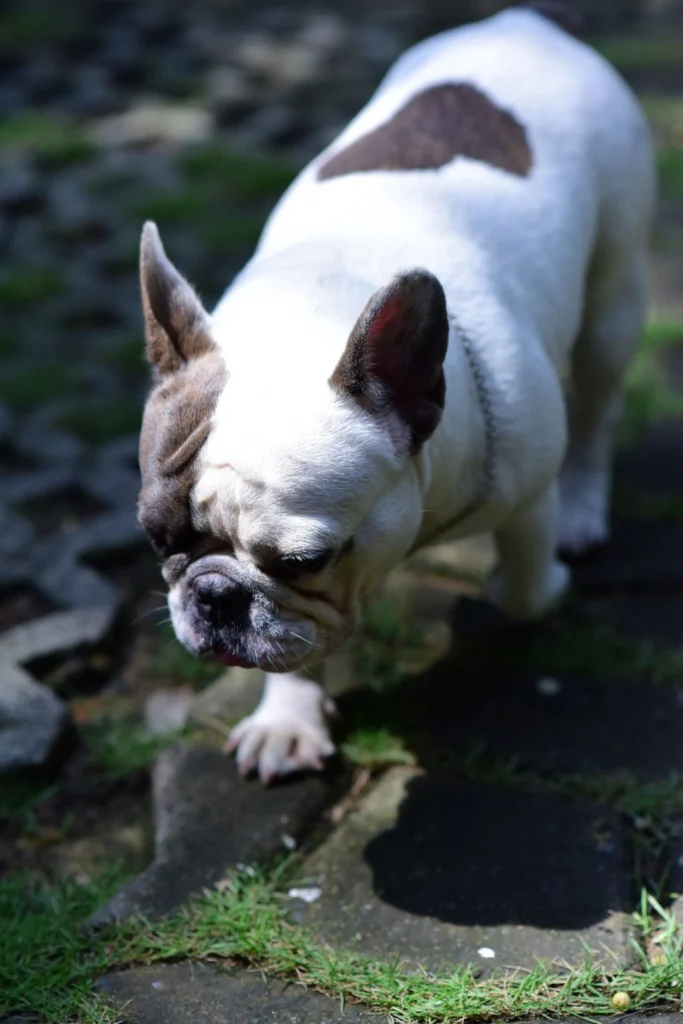
Signs can show up in a growing puppy or later as arthritis develops. Watch for:
- Limping on one or both back legs (VCA).
- Bunny hopping: moving both back legs together when running, a gait Merck says is sometimes evident.
- Trouble getting up from sitting or lying down, or a wobbly back end (VCA).
- Reluctance on stairs, jumping onto the couch or getting into the car.
- Pain when the hips are handled, a reduced range of motion, or a grating feel in the joint.
Signs can be subtle, so changes in mood, activity or sleep matter too. Our guide to signs a French Bulldog is in pain covers what to look for.
Hip dysplasia vs luxating patella vs IVDD
Kneecap and spine problems can look similar. These patterns help you describe what you see to your vet:
| Condition | Where | Typical pattern | Urgency |
|---|---|---|---|
| Hip dysplasia | Hip joints | Gradual limping or stiffness, slow to rise, sometimes bunny hopping | Vet appointment |
| Luxating patella | Kneecap | Skips on one back leg for a few steps, then walks normally | Vet appointment |
| IVDD | Spine | Back pain, hunched posture, wobbling, knuckling, dragging the back legs | Often same-day vet |
See our guides to luxating patella and IVDD and back problems. A dog can have more than one.
How vets diagnose hip dysplasia
Your vet watches your dog walk, then gently moves each hip to check for pain, range of motion and looseness (Merck describes a test called the Ortolani sign).
X-rays confirm the diagnosis and show any arthritis. VCA calls hip X-rays under general anesthesia the preferred method, and OFA recommends anesthesia so the dog relaxes for correct positioning. Because Frenchies are flat-faced, ask your vet how they manage the airway during sedation.
OFA and PennHIP screening
- OFA hip evaluation: a standard hip X-ray graded excellent, good or fair (all within normal limits), borderline, or mild, moderate or severe (dysplastic). Preliminary readings are available from 4 to 23 months of age.
- PennHIP: a method developed at the University of Pennsylvania’s School of Veterinary Medicine that measures hip looseness using a custom distraction device under sedation or anesthesia. It can identify at-risk dogs from as early as 16 weeks, and only specially certified vets can perform it.
The French Bull Dog Club of America requires an OFA or PennHIP hip evaluation, registered with OFA, as part of its CHIC health-testing program. Our guide to choosing a French Bulldog breeder explains how to read and look up those results.
Managing hip dysplasia at home
Most dogs start with conservative care. The OFA reports that up to 76% of severely dysplastic dogs with arthritis can function with conservative management. The key parts are:
- Weight control: OFA’s guide is that you should easily feel the ribs and see a waist in front of the hips. VCA strongly recommends weight loss for overweight dogs.
- Controlled exercise: start with short leash walks and build up gradually, scaling back if pain or stiffness returns.
- Low-impact activity: avoid jumping. OFA recommends swimming as non-weight-bearing exercise, but a Frenchie needs a well-fitted life jacket and close supervision, ideally in a canine rehab setting.
- Physical therapy: VCA calls it highly effective at improving quality of life. Ask your vet about a rehab referral.
- A joint-friendly home: rugs or runners on slippery floors, a ramp or steps for the couch and car, and a warm, well-padded bed. OFA notes that warmth helps arthritic joints. If you use a heating pad, take care not to burn the skin.
- Medication and supplements: your vet may prescribe pain relief during flare-ups or suggest joint support. Never give human painkillers, and check with your vet before starting any supplement.
For growing puppies, VCA advises keeping them lean and feeding measured meals rather than leaving food out, so they don’t grow too fast.
Surgery options
When conservative care isn’t enough, a veterinary surgeon may discuss surgery. The choice depends on age and how much arthritis is present:
- Juvenile pubic symphysiodesis (JPS): a procedure in growing puppies to help prevent the hip from slipping partly out of place (Merck).
- Triple or double pelvic osteotomy (TPO/DPO): rotates part of the pelvis to improve coverage of the ball. Merck notes JPS, TPO and DPO must be done early in growing dogs, and OFA says TPO is usually done in dogs under about 10 months with no arthritis yet.
- Femoral head and neck excision (FHO): removes the ball of the thighbone so a fibrous false joint forms. OFA describes it as a salvage procedure that relieves pain, with better long-term results in dogs under 20 kg (about 44 lb), which includes most Frenchies. Good muscle mass before surgery and early physical therapy afterward matter, and it works less well in obese dogs.
- Total hip replacement: replaces the joint with an implant. OFA calls it the treatment of choice for restoring pain-free function in older dogs whose arthritis can’t be managed medically. The main drawback is cost.
Vet note: Book a vet visit for any back-leg lameness, stiffness or bunny hopping that lasts more than a day or two or keeps coming back. Go the same day if your Frenchie suddenly can’t stand, wobbles, knuckles over, drags the back legs, cries out in pain or loses bladder control, as these point more to the spine than the hips.
FAQ
Do French Bulldogs get hip dysplasia?
Yes. In OFA data from 1974 to 2014, 28.6% of French Bulldog hip X-rays were graded dysplastic. Those dogs were voluntarily screened, though, and many dogs with abnormal hips show few signs in daily life.
At what age does hip dysplasia show up in Frenchies?
Signs can appear in a growing puppy or not until arthritis develops later in life. OFA offers preliminary hip readings from 4 months, and PennHIP can assess hip looseness from 16 weeks.
What do OFA hip scores mean for a French Bulldog?
OFA grades hips as excellent, good or fair (normal), borderline, or mild, moderate or severe (dysplastic). Normal grades receive an OFA number. Dysplastic results stay private unless the owner chooses the open database, so ask breeders to show you the actual results.
Can a French Bulldog live a normal life with hip dysplasia?
Many can. OFA reports that up to 76% of severely dysplastic dogs can function with conservative care such as weight control, controlled exercise and vet-guided pain relief. Surgery is an option if that isn’t enough.
Is my Frenchie’s bunny hopping always hip dysplasia?
No. It can point to hip problems, but kneecap or spine issues can also change how a dog moves. Your vet needs to examine your dog, and X-rays usually confirm the cause.
Sources
- Hip Dysplasia — Orthopedic Foundation for Animals
- Hip Dysplasia Statistics by Breed (January 1974 to December 2014, archived) — Orthopedic Foundation for Animals
- Hip Dysplasia in Dogs — Merck Veterinary Manual
- Hip Dysplasia in Dogs — VCA Animal Hospitals
- Health Testing and Registries — French Bull Dog Club of America
- The Key to Reducing Canine Hip Dysplasia (PennHIP brochure) — Antech Imaging Services