
If your dog skips along on three legs for a few steps and then trots on as if nothing happened, a French Bulldog luxating patella is one of the first things your vet will check for. It means the kneecap is slipping out of place, and Frenchies are more prone to it than the average dog.
Quick answer: A luxating patella is a kneecap that slips out of its groove at the knee. Frenchies usually show a skipping gait or hold a back leg up for a few steps. Mild cases are managed with weight control and controlled exercise; higher grades may need surgery. See a vet for any lameness that keeps returning or doesn’t settle.
Key takeaways
- A luxating patella is a kneecap that slips out of its groove; in small dogs it usually slips toward the inside.
- A UK study found French Bulldogs had 5.4 times the odds of patellar luxation compared with crossbreds.
- The classic sign is a skip: a back leg held up for a few steps, then normal walking again.
- Vets grade it from I (mild) to IV (kneecap permanently out); surgery is mostly considered from grade II up.
- Wobbling, dragging both back legs or back pain points more to the spine than the knee.
What is a luxating patella?
The kneecap (patella) normally glides up and down in a groove at the lower end of the thighbone (femur), called the trochlear groove. In patellar luxation, the kneecap slides out of that groove. The Merck Veterinary Manual describes it as a developmental orthopedic disorder that is often part of a wider set of hind limb shape problems involving the hip, thighbone and shinbone.
The kneecap can slip in two directions:
- Medial luxation (toward the inside of the knee) is the more common form, and it is the usual type in small and miniature breeds. It can come with an outward bowing of the lower thighbone, which can give a bow-legged look.
- Lateral luxation (toward the outside) is much less common and is seen more in large breeds.
The Orthopedic Foundation for Animals (OFA) explains that medial luxation in small breeds comes from anatomical deformities present at birth, even when the kneecap doesn’t start slipping until later. The OFA states it should be considered an inherited disease.
How common is patellar luxation in French Bulldogs?
The best data come from VetCompass, a Royal Veterinary College program that studies UK general-practice vet records.
- A 2016 study of 210,824 dogs found patellar luxation in 1.3% of dogs overall. French Bulldogs had 5.4 times the odds of a diagnosis compared with crossbred dogs, and 4.0% of the 1,280 French Bulldogs in the study were affected (O’Neill et al., 2016).
- A 2021 study comparing 2,781 French Bulldogs with 21,850 other dogs found patellar luxation recorded in 2.0% of French Bulldogs versus 1.0% of other dogs during 2016, with 2.31 times the odds after accounting for other factors (O’Neill et al., 2021).
Most Frenchies never have it, but the breed is at higher risk than dogs in general. Patellar luxation is one of several conditions covered in our French Bulldog health guide.
Signs of a French Bulldog luxating patella
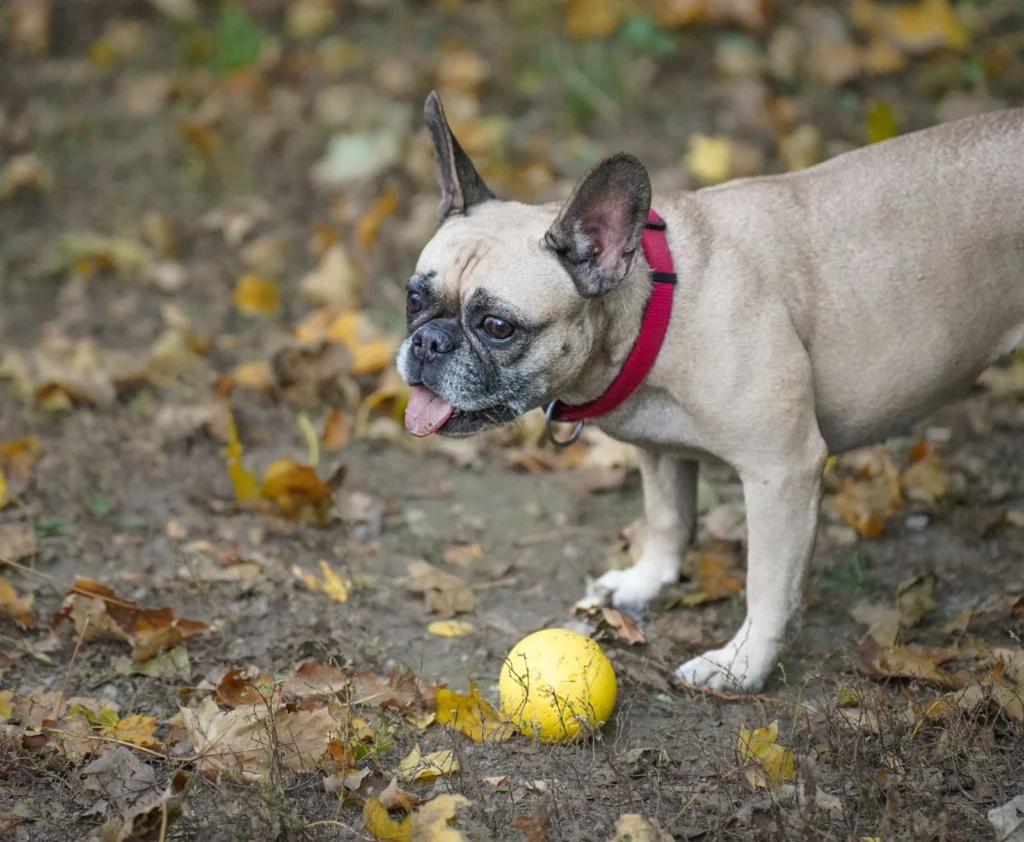
According to the American College of Veterinary Surgeons (ACVS), most affected dogs suddenly carry a back leg up for a few steps and may shake or stretch the leg out, which can let the kneecap slip back into place. Signs usually appear before 1 year of age but can start at any age (Merck). Watch for:
- A “skipping” or hopping step on one back leg that sorts itself out within a few strides
- Holding a back leg off the ground, then putting it down and walking normally
- Kicking or stretching a back leg out behind them
- In more advanced cases, limping that happens more often or doesn’t go away, or a bow-legged stance
Mild cases are often painless. As the condition progresses, the ACVS says lameness can become more frequent and eventually constant, and repeated slipping wears down the cartilage, leading to arthritis and pain. Dogs with patellar luxation are also more prone to cranial cruciate ligament injury, a common knee ligament tear.
Patellar luxation grades I to IV
Vets grade patellar luxation by feeling how easily the kneecap moves out of the groove and whether it goes back. Wording differs slightly between schemes; this table follows the Merck Veterinary Manual.
| Grade | What the kneecap does | What you may notice |
|---|---|---|
| I | Can be pushed out by hand but pops straight back into the groove | Often nothing, or rare, mild skipping |
| II | Slips out on its own or with handling and can stay out for a while; goes back by hand or when the leg straightens | Occasional skipping or holding the leg up |
| III | Out of the groove most of the time; can be pushed back but slips out again easily; bone changes are evident | Lameness most of the time, odd stance |
| IV | Permanently out and cannot be pushed back | Severe lameness and visible limb deformity |
One or both knees can be affected, sometimes at different grades.
How vets diagnose it
The ACVS explains that diagnosis is based mainly on feeling an unstable kneecap during an orthopedic exam. Your vet may also suggest:
- A sedated knee exam to check for ligament damage
- X-rays of the pelvis, knees and shinbones
- A CT scan to plan surgery in some cases
Luxating patella treatment: conservative care vs. surgery
Conservative management
Merck describes conservative care as weight management, controlled exercise, physical therapy and anti-inflammatory medication your vet may prescribe. It is generally used for grade I and some grade II dogs with little or no lameness, older dogs, and dogs for whom surgery isn’t an option. It aims to keep the dog comfortable but does not fix the underlying shape of the leg.
- Keep your dog lean. Extra weight adds load to sore joints. If your Frenchie is carrying a few pounds too many, see our safe weight-loss plan for French Bulldogs.
- Steady, controlled exercise. Regular leash walks rather than bursts of sprinting, sharp turns and jumping off furniture.
- Physiotherapy or rehabilitation to build the muscles that support the knee.
Surgery
Merck says surgery is typically recommended for grades II to IV, for dogs with marked lameness, and for dogs whose signs are getting worse. A surgeon may deepen the groove, realign where the kneecap ligament attaches on the shinbone, rebalance the soft tissues around the kneecap or correct a bowed thighbone, often combining several of these.
Recovery after surgery
The ACVS says most dogs need strict rest for several weeks after surgery, especially if bone was cut, and repeat X-rays are usually taken to check healing. Expect short leash walks for potty breaks, a crate or small pen, and no stairs, jumping or rough play until your vet says otherwise.
The outlook is good. Merck describes the prognosis as good for mildly or moderately affected dogs, and the ACVS reports that over 90% of owners are satisfied with their dog’s progress after surgery. Recurrence is uncommon.
Prevention and breeding
You can lower the odds when choosing a puppy. The French Bull Dog Club of America requires a veterinary evaluation for patellar luxation, registered with the OFA, as one of the tests for a CHIC number, alongside hip, eye and cardiac checks. The hip side of that screening is covered in our guide to hip dysplasia in French Bulldogs. OFA results are given for dogs 12 months and older. The ACVS advises that dogs diagnosed with patellar luxation should not be bred.
Ask breeders for both parents’ OFA patella results. Our guide to choosing a French Bulldog breeder covers what else to ask.
One surprise from the 2016 VetCompass study: dogs below the average weight for their breed had 1.4 times the odds of diagnosis. The authors suggest lighter dogs may have less thigh muscle, or that a sore knee may itself lead to muscle loss and a lower weight. Either way, weight control is not a way to prevent patellar luxation, which is largely down to inherited leg shape. Keeping your dog lean still matters, because it eases strain on joints that are already affected.
Knee or spine? How it differs from IVDD and hemivertebrae
Frenchies are also prone to spinal problems such as IVDD and hemivertebrae, which can look like back leg trouble. As a general guide:
| More like a knee problem | More like a spine problem |
|---|---|
| Usually one back leg (though both knees can be affected) | Often both back legs, or wobbly, uncoordinated walking |
| Brief skip or leg held up, then normal again | Signs that persist or get worse over hours or days |
| Dog otherwise bright and comfortable | Back or neck pain, hunched posture, crying when picked up |
| Normal paw placement | Scuffing or knuckling paws, dragging the legs |
Sudden weakness or wobbling in the back legs, dragging the legs, being unable to stand, or problems with peeing or pooping can point to the spine and need a vet straight away. Read more in our guide to IVDD and back problems in French Bulldogs.
Vet note: A skip that happens once and never again may not need treatment, but book a vet check if it keeps coming back, lasts more than a day, or your dog seems sore. Go to a vet urgently if your Frenchie suddenly can’t walk, drags the back legs or can’t pee. Never pop a kneecap back yourself or give human pain medication.
FAQ
Can a luxating patella in a French Bulldog heal on its own?
No. The kneecap may slip back into place by itself, but the shape problem that lets it slip stays. Mild cases can stay stable for years with good management, while others get worse, so regular vet rechecks matter.
Does my Frenchie need surgery for grade II patellar luxation?
Not always. Merck notes that some grade II dogs with little or no lameness are managed conservatively. Your vet will weigh your dog’s signs, age and X-rays.
Can my French Bulldog live a normal life with a luxating patella?
Many can, especially with mild grades, a lean body weight and sensible exercise. Dogs that need surgery generally do well afterward.
Sources
- Patellar Luxation in Dogs and Cats — Merck Veterinary Manual
- Patellar Luxations — American College of Veterinary Surgeons
- The epidemiology of patellar luxation in dogs attending primary-care veterinary practices in England (O’Neill et al., 2016) — Canine Genetics and Epidemiology
- French Bulldogs differ to other dogs in the UK in propensity for many common disorders: a VetCompass study (O’Neill et al., 2021) — Canine Medicine and Genetics
- Patellar Luxation — Orthopedic Foundation for Animals
- Health Testing and Registries — French Bull Dog Club of America