
A French Bulldog dry nose is one of the most common things owners notice, and usually one of the least worrying. Here is what causes dryness or crusting, how to care for it safely, and when to call your vet.
Quick answer: A dry nose on its own is not a reliable sign of illness. French Bulldogs often have drier noses after sleep, in sun, wind or heated rooms, with age, and because their short faces make nose-licking harder. See your vet for cracks, bleeding, sores, color loss, crusts that keep building, discharge, or a dry nose with lethargy or appetite changes.
Key takeaways
- A dry or warm nose does not mean your Frenchie is sick, and sick dogs can have wet noses.
- Short-faced breeds often struggle to lick their noses, so dryness is common in Frenchies.
- Thick, crusty buildup on the top of the nose may be nasal hyperkeratosis, which appears to be more common in flat-faced dogs.
- Cracks, bleeding, sores, color loss or a smooth, shiny nose need a vet check.
- Anything you put on the nose will be licked off, so ask your vet which product is safe.
Is a French Bulldog dry nose a sign of illness?
Not by itself. The American Kennel Club points out that sick dogs can have wet noses too, and that most of the time a dry nose is just a dry nose. It can go along with fever or dehydration, so the rest of the picture matters more than the nose.
Look at your dog as a whole instead: is your Frenchie eating, drinking and acting normally? The gums tell you more than the nose. Moist, pink gums are a good sign; very dry or tacky gums may point to dehydration.
Common causes of a dry, crusty nose in Frenchies
Sleep and a short face
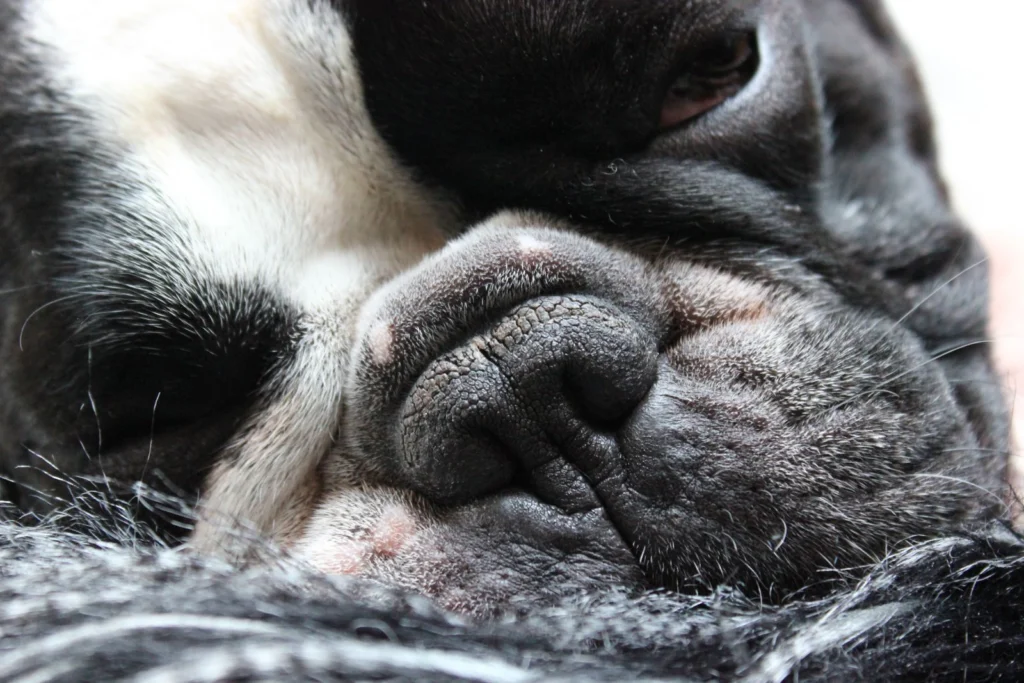
Dogs do not lick their noses while they sleep, so a dry nose after a nap is normal; the AKC says it usually turns moist again within about 10 minutes of waking. Short-snouted breeds often have difficulty licking their noses at all, which is one reason a Frenchie’s nose can look drier than a longer-nosed dog’s.
Weather, sun and indoor heating
Hot sun, wind and cold air can all dry the nose, and so can lying next to a heat vent or fireplace, which makes winter a common time for dryness. Moving your dog’s bed away from heaters can help (see also French Bulldogs in cold weather).
Age
Older dogs may simply develop drier noses. Mention it at your dog’s next checkup, especially if it comes with crusting or cracking.
Allergies
Allergies are another possible cause. If nose changes come with itching, paw licking, ear problems or red skin, read our guide to French Bulldog allergies and talk to your vet.
Dry nose remedies: safe home care
- Keep fresh water available, especially after exercise.
- Move beds away from heaters and fireplaces.
- Ask your vet before using any balm. Dogs lick their noses often, so anything applied should be safe to swallow. A dog-specific nose balm may help chronic dryness; your vet can suggest a suitable one.
- Skip human lip balms, sunscreens and medicated creams unless your vet has approved them.
- Don’t scrub or peel crusts.
Nasal hyperkeratosis in French Bulldogs
A thick, rough, hard crust on top of the nose may be nasal hyperkeratosis: a buildup of excess keratin, the tough protein in the outer skin. A 2025 pilot study in Veterinary Sciences calls it common in dogs, particularly brachycephalic (flat-faced) breeds. French Bulldogs made up 12 of the 20 dogs in that small treatment study, and were also the largest group in an earlier trial the authors cite, though a treatment study on its own can’t show how often the breed is affected. (The study was funded by the maker of the balm it tested.)
In a 2021 Swedish owner survey published in Veterinary Record Open, owners reported nasal hyperkeratosis in 55% (22 of 40) of the brachycephalic dogs in the control group versus 9.5% of non-brachycephalic dogs, and the flat-faced dogs showed signs younger (median 2 versus 6 years). The authors suggest short-faced anatomy may play a role, but the link has not been well documented and the cause is still poorly understood.
Typical signs include a dry, firm, rough and thickened area on the top of the nose, with brownish to grayish crusts that stick firmly. Mild cases can be mostly cosmetic, but it can progress to painful cracks (fissures) or raw areas that let infection in. Your vet will want to rule out other causes, such as infection or autoimmune disease, first. Care usually focuses on keeping the nose soft and comfortable, often with a moisturizing balm your vet recommends. Don’t pick at the crusts.
Sunburn on pale noses
Frenchies with pink or partly unpigmented noses are more vulnerable to sun damage. In nasal solar dermatitis, the Merck Veterinary Manual says the nonpigmented areas around the nostrils are affected first, with changes worse in summer. The ASPCA notes that light-colored pets are prone to skin cancer from the sun on areas such as the nose and ear tips.
The simplest protection is limiting time in strong midday sun. Don’t assume a human sunscreen is safe for dogs: the ASPCA warns that repeated exposure to zinc oxide on the skin can lead to zinc toxicity that damages red blood cells. Ask your vet whether your dog needs sun protection and which product to use.
Autoimmune conditions that affect the nose
Less commonly, a crusty or changing nose signals an immune-mediated skin disease, where the immune system attacks the skin.
- Discoid (cutaneous) lupus: crusting that usually starts around the nose, lighter (depigmented) patches, ulcers, and loss of the nose’s bumpy, cobblestone-like texture. UV light appears to make it worse.
- Pemphigus foliaceus: crusts and ulcers around the eyes, ears, footpads, groin and bridge of the nose, usually appearing suddenly.
These cannot be diagnosed by looks alone; a small skin biopsy, sometimes under sedation or anesthesia, is needed to confirm the cause.
| What you see | Possible cause | What to do |
|---|---|---|
| Dry after naps, moist again soon after waking | Normal sleep dryness | Nothing; just keep an eye on it |
| Thick, hard crust on top of the nose | Nasal hyperkeratosis | Vet check; ask about a dog-safe balm |
| Red or peeling pink areas, worse in summer | Sun damage | Limit midday sun; ask your vet about protection |
| Color loss, smooth surface, sores or ulcers | Possible autoimmune disease | Book a vet appointment |
When to see a vet
Book a vet visit if you notice:
- Cracks, bleeding, open sores or ulcers on the nose
- Loss of color, or the nose turning smooth and shiny instead of textured
- Crusts that keep thickening or spread to the muzzle, eyes or ears
- Thick, colored or bloody nasal discharge
- A dry nose together with lethargy, vomiting, diarrhea, appetite changes, or very dry or tacky gums
- Pawing at the nose, or dryness that does not improve
Bright red-purple or pale bluish gums need urgent attention.
Nose leather vs. nose fold vs. nostrils
The nose leather (the hairless tip) is what this article covers. The nose fold or nose rope above it is a skin wrinkle that needs regular cleaning and thorough drying; see our skin fold care guide. Keep fold cleansers off the nose leather unless your vet says otherwise.
The nostrils are separate again. Narrow, pinched nostrils (stenotic nares) affect breathing, not nose moisture, and are part of BOAS. Noisy or labored breathing deserves its own vet check.
Vet note: A dry nose in a Frenchie who is eating, drinking and behaving normally is rarely urgent. Changes in color, texture or comfort are what matter. Photos taken over a few weeks can help you show your vet how the nose has changed.
FAQ
Why is my Frenchie’s nose dry when he wakes up?
Dogs don’t lick their noses while sleeping, so dryness after sleep is normal. It usually becomes moist again within about 10 minutes of waking.
Can I put human lip balm on my French Bulldog’s nose?
Ask your vet first. Whatever goes on the nose gets licked and swallowed, so your vet can recommend a dog-safe option.
Is a crusty nose on my Frenchie serious?
Often it is nasal hyperkeratosis, which can be mostly cosmetic in mild cases but can progress to painful cracks. Have your vet check it to rule out infection or autoimmune disease, and don’t pick at the crusts.
Why is my French Bulldog’s nose turning pink?
Some noses lighten naturally, but loss of pigment can also be a sign of discoid lupus or other conditions, especially if the surface looks smooth or has sores. Have your vet take a look.
Sources
- Why Is My Dog’s Nose Dry? — American Kennel Club
- Evaluation of the Interest in and Tolerance of a Topical Emollient in the Management of Canine Nasal Hyperkeratosis: An Open-Label, Prospective, Uncontrolled Pilot Study — Veterinary Sciences (2025)
- Nasal hyperkeratosis in Griffon breeds: Clinical, histopathological features and the prevalence in the Swedish population compared to a control group and other brachycephalic breeds — Veterinary Record Open (2021)
- Nasal Dermatoses in Dogs — Merck Veterinary Manual
- Discoid (Cutaneous) Lupus Erythematosus and Autoimmune Skin Disease in Dogs — VCA Animal Hospitals
- Pets and Sunscreen: Don’t Get Burned by the Myths! — ASPCA