
As fall turns colder across much of the US, it is worth thinking about how your Frenchie handles the chill. French Bulldog cold weather care matters more than many owners expect: this is a small dog with a short, smooth coat and very little natural insulation, so a damp, windy walk that feels brisk to you can leave your dog genuinely cold. The good news is that a few simple habits keep winter safe and comfortable, from a well-fitted coat to clean paws and a warm, draft-free bed.
Key takeaways
- Frenchies have a short, smooth coat, so many feel the cold quickly, especially when wet or in wind.
- Shorter, more frequent winter walks are safer than one long outing in freezing weather.
- A coat or sweater should fit snugly but never press on the throat, cover the face or restrict breathing.
- Wipe paws and belly after every walk to remove ice-melt salt and other chemicals.
- Antifreeze is deadly in small amounts: clean up spills and call a vet or poison line at once if you suspect a lick.
Why French Bulldogs feel the cold
The French Bull Dog Club of America breed standard describes the coat as “brilliant, short and smooth.” That sleek coat traps very little warm air. The American Kennel Club notes that small dogs, puppies, seniors and short-coated dogs lose body heat faster than others, and many Frenchies tick more than one of those boxes.
Moisture and wind make things worse. VCA Animal Hospitals explains that wet or damp dogs are more vulnerable to cold injury, and the Merck Veterinary Manual notes that frostbite is most likely in wet or windy conditions.
How cold is too cold for a French Bulldog?
There is no single outdoor temperature that is “safe” for every Frenchie, and the veterinary sources we reviewed do not give one. Wind, wet fur, sun, how active your dog is and their age and health all change the picture. VCA notes that below freezing (32°F) the body narrows blood vessels near the skin to protect its core, which is why paws, ear tips and the tail are the areas most at risk in prolonged cold.
So the most reliable guide is your own dog. Plan for extra caution once it feels cold to you, keep outings short in freezing, wet or windy weather, and head home as soon as your Frenchie shows signs of being uncomfortable. The same principle applies to our French Bulldog heat safety advice: watch your dog, not just the thermometer.
Signs your Frenchie is too cold
Early signs that your dog wants to go inside include:
- Shivering or trembling
- Curling up tightly or trying to burrow into blankets
- Slowing down, stopping or refusing to keep walking
- Lifting paws off cold ground or seeming reluctant to put them down
Shivering is a useful early clue, but do not rely on it alone (for other reasons a Frenchie may tremble, see why a French Bulldog might be shaking). The Merck Veterinary Manual warns that shivering is not a reliable sign of hypothermia, so a dog who is not shivering can still be dangerously cold.
Hypothermia
Hypothermia means the body’s core temperature has dropped too low. The AKC describes mild hypothermia as a body temperature between 90°F and 99°F, moderate as 82°F to 90°F and severe as below 82°F. Merck lists weakness or disorientation, shallow breathing and a slow pulse, with collapse and unconsciousness in severe cases.
Frostbite
Frostbite is damage to the skin and tissue from extreme cold, and it usually affects the ear tips, paws and tail. VCA lists these signs:
- Pale, gray or bluish skin
- Skin that feels cold, brittle or painful to the touch
- Swelling, blisters or skin ulcers
- Licking or chewing at the area
- Blackened or dead skin in severe cases
Signs can take several days to appear, especially on the tail tip or ears.
What to do if your dog gets too cold
If you suspect hypothermia or frostbite, call your vet straight away. While you arrange care, these first-aid steps come from VCA and Merck:
| Do | Don’t |
|---|---|
| Move your dog somewhere warm and dry | Rub or massage frostbitten areas |
| Dry a wet dog first, then wrap in warm, dry towels or blankets | Use a heating pad, hair dryer or other direct dry heat |
| Place towel-wrapped warm (not hot) water bottles near the body | Apply snow or very hot water |
| Warm frostbitten areas gently in water that feels comfortable to your hand | Warm an area outdoors if it may refreeze |
| Keep your dog warm on the way to the clinic | Give any human pain reliever, which can be toxic to dogs |
VCA advises treating hypothermia first, and slowly: gentle, gradual warming is safer than fast heat.
Coats and sweaters: fit matters more than thickness
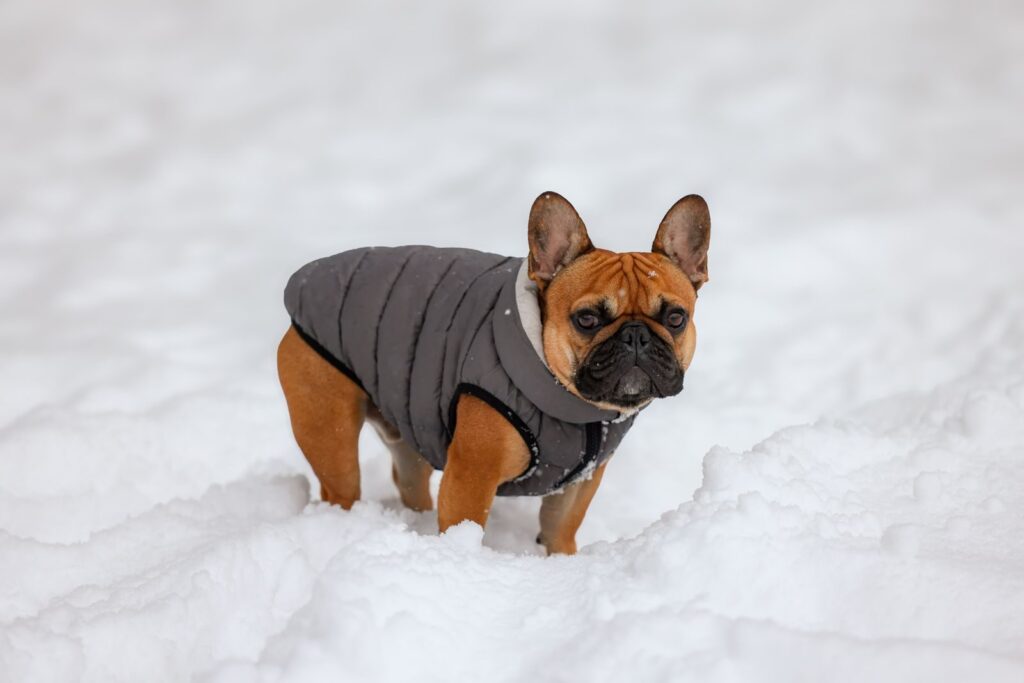
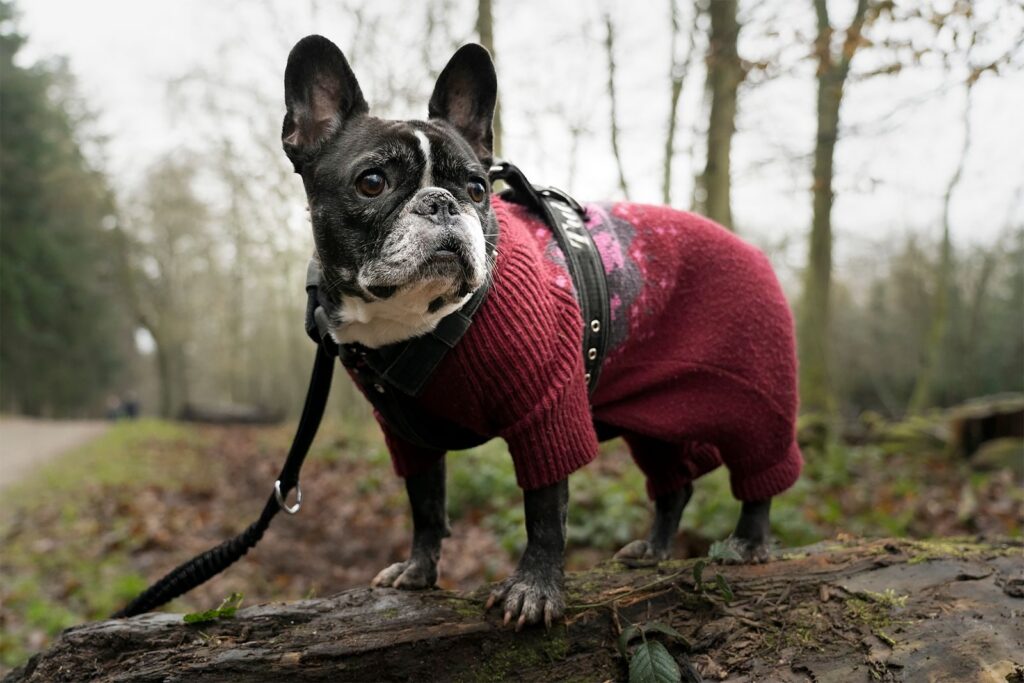
A coat or sweater is a sensible winter tool for a short-coated breed. The ASPCA suggests that short-haired dogs may benefit from a coat or sweater with a high collar that covers from the base of the tail to the belly. The AKC adds that clothing supplements good care but does not replace it, and should never be left on an unattended dog.
For a Frenchie, fit needs a little extra thought:
- Keep the throat and face clear. A high collar should sit loosely around the neck. Never use scarves, hoods or snoods that cover the nose or mouth.
- Check the chest. Frenchies have deep, broad chests. A coat that is tight across the chest can make breathing harder. You should be able to slide two fingers under the straps.
- Watch your dog’s breathing. Cold weather does not change a Frenchie’s flat-faced airway. If your dog breathes more noisily or seems to struggle in a coat, it is too tight or too heavy.
- Choose a harness, not a collar, for the leash. Many winter coats have an opening for a harness clip. Our harness guide explains why a well-fitted harness is kinder to a Frenchie’s neck and airway.
- Take it off indoors, and swap a damp coat for a dry one.
French Bulldog cold weather walks: shorter and more often
Your Frenchie still needs daily exercise in winter. Merck notes that walks matter for a dog’s overall health and advises getting pets outside even as temperatures drop, while adjusting walk times. In practice that usually means:
- Several short walks instead of one long one
- Walking in the warmest part of the day
- Keeping your dog on a leash near snow and ice. The ASPCA notes dogs can lose their scent in snow and get lost more easily
- An ID tag and a thorough towel-dry when you get home
Paws, ice melt and antifreeze
Winter is hard on paws. Ice, packed snow and de-icing salt can crack pads and irritate the skin between the toes. The ASPCA recommends a vet-approved paw protectant or booties before walks, then washing and drying the feet and belly afterward and checking for cracked pads or redness. For a full routine, see our French Bulldog paw care guide.
Wiping paws is about more than comfort. Merck warns that dogs who lick rock salt off their paws can be poisoned, with vomiting within several hours that can progress to weakness, diarrhea, muscle tremors and seizures. The ASPCA suggests pet-friendly ice melts for your own steps and yard.
Antifreeze is a true emergency. Many antifreeze products contain ethylene glycol, which Merck describes as sweet-tasting with a small lethal dose: roughly 3 to 4 teaspoons for a dog. Pet Poison Helpline warns that even small amounts can be fatal if treatment is delayed, and that it can turn up in leaking cars, garages and winterized RV plumbing. Merck lists clumsiness and excess thirst and urination among the signs.
- Store antifreeze sealed and out of reach, and clean up spills immediately.
- The ASPCA suggests choosing products made with propylene glycol rather than ethylene glycol.
- If you think your dog licked any, do not wait for symptoms. Call your vet, the ASPCA Animal Poison Control Center at (888) 426-4435 or Pet Poison Helpline at (855) 764-7661 right away.
Never leave your Frenchie in a cold car
The ASPCA warns that a car in cold weather can act like a refrigerator, holding in the cold, and a pet left alone inside can freeze to death. If your dog cannot come in with you, leave them at home.
Indoor exercise on bad-weather days
When it is icy, sleeting or bitterly cold, a short potty trip plus indoor activity is often the best plan. Good options include:
- Sniffing games: hide treats around a room and let your dog search
- Puzzle feeders and snuffle mats
- Short positive-reinforcement training sessions to practice cues or teach a new trick
Our French Bulldog exercise needs guide has more ideas. Count treats toward daily calories so winter does not bring weight gain.
Dry skin and a warm home
Heated indoor air can leave skin dry and itchy. The ASPCA suggests running a humidifier, towel-drying your dog well after time outside and limiting baths, since frequent washing strips natural oils. If a bath is needed, ask your vet about a moisturizing shampoo. Keep fresh water available at all times.
A warm, draft-free bed raised slightly off the floor, with a blanket your Frenchie can burrow into, makes a big difference. Keep space heaters and fireplaces guarded so a curious dog cannot get too close.
The ASPCA notes that pets burn extra energy staying warm, but a Frenchie walking less in winter may not need more food. Ask your vet before changing portions.
Vet note: Call your vet promptly if your Frenchie seems weak, confused or unusually sleepy after being in the cold, has pale, gray or blackened skin on the ears, paws or tail, or may have licked antifreeze or ice melt. With antifreeze, get help before signs appear. VCA notes that dogs with heart disease, diabetes or poor circulation are at higher risk of frostbite, so ask your vet about winter care for seniors and dogs with health conditions.
FAQ
Does my French Bulldog need a coat in winter?
Many do. With a short, smooth coat, Frenchies have little natural protection from cold, wind and wet. A well-fitted coat or sweater that keeps the throat clear, does not squeeze the chest and comes off indoors is a good idea for cold-weather walks.
Is it normal for my Frenchie to shiver outside?
Shivering is a common sign that your dog is cold and ready to go in. Head home and dry them off. Do not rely on shivering alone, though: Merck notes it is not a reliable sign of hypothermia, so also watch for weakness, slowing down or confusion.
Is road salt dangerous for my dog?
It can be. Salt can irritate paws and make dogs ill if licked off. Wipe paws after walks and call your vet if your dog vomits or seems unwell.
Sources
- Cold Weather Safety Tips — ASPCA
- Frostbite in Dogs — VCA Animal Hospitals
- Keeping Pets Safe During Cold Winter Months — Merck Veterinary Manual
- What to Do in a Dog or Cat Emergency — Merck Veterinary Manual
- Hypothermia in Dogs: How Cold Is Too Cold? — American Kennel Club
- Antifreeze Is Toxic To Dogs — Pet Poison Helpline