
French Bulldog teeth are packed into a very short jaw, so plaque has more corners to hide in and daily care matters. This guide covers why flat-faced dogs have dental quirks, the signs of gum disease, how to brush step by step and when a professional cleaning is needed.
Quick answer: Brush your French Bulldog’s teeth daily with dog toothpaste, or at least three times a week, focusing on the outer surfaces along the gumline. Never use human toothpaste. See your vet if you notice bad breath, red or bleeding gums, brown tartar, a broken or discolored tooth, facial swelling, or your dog dropping food or refusing to chew.
Key takeaways
- A short jaw can mean crowded or rotated teeth, which trap plaque and may need a vet’s attention.
- Gingivitis can be reversed with proper cleaning; periodontitis causes permanent loss of tooth support.
- Daily brushing with dog toothpaste is the best home care. Human toothpaste is not safe to swallow.
- Skip antlers, hooves, real bones and hard nylon toys: they can break teeth.
- Real cleaning below the gumline needs anesthesia; anesthesia-free scraping is not recommended.
Common French Bulldog teeth problems: crowding, rotation and bite
Dogs of every face shape have the same number of adult teeth, but a brachycephalic (flat-faced) skull gives them much less room. The Merck Veterinary Manual notes that significantly rotated teeth are often found in flat-faced breeds and are usually removed, and that crowded teeth are treated by extracting one or more of them. Some teeth never erupt because they sit in the wrong position, and these hidden teeth can form cysts that damage the jaw.
Bite problems are another factor. According to a 2024 study in the American Journal of Veterinary Research that screened tooth photographs of 1,096 dogs, brachycephalic dogs had higher odds of malocclusion (odds ratio 1.93) and missing teeth (odds ratio 3.63) than dogs with longer muzzles.
What the VetCompass data shows
Large-scale vet records tell a less obvious story. A VetCompass study of UK primary-care records from 2016 (O’Neill et al., 2021, Canine Medicine and Genetics) found dental disorders recorded in 2.3% of French Bulldogs compared with 14.3% of other dogs, and periodontal disease in 1.6% versus 12.8%. After the researchers adjusted for age and other factors, French Bulldogs still had about 70% lower odds of a recorded dental disorder (adjusted odds ratio 0.30).
That is a real finding, but it is not proof that Frenchies have “good teeth.” The study counted diagnoses written in vet records during a single year, and the French Bulldogs were much younger (median age about 1.5 years versus about 4.5 for other dogs). Merck notes that periodontitis usually begins at around 4 to 6 years of age, so most of these dogs had not yet reached the age when gum disease typically appears. The authors also caution that some confounding may remain after adjustment and that results for individual disorders should be treated as hypothesis-generating. Whatever the records show at a young age, the crowded, rotated teeth described above still trap plaque, so a Frenchie’s mouth needs daily care as the dog gets older.
Periodontal disease: what it is and the signs
Plaque is a soft film of bacteria that forms on teeth constantly. If it isn’t removed, it hardens into tartar and inflames the gums. Merck describes two stages:
- Gingivitis: inflammation of the gums only. Gums turn red or purple, the edges swell and bleed on contact, and breath smells bad. Gingivitis can be reversed with proper tooth cleaning.
- Periodontitis: infection that reaches the ligaments and bone holding the tooth. It is irreversible and causes permanent loss of tooth support, and it usually starts at around 4 to 6 years of age.
Watch for these signs, and book a dental check if you see any of them:
| Sign | What it may mean |
|---|---|
| Persistent bad breath | Plaque, tartar or gum infection |
| Brown or yellow build-up along the gumline | Tartar that brushing can no longer remove |
| Red, swollen or bleeding gums | Gingivitis |
| Dropping food, chewing on one side, avoiding hard treats | Mouth pain, a loose or broken tooth |
| Pawing at the mouth or not wanting the face touched | Oral pain |
| A reddish-brown, purple or gray tooth | Damage inside the tooth, which can follow an injury or fracture |
| Facial swelling | Possible tooth root abscess; see your vet promptly |
Many dogs hide dental pain and keep eating. If you’re unsure whether your dog is hurting, our guide to signs a French Bulldog is in pain can help.
How to clean French Bulldog teeth, step by step
Daily brushing is the best way to keep plaque off the teeth. VCA Animal Hospitals gives three times a week as the minimum to help control plaque and tartar. Merck puts it simply: gum disease will not develop around clean teeth.
What you need
- Dog toothpaste only. Human toothpaste is not made to be swallowed and can upset the stomach; some contain high sodium or xylitol, which is toxic to dogs.
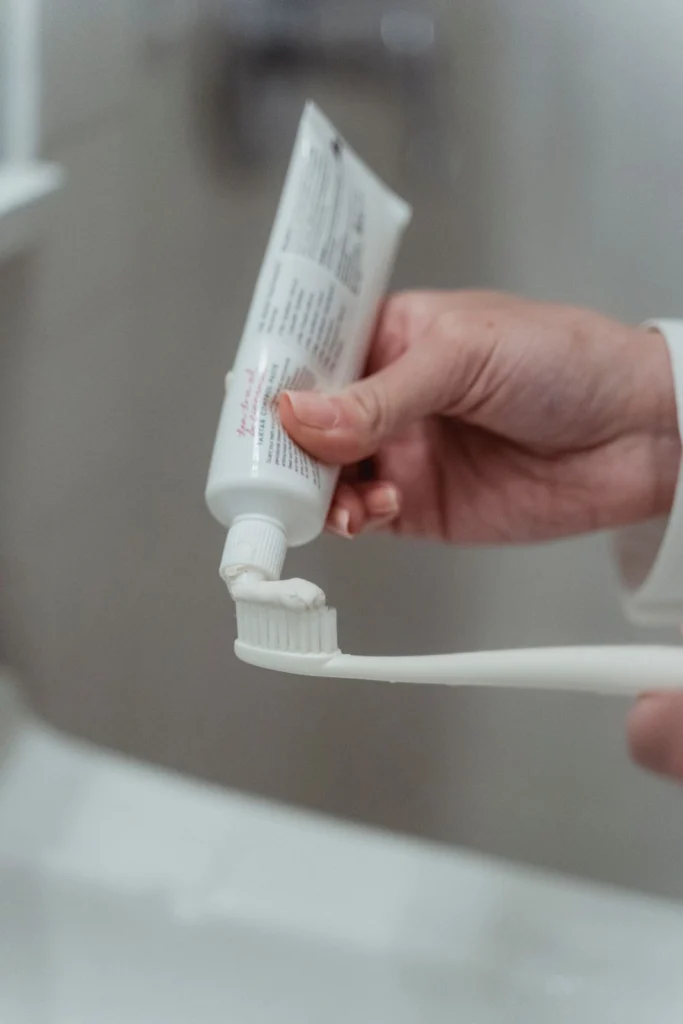
- A small, soft brush. A finger brush is often easiest to start with. A soft toothbrush made for human babies or a small angled-handle brush also works well in a Frenchie’s compact mouth.
- Small, tasty rewards and a calm moment.
Build up slowly with rewards
- Taste first. Let your dog lick a little dog toothpaste off your finger. Praise and reward.
- Touch the lips. Over a few days, gently lift the lip for a second or two, then reward. Stop before your dog pulls away.
- Finger or cloth on the teeth. Rub a fingertip or soft cloth with paste along the outer surfaces of a few teeth, using a gentle back-and-forth motion along the gumline.
- Add the brush. Once your dog is relaxed, switch to the brush. Start with the big cheek teeth and canines, where plaque builds up fastest, then work toward the rest.
- Focus on the outside. The outer surfaces are where most periodontal damage happens; the tongue clears much of the inner surface. Aim for about 30 seconds per side.
- End on a good note with praise or a reward.
Keep sessions short and never hold your dog down. If your Frenchie struggles, go back a step for a few days. If your dog won’t accept a brush at all, Merck suggests wiping the teeth with gauze every 2 to 3 days as a fallback. Starting gently in puppyhood makes this much easier; see French Bulldog puppy teething for what’s normal while adult teeth come in.
Dental chews, toys and toothpaste: what helps and what doesn’t
| Helps | Use with caution or avoid |
|---|---|
| Daily brushing with dog toothpaste | Human toothpaste or baking soda |
| Products accepted by the Veterinary Oral Health Council (VOHC), whose seal means they have been tested to reduce plaque or tartar | Antlers, hooves, real bones and hard nylon toys, which commonly fracture teeth |
| Dental diets, chews or water additives your vet recommends, as extras | Chomping on ice cubes (licking or chasing them is fine) |
| Chews sized for a small dog that you can dent with a fingernail | Relying on chews alone instead of brushing |
Cornell’s Riney Canine Health Center notes that most veterinary dentists go by a simple “thumbnail test”: if you can’t press a dent into a chew with your fingernail, it is too hard. Pick sizes made for small dogs and supervise chewing. Signs of a fractured tooth include sensitivity to cold water, reluctance to chew, or walking up to the bowl and then leaving without eating.
Professional cleaning under anesthesia
Once tartar forms, brushing can’t remove it. A proper dental cleaning is done under general anesthesia so the vet can examine each tooth, probe for pockets around the gums, take dental X-rays, scale off tartar above and below the gumline, and polish the teeth. Below the gumline is where periodontal disease is most active, and in a crowded Frenchie mouth, dental X-rays are needed to see roots and unerupted teeth hidden below the gumline.
Many owners worry about anesthesia in a flat-faced breed. That concern is reasonable, and it’s worth asking your vet how they manage the airway before, during and after the procedure. Our guide to French Bulldog anesthesia and surgery explains what to ask and how to prepare.
Why anesthesia-free cleaning isn’t recommended
The American Veterinary Dental College (AVDC) advises owners against anesthesia-free dental cleaning for pets. Scraping visible tartar off an awake dog leaves the plaque and bacteria below the gumline untreated, it does not allow X-rays or a full oral exam, and restraint can be stressful and painful. The AVDC adds that whiter-looking teeth can give owners a false sense of security.
Vet note: Ask your vet to look in your Frenchie’s mouth at every checkup, including puppy visits, so crowded, rotated or missing teeth are noted early. A broken tooth, a discolored tooth, facial swelling, or a dog who suddenly won’t chew needs a vet visit soon, not just more brushing. Your vet can advise on pain relief and treatment.
FAQ
How often should I brush my French Bulldog’s teeth?
Daily is best. If that isn’t realistic, aim for at least three times a week, which VCA gives as the minimum to help control plaque and tartar.
Can I use human toothpaste on my Frenchie?
No. Human toothpaste isn’t designed to be swallowed, and some products contain xylitol, which is toxic to dogs. Use a toothpaste made for dogs.
Are dental chews enough on their own?
No. Chews and other VOHC-accepted products can help as extras, but they don’t replace brushing.
Is it normal for my French Bulldog to have crooked teeth?
Crowded or rotated teeth are common in flat-faced breeds. Your vet can tell you whether any need treatment, which sometimes means extraction.
How do I know if my Frenchie needs a dental cleaning?
Visible tartar along the gumline, red or bleeding gums, persistent bad breath, or signs of mouth pain all mean it’s time for a vet exam. Your vet will recommend a cleaning under anesthesia if needed.
Sources
- Dental Disorders of Dogs — Merck Veterinary Manual
- French Bulldogs differ to other dogs in the UK in propensity for many common disorders: a VetCompass study — Canine Medicine and Genetics (O’Neill et al., 2021)
- Initial screening for dental abnormalities identified by labial and buccal photographs in dogs and cats — American Journal of Veterinary Research (Ryu et al., 2024)
- Brushing Your Dog’s Teeth — VCA Animal Hospitals
- Risks from a fractured tooth — Cornell University College of Veterinary Medicine
- Reasons not to Choose Anesthesia Free Dentals for Your Pet — American Veterinary Dental College