
When do French Bulldog ears stand up? There is no fixed age, and the honest answer is that it varies from puppy to puppy. Here is what the breed standard asks for, which floppy-ear situations are normal, why home taping is a bad idea and which ear changes need a vet.
Quick answer: French Bulldog ears stand up on no set timetable, and none of the veterinary or breed-club sources used here gives an age. Ear type is largely inherited. Let soft or uneven ears develop on their own, don’t tape or glue them at home, and see a vet for swelling, lumps, pain, discharge or head shaking.
Key takeaways
- No vet or breed-club source gives an age for Frenchie ears to stand. Timing varies from puppy to puppy.
- The breed standard calls for erect “bat ears”, but that is a show standard, not a health requirement.
- Ear type is largely genetic, so the parents’ ears tell you more than any age chart.
- Don’t tape or glue ears at home. If you are worried about ear carriage, ask your vet first.
- Swelling, lumps, pain, discharge, a bad smell or constant head shaking need a vet visit.
When do French Bulldog ears stand up?
Many websites give a confident window in weeks or months, but those figures come from breeder and shop pages, not veterinary references. The official breed standard describes the adult ear in detail but says nothing about when a puppy’s ears should get there. The MSD Veterinary Manual’s guide to ear structure doesn’t give a timeline either. The accurate answer is that timing varies.
What that means in practice:
- A young puppy’s ears may be soft, folded or tipped. On their own, soft or tipped ears in a young puppy are not one of the warning signs the veterinary sources here list.
- Uneven ears aren’t on that list either. If one ear lifts before the other and both look healthy, keep watching.
- Some dogs keep ears that never stand fully erect. Ear carriage is largely inherited, so this can happen even with good care.
Hearing is a separate milestone. Our French Bulldog puppy growth milestones guide covers when a puppy’s ear canals open and hearing begins. Whether the ear flap stands or folds is a different question.
Rather than counting weeks, take a front-on photo of your puppy’s head every couple of weeks and bring the photos to routine puppy checks.
What “bat ears” means in the breed standard
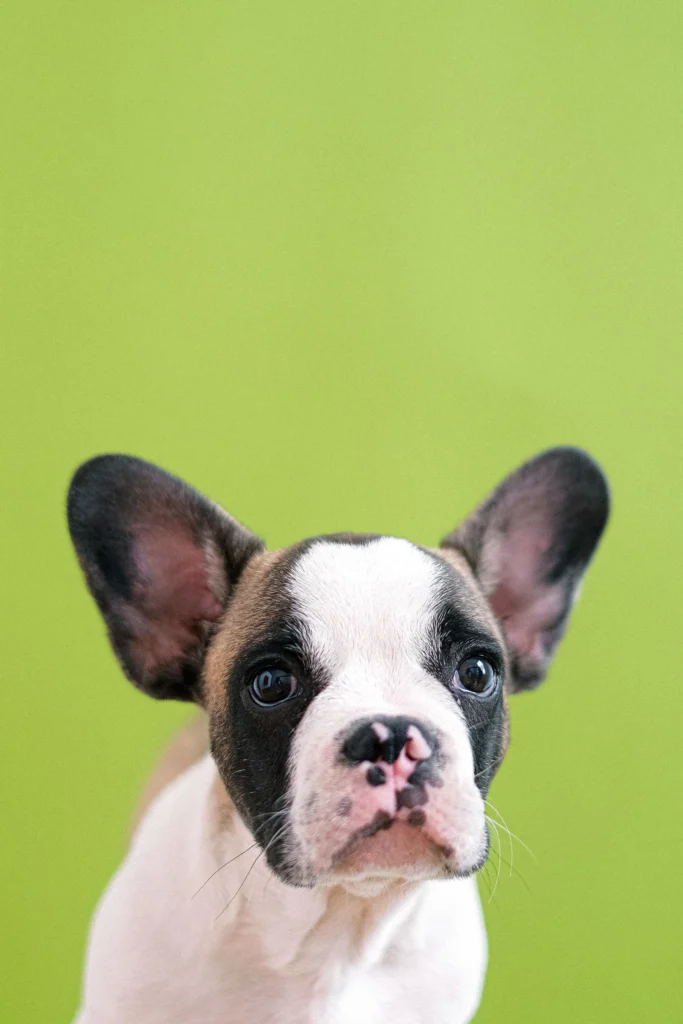
The American Kennel Club’s official French Bulldog standard, approved in 2018, names “the square head with bat ears and the roach back” as hallmarks of the breed. It describes the ear like this: “Known as the bat ear, broad at the base, elongated, with round top, set high on the head but not too close together, and carried erect with the orifice to the front. The leather of the ear fine and soft.” “Leather” here means the ear flap itself. The standard lists “other than bat ears” as a disqualification in the show ring.
Judges’ education material from the French Bull Dog Club of America (FBDCA) adds some useful context:
- The breed originally had both rose ears and bat ears. European fanciers preferred the rose ear, and American fanciers preferred the bat ear.
- The FBDCA was formed in 1897 and wrote the first standard, with the bat ear as the only acceptable ear.
- Judges are told that ears should sit at about “11 and 1 o’clock”, that “ears are expressive”, and not to penalize a dog “for failure to use ears at all times.”
That last point matters for owners. Even in a show dog, ears that relax or move around are part of normal expression. The standard describes the ideal for judging; it is not a health checklist. A pet Frenchie whose ears don’t match the standard is not unhealthy for that reason alone.
How a puppy’s ear is built
The MSD Veterinary Manual describes the outer ear flap, or pinna, as “the flap of cartilage covered by skin and hair.” It catches sound and channels it down the ear canal to the eardrum. The size and shape of the pinna vary by breed, and dogs can move the left and right pinna independently.
Whether an ear stands or flops comes down to genetics more than anything an owner does. A 2010 genetic study summarized in PLoS Biology found that, across dog breeds, one genomic region emerged as the likely source of ear type, from large erect ears to low-hanging floppy ones. The researchers reported that the modern variant in this region is nearly universal in floppy-eared dogs.
The study looked at many breeds and didn’t single out French Bulldogs, but the practical point applies: a puppy’s ear carriage is shaped largely by what they inherited. If you are still choosing a puppy, it is reasonable to ask the breeder about the parents’ ears. If your puppy is already home, the parents’ ears are a better guide than an age chart.
French Bulldog floppy ears or one ear up: what’s normal?
Ear carriage and ear health are separate questions. A soft, folded ear that looks clean, doesn’t smell and doesn’t bother your puppy is very different from an ear that is swollen, sore or itchy.
| What you notice | What it may mean | What to do |
|---|---|---|
| Both ears soft, folded or tipped in a young puppy, ears clean and not sore | Ear carriage is still forming; timing varies | Keep watching and mention it at the next routine check |
| One ear up and one down, both clean and not sore | Not listed as a warning sign in the vet sources here | Take photos over time and ask at the next routine check |
| Ear flap that suddenly looks thick, puffy or spongy | A hematoma, a fluid-filled swelling inside the flap, often after head shaking or scratching | See your vet promptly |
| Head shaking, scratching, a bad smell, discharge or redness | Possible ear infection | Book a vet visit; don’t clean a sore ear first |
| Sudden swelling of the face, or bumps or pustules on the face, muzzle or ears in a young puppy | Several causes are possible, including juvenile cellulitis | See your vet the same day |
| Red, sore skin on the inside of the ear flap after a product was put on it | Irritation from a product on the skin | Stop applying anything and call your vet |
| Painful, swollen, red or misshapen ear flaps, usually both sides | Several causes, including inflamed ear cartilage | See your vet |
The Merck Veterinary Manual explains that an untreated hematoma can heal as a thickened, wrinkled “cauliflower ear,” and it advises that any lumps on a young puppy’s face or ears should be checked by a vet. VCA Animal Hospitals notes that juvenile cellulitis usually affects puppies up to six months old. It often starts with sudden swelling of the face and muzzle, can involve swollen lymph nodes under the jaw, and may leave the puppy lethargic, off their food or feverish. Prompt treatment usually leads to full recovery.
If your Frenchie is an adult and their ears never stood up fully, that most likely reflects what they inherited. An ear that used to stand and now droops, or looks swollen, misshapen or painful, is a different matter and needs a vet check.
Should you tape or glue a French Bulldog puppy’s ears?
Search results are full of taping and gluing instructions, often from sites that sell the supplies. None of the veterinary or breed-club sources used for this article recommends home taping or gluing for French Bulldog puppies, and the breed standard says nothing about it.
There are good reasons to leave the ears alone:
- The ear flap is delicate. It is a flap of cartilage covered by skin. Tape and glue go straight onto that skin and have to be peeled off again.
- The inner ear skin can react. The Merck Veterinary Manual notes that even some ointments and medications can irritate the inner, hairless side of the ear flap, with reactions showing up one to seven days after treatment starts.
- Genetics sets the limit. If ear type is largely inherited, an ear without the build to stand may never hold itself up, however it is supported.
- It isn’t needed for a pet. Ear carriage matters in the show ring, not for a healthy companion dog.
If you are worried about how your puppy’s ears are developing, or a breeder suggests taping, talk to your vet before doing anything. Your vet can examine the ears and tell you whether any intervention makes sense.
Caring for your puppy’s ears while they develop
Whatever shape your puppy’s ears end up, good habits now make lifelong ear care easier:
- Make ear handling pleasant. Touch the ears briefly, then give a treat. Build up slowly to lifting the flap and looking inside.
- Do a weekly look-and-sniff check. Healthy ears look clean, without strong smell, redness or discharge.
- Clean only when needed. Use a dog ear cleaner your vet recommends, never cotton swabs in the canal, and never clean an ear that looks sore. Our French Bulldog ear infections guide walks through safe cleaning step by step.
- Fold ear checks into grooming. See the French Bulldog grooming guide for a weekly schedule.
- Don’t pinch, massage or fold the ears into shape. No vet source here recommends it, and it adds handling to a delicate flap.
You may also read that ears droop while a puppy is teething. None of the veterinary sources used here make that link, so treat it as anecdote. Our French Bulldog puppy teething guide covers what does happen as baby teeth give way to adult teeth.
Vet note: Ear shape alone is rarely urgent, but ear health is worth watching. See your vet promptly for a swollen or spongy ear flap, discharge, a bad smell, redness, pain when the ear is touched, or constant head shaking or scratching. Go the same day if a young puppy has sudden facial swelling or bumps on the face or ears, or seems lethargic, off their food or feverish. Ask before taping, gluing or applying anything to the ears.
FAQ
Why are my French Bulldog’s ears not standing up yet?
Timing varies, and no veterinary or breed-club source used here sets an age by which a Frenchie’s ears must stand. Ear type is largely inherited, so some dogs take longer and some never carry their ears fully erect. If the ears are clean and comfortable, keep watching and raise it at your puppy’s next routine check.
Is it normal for one ear to be up and one down?
Uneven ears in a healthy puppy aren’t listed as a warning sign in these sources. What matters more is whether either ear looks swollen, red, smelly or sore. If it does, or if an ear that was standing suddenly droops and looks puffy, see your vet.
Does a Frenchie with floppy ears mean the dog isn’t purebred?
Ear carriage alone can’t tell you that. The breed standard disqualifies ears other than bat ears in the show ring, but that is a judging rule. Registration papers and the breeder’s records, not ear shape, are how a dog’s pedigree is documented.
Can I tape my French Bulldog’s ears to make them stand?
Home taping or gluing isn’t recommended by any of the veterinary or breed-club sources here. The ear flap is cartilage covered by skin, and some products applied to the inner side of the flap can irritate it. If you are concerned about ear carriage, ask your vet before trying anything.
Sources
- Official Standard of the French Bulldog — American Kennel Club
- Judging the French Bulldog (judges’ education presentation) — French Bull Dog Club of America
- Ear Structure and Function in Dogs — MSD Veterinary Manual
- Disorders of the Outer Ear in Dogs — Merck Veterinary Manual
- Juvenile Cellulitis (Puppy Strangles) — VCA Animal Hospitals
- A Dog’s Eye View of Morphological Diversity — PLoS Biology, via PubMed Central