
Both are small, flat-faced, short-coated companions with upright ears, so it is no surprise that people mix them up on the sidewalk. Look closer, though, and the French Bulldog vs Boston Terrier comparison reveals real differences in build, coat markings, weight limits, energy and specific health risks. This guide compares them using American Kennel Club (AKC) breed standards, The Royal Kennel Club and UK veterinary research, without promoting either breed.
Key takeaways
- AKC standards cap Boston Terriers at 25 pounds and French Bulldogs at 28 pounds.
- Bostons must show white “tuxedo” markings; Frenchies have large bat ears and a heavier build.
- Both breeds are brachycephalic, so breathing problems and heat intolerance are shared risks.
- Prominent eyes make Bostons prone to injuries and ulcers; daily eye checks are advised.
- The AKC says some Bostons need daily time to run and play; Frenchies usually need only short walks.
French Bulldog vs Boston Terrier at a glance
The table below summarizes the main differences. Weight, ears, tail, coat, colors and temperament wording come from the AKC breed standards; size, exercise and lifespan categories come from The Royal Kennel Club.
| Feature | French Bulldog | Boston Terrier |
|---|---|---|
| Origin | Developed in France from small bulldogs taken there by Nottingham lace makers during the Industrial Revolution | Developed in Boston, USA, from a Bulldog and English White Terrier cross; first club founded in the 1890s |
| Size category (Royal Kennel Club) | Small | Small |
| Weight (AKC standard) | Must not exceed 28 lb; heavier dogs are disqualified | Three classes: under 15 lb, 15 to under 20 lb, and 20 to 25 lb |
| Build | Compact, muscular and heavy-boned, with a large square head and roach back | Short-backed and square, with leg length balancing body length; “blocky or chunky” is a fault |
| Ears | “Bat ears”: broad at the base, rounded at the top, carried erect | Small and erect, set near the corners of the skull |
| Tail | Short, hung low, straight or screwed (but not curly), thick at the root and fine at the tip | Short, set low, fine and tapering, straight or screw, not carried above the horizontal; a docked tail disqualifies |
| Coat | Brilliant, short and smooth | Short, smooth, bright and fine |
| Accepted colors (AKC) | White, cream or fawn (or combinations), with brindle, piebald, black mask, black shading and white markings allowed | Brindle, seal or black, always with white markings (muzzle band, blaze and forechest required) |
| Temperament (AKC standard) | Affectionate, even-tempered and adaptable; active, alert and playful but “not unduly boisterous” | Friendly and lively, with an “excellent disposition” and high intelligence |
| Exercise (Royal Kennel Club) | Up to 1 hour per day | Up to 1 hour per day |
| Lifespan | Royal Kennel Club: over 10 years; the AKC lists 10 to 12 years (UK veterinary studies suggest shorter lives; see the breed overview) | Royal Kennel Club: over 10 years; the AKC lists 11 to 13 years |
Origins: two branches of the bulldog family
The two breeds are related through the Bulldog. According to The Royal Kennel Club, the French Bulldog grew out of small bulldogs that Nottingham lace makers took to northern France during the Industrial Revolution, where a separate breed with large bat ears emerged and became fashionable in Paris. Our French Bulldog breed overview covers that history in more detail.
The Boston Terrier is an American breed. The AKC describes it as the result of a cross between an English Bulldog and a White English Terrier, later considerably inbred, and notes that fanciers first formed the “American Bull Terrier Club” in 1889 before changing the name in 1891. By the 1950s, it was America’s most popular breed. The AKC notes its nickname, “The American Gentleman.”

How to tell them apart
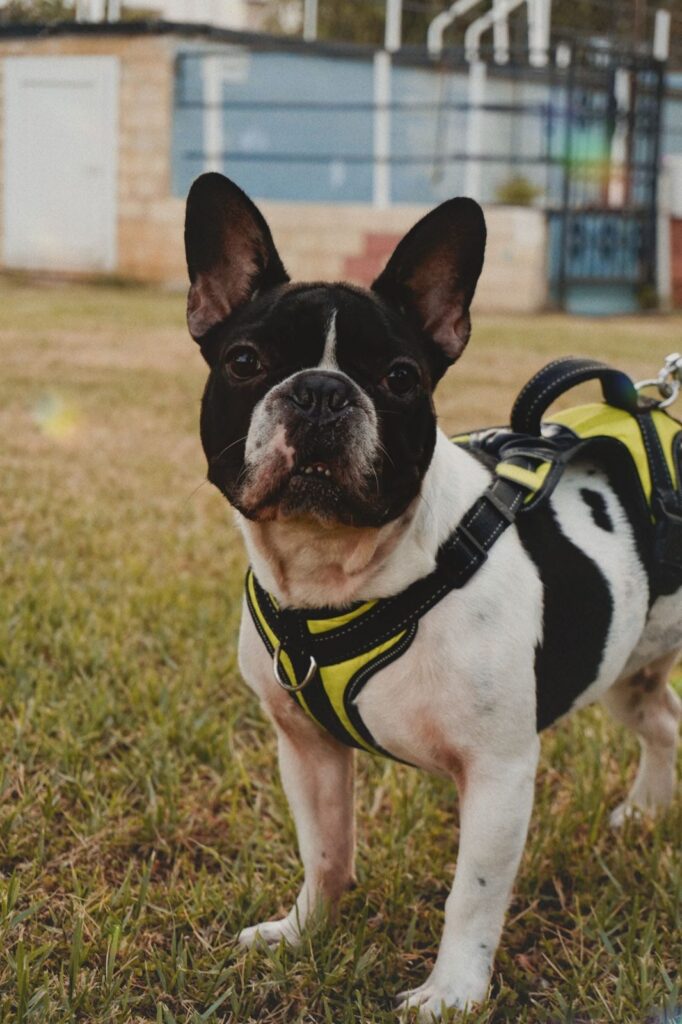
- Markings: The Boston’s “tuxedo” is part of its standard. The AKC requires a white muzzle band, a white blaze between the eyes and a white forechest, and disqualifies solid black, brindle or seal dogs without them. French Bulldogs come in fawn, cream, white and brindle, often with a black mask or pied patches, and the AKC disqualifies black and white as well as solid black.
- Ears: Both breeds have upright ears, but the French Bulldog’s bat ears are large, broad at the base and rounded at the tip. The Boston’s ears are small and sit toward the corners of the skull. Any ear other than a bat ear disqualifies a French Bulldog.
- Body shape: The French Bulldog is heavy-boned and muscular, with a slight arch over the loin (the roach back). The Boston has a square outline, with leg length balancing body length, and its standard warns against looking “blocky or chunky.”
- Face: The French Bulldog has heavy wrinkles forming a roll over its very short nose. The Boston standard asks for a skull and muzzle “free from wrinkles,” with large, round, wide-set eyes.
Temperament and energy
Both breeds are bred today as companions, and their AKC standards describe them in similarly warm terms (see the table above).
Energy is where many families notice a difference. The AKC says a short walk or outdoor play session each day usually keeps a French Bulldog in shape. For Bostons, it says needs vary: for some, a brisk walk once or twice a day is enough, while others need more time to run and play every day. It suggests sports such as agility, obedience, flyball and rally as an enjoyable way to channel the breed’s energy.
The Royal Kennel Club lists both breeds as needing up to an hour of exercise a day, and both are rated suitable for apartment living. Individual personality, early socialization and reward-based training matter more than breed labels.
Health: flat faces, different weak spots
Both breeds are brachycephalic, meaning they have a shortened skull and muzzle. The Royal Kennel Club warns that some flat-faced dogs have excess soft tissue in the nose and throat, making breathing difficult, a problem known as brachycephalic obstructive airway syndrome (BOAS). The AKC notes that, like all flat-faced breeds, Bostons can struggle to breathe in excessive heat or humidity, and that French Bulldogs do poorly in hot or humid weather. Neither breed should be exercised hard on warm days.
Boston Terrier: the eyes come first
The AKC states that protecting the Boston’s large, prominent eyes is “of special importance” and recommends checking them daily for redness or irritation. It says responsible breeders screen for eye problems such as cataracts, corneal ulcers and glaucoma, as well as deafness and patellar luxation (a kneecap that slips out of place). The Royal Kennel Club explains that brachycephalic dogs may have shallow eye sockets, leaving the eyes more prominent and at higher risk of trauma, ulcers and dryness.
French Bulldog: airway, skin, ears and spine
A large VetCompass study of UK French Bulldogs under veterinary care in 2016 found increased odds for 20 of 43 common disorders compared with other dogs. French Bulldogs had about 31 times the odds of BOAS, 42 times the odds of narrowed nostrils (stenotic nares), 14 times the odds of ear discharge and 11 times the odds of skin fold dermatitis. They also had about 4.4 times the odds of corneal ulceration, so eye care matters for Frenchies too; see our guide to French Bulldog eye problems. At a grouped level, they had about three times the odds of spinal cord disorders, and the authors note earlier reports of malformed vertebrae (hemivertebrae) in the breed.
The authors concluded that many of these problems are linked to the breed’s extreme body shape and called for breeding toward more moderate features. No equivalent breed-wide VetCompass study of Boston Terriers was found for this article, so the two breeds can’t be compared head to head on disease odds.
Health testing to ask about
Breed bodies recommend different screening for each breed, which reflects their different weak spots:
| Source | French Bulldog | Boston Terrier |
|---|---|---|
| The Royal Kennel Club: minimum (“Good Practice”) | BOAS breathing test (Respiratory Function Grading) | Eye testing under the BVA/KC/ISDS Eye Scheme |
| The Royal Kennel Club: additional (“Best Practice”) | DNA test for hereditary cataracts (HC-HSF4-2); elbow and hip dysplasia screening (BVA/KC schemes); eye testing (BVA/KC/ISDS Eye Scheme) | DNA test for hereditary cataracts (HC-HSF4); also a new BOAS breathing test (KC Respiratory Function Grading), recognized in August 2026, which will be added formally to the Health Standard from January 2027 |
| AKC breed pages (national breed club recommendations) | Patella evaluation, hip evaluation, cardiac exam, ophthalmologist evaluation | Patella evaluation, ophthalmologist evaluation, BAER hearing test |
Whichever breed you choose, ask to see test results for both parents. Our guide to choosing a French Bulldog breeder explains what to ask.
Which breed suits whom?
Neither breed is “better”; they suit different households.
- A Boston Terrier may suit you if you want a lighter, more athletic small dog that enjoys play, games and possibly dog sports. The AKC notes Bostons left alone for long periods tend to become frustrated. You’ll need to be diligent about eye care and avoid hard exercise in heat.
- A French Bulldog may suit you if you prefer a lower-key companion that is happy with short walks and plenty of time with its people. Be prepared for a breed with well-documented airway, skin, ear and spinal risks, and the vet costs that can follow.
In both cases, a cool home, a lean body condition, a harness rather than a collar for walks and a budget or insurance for specialist care are wise.
Vet note: In either breed, noisy breathing at rest, struggling with mild exercise or collapse is not “normal for the breed,” so ask your vet to assess the airway. A squinting, watering or cloudy eye can mean a corneal ulcer and should be seen by a vet the same day, because these can worsen quickly.
FAQ
Is a Boston Terrier a type of bulldog?
Not exactly. The Boston Terrier is its own breed, but it descends from a Bulldog and white terrier cross, and The Royal Kennel Club calls it the smallest of the bull breeds. That shared ancestry explains the resemblance to the French Bulldog.
Which is smaller, a French Bulldog or a Boston Terrier?
Boston Terriers are generally lighter. The AKC standard allows Bostons up to 25 pounds, split into three weight classes, while French Bulldogs must not exceed 28 pounds and are more heavily boned.
Can a French Bulldog have Boston Terrier markings?
A French Bulldog can have white markings, but black and white is a disqualifying color under the AKC French Bulldog standard. Black-and-white “tuxedo” markings are the hallmark of the Boston Terrier.
Which breed is healthier?
Neither can be called problem-free. Both are flat-faced breeds with breathing and heat risks. Bostons are especially known for eye problems, while UK veterinary data show French Bulldogs at high risk of airway, skin and ear disorders. Breeding, weight and care make a big difference for any individual dog.
Sources
- Official Standard of the Boston Terrier — American Kennel Club
- Official Standard of the French Bulldog — American Kennel Club
- Boston Terrier dog breed information — American Kennel Club
- French Bulldog dog breed information — American Kennel Club
- Boston Terrier breed information — The Royal Kennel Club
- French Bulldog breed information — The Royal Kennel Club
- French Bulldogs differ to other dogs in the UK in propensity for many common disorders: a VetCompass study — Canine Medicine and Genetics (Royal Veterinary College VetCompass), via PMC