
Choosing a muzzle for French Bulldogs takes more care than for most breeds. A flat face leaves little room for a muzzle to sit, and the wrong design can stop a Frenchie from panting, which is a dog’s main way to cool down and something flat-faced dogs already find harder than most.
Quick answer: The safest muzzle for a French Bulldog is a well-fitted basket style that lets your dog open their mouth fully, pant, drink and take treats. Avoid fabric or sleeve muzzles that hold the mouth shut. Keep wear short, never leave your dog alone in one, and ask your vet for fitting advice, because muzzles can worsen breathing problems in flat-faced breeds.
Key takeaways
- A muzzle can make vet visits, handling and scavenging-prone walks safer, but it never fixes the reason a dog bites.
- Fabric and sleeve muzzles that close the mouth stop panting. They are risky for flat-faced Frenchies.
- A safe Frenchie muzzle is a basket style that allows open-mouth panting, drinking and treats.
- Never leave a muzzled dog alone, and as a precaution, avoid muzzled outings in hot or humid weather.
- Teach muzzle wearing slowly with treats, in short sessions, before you ever need it.
When might a Frenchie need a muzzle?
Cornell University’s College of Veterinary Medicine points out that any dog may bite when in pain or handled by strangers, so muzzle training is worthwhile even for a friendly Frenchie. Common reasons include:
- Vet visits and handling by strangers. Cornell notes that a muzzle-trained dog can often be handled more gently, with less restraint.
- Scavenging. The PDSA and Cornell both list dogs that eat things they shouldn’t on walks.
- Nervous dogs and dogs with a high prey drive, both of which the PDSA lists.
- Legal requirements. The PDSA notes some dogs must legally wear one in public; rules vary, so check locally.
Basket vs. fabric muzzles: why closed styles are risky for flat faces
Dogs cool themselves mainly by panting. A Frenchie already does this inefficiently, because the shortened skull crowds the airway (explained in detail in our guide to BOAS and French Bulldog breathing problems). A muzzle that clamps the mouth shut takes away your dog’s main way to cool down.
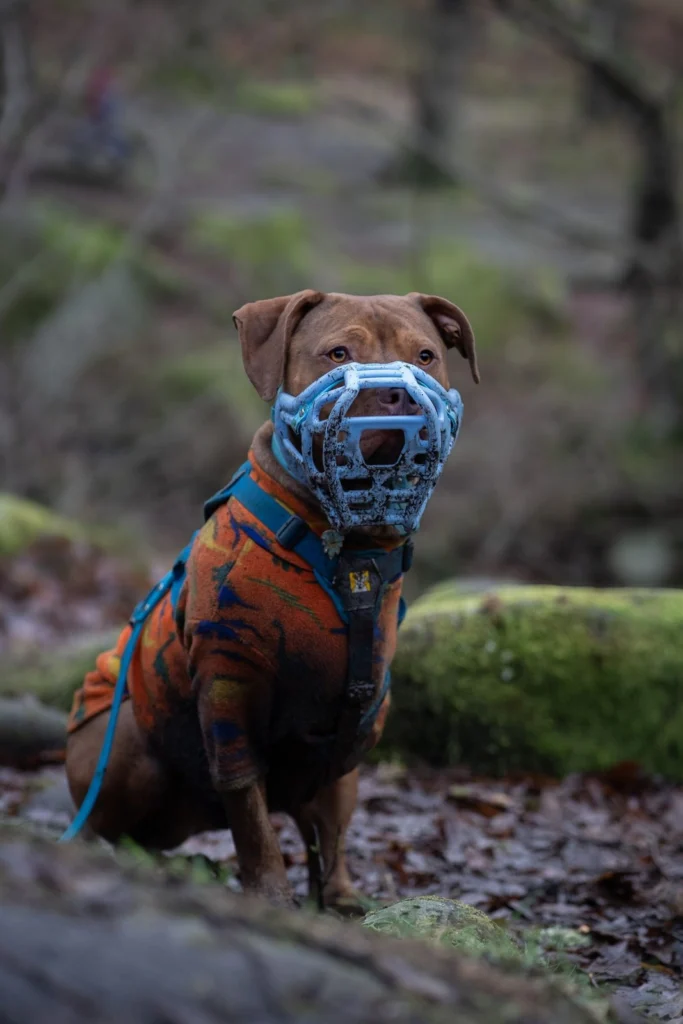
The PDSA says muzzles that hold the mouth closed should never be used for longer than a few minutes, because they restrict panting and drinking, and that longer use is likely to cause distress and can lead to life-threatening problems such as heatstroke. It also warns that you need to be very careful when muzzling flat-faced breeds, including French Bulldogs, because they often have breathing difficulties that a muzzle can make worse. Blue Cross is even more direct: a muzzle must let a dog breathe easily, open their mouth and pant, and drink, and fabric muzzles do not allow these, so they are not a safe option.
That rules out the soft nylon sleeve style, which Cornell calls not appropriate for most situations.
Choosing a muzzle for French Bulldogs: what it must allow
A good brachycephalic muzzle is defined by function, not a label. Check any option against this list:
| Must allow or have | Why it matters |
|---|---|
| Full open-mouth panting | Panting is how dogs shed heat; a closed mouth raises heatstroke risk. |
| Drinking water | Blue Cross and the PDSA list drinking as a basic requirement. |
| Taking treats through the front or sides | Essential for training and for keeping the experience positive. |
| A shape that suits a flat face | A short, broad face usually needs a shallower, wider basket than a long-nosed breed. |
| A clear eye line | Nothing should rub the face or get in the way of your dog seeing. |
| Secure straps | Your dog should not be able to shake or paw it off. |
The PDSA notes it can be very tricky to find a muzzle that fits a flat-faced breed because of the shape of the face, and suggests asking your vet for advice. Blue Cross notes that custom-fit muzzles are an option if nothing fits comfortably.
How to measure and check the fit
The PDSA suggests two measurements, taken with a soft tape or a piece of string:
- Length: from the tip of the nose to just below the eyes.
- Circumference: around the widest part of the nose, just below the eyes.
Then check the fitted muzzle:
- There is a small gap, about 1 cm according to the PDSA, between the end of the nose and the front of the basket.
- Your dog can open their mouth wide enough to pant and drink.
- You can slip a finger under the straps. Cornell suggests one to two fingers, tight enough that the muzzle can’t slip over the head.
- Nothing rubs or digs into the face, including the nose wrinkle. Blue Cross suggests a layer of thin fleece where the muzzle touches the skin.
Safety rules for a Frenchie muzzle
- Never leave your dog alone while muzzled. The PDSA warns that a dog could get caught and injured, and Cornell adds that an unattended dog may get the muzzle off and chew or swallow pieces.
- Keep wear short. The PDSA advises removing the muzzle if your dog seems stressed; take it off straight away if breathing becomes labored, too.
- Be cautious in heat. As a general precaution rather than a rule from these sources, it makes sense to skip muzzled outings on warm or humid days, since anything over the face may add some restriction for a dog that already struggles to cool down. See our French Bulldog heat safety guide.
- Never use it as punishment (PDSA), and wash it in warm, soapy water after use (Cornell).
Step-by-step muzzle training
The PDSA recommends training at your dog’s pace, in several short sessions over a few weeks. Cornell suggests sessions of about 5 to 10 minutes, starting when your dog is calm. Use small, high-value treats, or a soft, lickable food such as a little pâté or spreadable cheese (Battersea and Blue Cross both suggest this), and count them in your dog’s daily allowance (treats should stay at or under 10% of daily calories).
- Make it interesting. Put the muzzle on the floor with treats in and around it, as the PDSA suggests. Let your dog come to it; don’t push it toward their face.
- Nose in for a treat. Put a treat or soft food inside so your dog noses in to get it, starting near the opening if they hesitate.
- Treats through the basket. Hold the muzzle up empty. When your dog puts their nose in, feed a treat through the front or sides. Cornell suggests ending these drills after a minute or two.
- Straps and sounds. Hold the straps behind the ears without fastening them, rewarding all the while. Blue Cross suggests getting your dog used to the click of the buckle while the muzzle is off.
- Fasten briefly. Do it up, feed through the muzzle, and take it off straight away. Blue Cross suggests starting with about two seconds and building up slowly.
- Build duration. Add a few seconds at a time, then add movement, the leash and new places.
- Keep it positive. Treats come with the muzzle on and stop when it comes off (Blue Cross). Keep putting it on regularly for a reward, even if your dog rarely needs it (PDSA).
If your dog panics or tries to get the muzzle off, you may have moved too fast. Battersea and the PDSA both advise going back a step and taking it more slowly, and the PDSA says to stop and try another day if your dog seems stressed. If progress stalls, ask a qualified positive-reinforcement trainer or accredited behaviorist for help.
Emergencies: why improvised muzzles are risky for Frenchies
The AVMA warns that pain, fear and confusion can make even the gentlest pet unpredictable after an injury. It advises keeping your face away from your pet’s mouth, not trying to hug an injured pet, and applying a muzzle if your pet threatens to bite; its first aid kit list includes a gauze roll for muzzling an injured animal. On a flat-faced dog, though, a tied gauze loop works much like a closed fabric muzzle: it can hold the mouth shut and limit panting, and a short nose may give it little to grip. That is our reasoning from the breathing concerns above, not an AVMA statement, so ask your vet ahead of time what they would suggest for your Frenchie.
The AVMA also says not to muzzle a pet that is vomiting. If your injured Frenchie might bite, keep your face clear, ask someone to help you move them where possible (AVMA), and call your vet or emergency clinic so they are ready when you arrive. A dog already comfortable in a well-fitted basket muzzle is likely to be easier and safer to help.
A muzzle is not a fix for behavior problems
A muzzle prevents bites; it doesn’t change why a dog feels the need to bite. Cornell advises that dogs with a bite history or handling sensitivities should be helped by a qualified positive-reinforcement trainer or a board-certified veterinary behaviorist. Cornell also notes that pain can make even friendly dogs more likely to growl or bite, so a vet check is a sensible first step if your Frenchie has started snapping. (See signs a French Bulldog is in pain.) For puppies, normal mouthing is a separate issue covered in our guide to French Bulldog biting and mouthing, and gentle, early exposure to new people and handling is covered in socializing a French Bulldog.
Vet note: Ask your vet or vet nurse to check a new muzzle’s fit on your Frenchie, and mention any noisy breathing, snoring or heat intolerance first. Remove a muzzle immediately and seek urgent veterinary help if your dog struggles to breathe, collapses, or has blue, gray or very pale gums or tongue.
FAQ
Can French Bulldogs wear a muzzle safely?
Yes, if it is a well-fitted basket style used for short, supervised periods. Avoid fabric muzzles that hold the mouth closed.
How long does muzzle training take?
It depends on the dog. The PDSA suggests several short sessions over a few weeks, and Battersea recommends spreading training over at least a few days. Go at your dog’s pace and back up a step if they seem worried.
Can my Frenchie wear a muzzle on a hot day?
It’s best to avoid it where you can. This is a precaution rather than a specific vet rule: Frenchies overheat easily, closed muzzles are known to raise heatstroke risk, and even a basket may add some restriction. Walk in the early morning or late evening instead, and if a muzzle is needed, use a well-fitted basket and keep the outing short.
Sources
- How to muzzle train your dog — PDSA
- Basket muzzle training — Cornell University College of Veterinary Medicine
- Muzzle training your dog and finding the right muzzle (fact sheets) — Blue Cross
- Muzzle training your dog — Battersea Dogs & Cats Home
- Pet first aid (client brochure) — American Veterinary Medical Association