
Your Frenchie suddenly stretches out their neck, makes a harsh hacking or heaving noise, and looks like they are about to bring something up, and then nothing happens. If you are wondering “why is my French Bulldog gagging?”, you are not alone. Gagging is a common sign in flat-faced breeds, and most of the time it passes quickly. But it can also be the first clue to an airway problem, an infection, or, rarely, a true emergency. This guide helps you work out what you are seeing, what the usual causes are, and when it is time to call your vet.
Key takeaways
- Gagging is a symptom, not a diagnosis. Note when it happens and film it for your vet.
- Flat-faced breeds like Frenchies often gag after eating, drinking, excitement or exercise because of airway changes.
- A harsh cough followed by gagging can be kennel cough, which is contagious.
- Pawing at the mouth, struggling to breathe or blue gums can mean choking. Go to a vet now.
- Nonstop retching that brings nothing up, especially with a swollen belly, is an emergency.
Gagging, coughing, retching or something else?
Owners often use “gagging” for several different things. The difference matters, because each one points your vet in a different direction. Merck Veterinary Manual describes vomiting as an active, forceful process that is usually preceded by nausea, drooling and retching, while regurgitation is passive and needs no abdominal effort. Retching is gagging and heaving as if about to be sick while bringing up little or nothing. Our guide to vomiting vs. regurgitation explains the difference in more detail.
| What you see | Typical look and sound | What it can point to |
|---|---|---|
| Gagging | Neck stretched, mouth open, a throaty “hack” as if clearing the throat; may bring up a little foam or saliva | Throat or airway irritation, a long soft palate, something in the throat, or the tail end of a cough |
| Coughing | Air forced out through the mouth in a dry, harsh or honking burst; may be followed by a gag | Kennel cough, other airway inflammation, a narrow or weak windpipe |
| Retching | Belly heaving, drooling, lip licking, as if about to vomit; little or nothing comes up | Nausea before vomiting; if continuous and unproductive, possible GDV (twisted stomach) |
| Regurgitation | Food, water or foam comes up with little or no effort, often soon after eating or drinking | Throat or esophagus problems, often linked to BOAS in flat-faced breeds |
| Reverse sneezing | Loud snorts pulled in through the nose, mouth usually closed; normal right before and after | Irritation at the back of the nose; usually harmless if brief |
You don’t need to label it perfectly. A short video and a note of when it happened will help your vet far more than a guess.
Why is my French Bulldog gagging? Common causes
1. Airway anatomy (BOAS)
French Bulldogs are brachycephalic, and many have some degree of brachycephalic obstructive airway syndrome (BOAS). MSPCA-Angell lists an elongated soft palate, everted laryngeal saccules and a hypoplastic (abnormally narrow) trachea among the problems these breeds can have. Its list of clinical signs includes snorting, loud snoring, coughing and exercise intolerance, alongside gagging, regurgitation, vomiting and difficulty eating.
VCA Animal Hospitals adds that affected dogs breathe noisily, especially with exercise, tire easily and get worse in hot or humid weather, and that BOAS can affect the digestive tract, causing gastroesophageal reflux and signs such as retching or vomiting. In practice, a Frenchie with airway issues may gag after gulping a meal, lapping water, an exciting greeting or a play session, when they are already working harder to breathe. If the gagging comes with snoring while awake, noisy breathing or tiring quickly on walks, read our guide to BOAS and breathing problems in French Bulldogs and ask your vet for an airway assessment. MSPCA-Angell calls regurgitation and vomiting the most concerning of these signs, partly because of the risk of breathing food into the lungs.
2. Regurgitation after eating or drinking
Gagging followed by undigested food or water coming up soon after a meal sounds more like regurgitation than vomiting. Merck notes that coughing and breathing difficulty are more often associated with regurgitation than with vomiting, which fits with how closely the airway and the throat are linked in this breed. Occasional episodes are worth mentioning at a checkup; frequent ones deserve a vet visit even if your dog seems otherwise well.
3. Kennel cough and other respiratory infections
If the gag comes at the end of a coughing fit, infection is high on the list, especially after boarding, daycare, training class or the dog park. Merck describes the most common sign of kennel cough (infectious tracheobronchitis) as “spasms of harsh, dry coughing, which may be followed by retching and gagging.” Merck says the cough usually eases during the first 5 days, though the illness can last 10 to 20 days.
Kennel cough is contagious. Call ahead before your visit so the clinic can keep your dog away from other patients. Merck warns that fever, a thick nasal discharge, dullness, loss of appetite or a wet cough, especially in puppies, can mean a more serious infection such as pneumonia. Vaccines cover several of the organisms involved; check where your puppy is on the French Bulldog puppy vaccination schedule. With an airway that is already narrow, a Frenchie with a respiratory infection is worth watching closely.
4. Something stuck in the mouth or throat
Stick or bone fragments, chunks of toys and other objects can lodge in the mouth or throat. A dog with something stuck may gag repeatedly, drool, paw at the mouth or have trouble swallowing, and PDSA lists pawing at the mouth and choking sounds among the signs of choking. If your dog can still breathe normally, keep them calm and go to your vet promptly. If they are struggling to breathe, it is an emergency (see below).
5. Nausea before vomiting
Retching with lip licking, drooling and restlessness is often the warm-up to vomiting. One episode in a bright, alert adult dog may just need watching. If your Frenchie retches up yellow fluid on an empty stomach, our guide to a French Bulldog throwing up yellow foam covers the usual causes.
6. Eating or drinking too fast
Some Frenchies inhale their food and gag as it goes down, especially when excited at mealtime. MSPCA-Angell advises avoiding overfeeding in brachycephalic dogs, and smaller, calmer meals are a simple, low-risk change to try. Our feeding schedule by age can help you split the daily amount sensibly. If gagging at meals continues, mention it to your vet rather than assuming it is just greed.
7. Collar pressure and the windpipe
Pulling against a collar presses on the throat. MSPCA-Angell recommends a harness instead of a collar for brachycephalic dogs, and that is an easy swap if your Frenchie gags or coughs on walks. A narrow windpipe (hypoplastic trachea) is part of the breed’s airway picture, and VCA notes that BOAS can also lead to bronchial collapse, where the smaller airways weaken and collapse. A collapsing trachea, which typically causes a honking cough, is a different problem that is more common in toy and miniature breeds. Only your vet can tell these apart, often with imaging.
When gagging is an emergency
Get to a vet or emergency clinic immediately if your French Bulldog:
- Is struggling to breathe, paws at the mouth or makes choking sounds
- Has blue, purple, gray or very pale gums or tongue
- Collapses or faints
- Keeps retching without bringing anything up, or brings up only a little foam, especially with a swollen belly, drooling or restlessness. PDSA lists these as signs of GDV (a twisted stomach), which is most common in large, deep-chested dogs but is life-threatening in any dog
- Gags nonstop and doesn’t settle within a few minutes
- Gags after chewing a stick, bone, toy or anything that may have broken off
If you think your Frenchie is choking
PDSA’s first step is to tell coughing (the dog can still breathe) from choking (the dog is struggling to breathe). If your dog is coughing and breathing, let them cough and get them checked. If they are choking, call your vet or emergency clinic right away and head there. PDSA warns not to put your fingers in a conscious dog’s mouth, because it can make them panic and you may be bitten. As a general rule, reaching in blindly also risks pushing an object further back. Ask the vet on the phone to talk you through anything you can safely do on the way.
What you can do at home
- Film an episode and note the time, what happened just before, and what (if anything) came up.
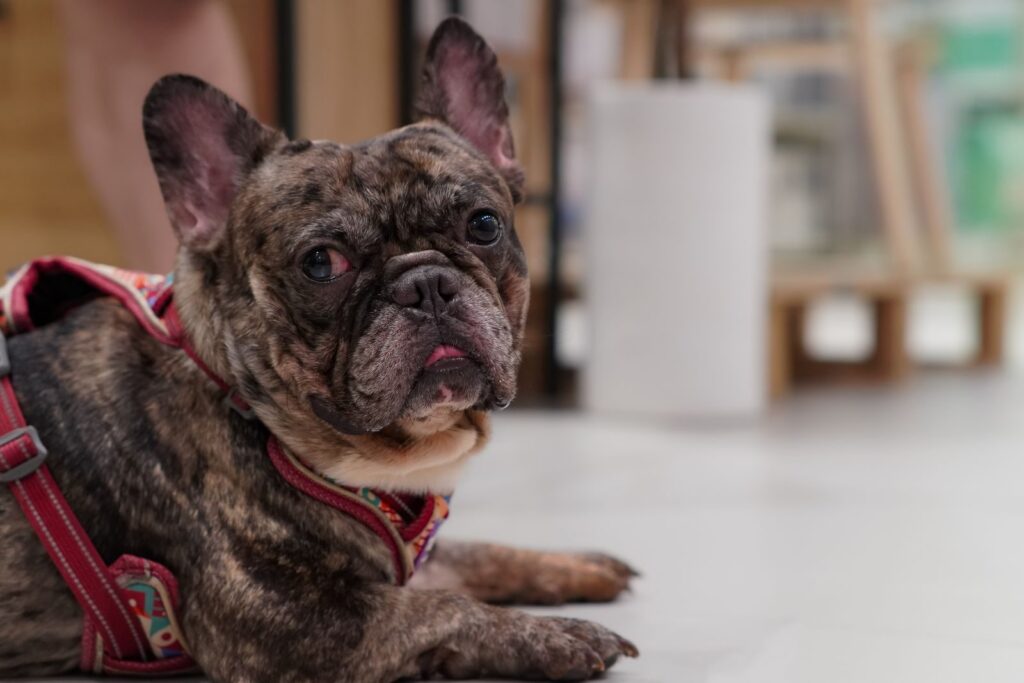
- Use a well-fitted harness instead of a collar.
- Keep meals calm and portions sensible, and avoid hard exercise straight after eating.
- Keep your dog cool and avoid heat and stress, as MSPCA-Angell advises for flat-faced breeds.
- Keep your Frenchie at a healthy weight, another MSPCA-Angell tip for flat-faced breeds.
- Keep coughing dogs away from other dogs until your vet has checked them.
Don’t give human cough or stomach medicines. If your dog needs treatment, your vet may prescribe something suitable.
Vet note: This article is general information, not a diagnosis. An occasional quick gag in a Frenchie who is otherwise well is often not serious, but gagging that keeps happening, comes with a cough, regurgitation or noisy breathing, or appears in a puppy deserves a vet check. Choking, blue or gray gums, collapse, or unproductive retching with a swollen belly are emergencies.
FAQ
Why does my French Bulldog gag after drinking water?
Gulping water while also working to breathe through a short airway can cause a gag or bring water back up. It is common in flat-faced breeds, but frequent episodes, or water and food coming back up regularly, are worth discussing with your vet because they can be linked to BOAS and regurgitation.
My Frenchie is coughing and gagging but otherwise fine. Is it kennel cough?
It could be, especially after contact with other dogs. Merck notes that the harsh cough can be followed by retching and gagging. Call your vet, mention the cough before you arrive, and watch for fever, nasal discharge, low energy or a poor appetite, which suggest something more serious.
Is gagging the same as reverse sneezing?
No. Reverse sneezing is loud snorting pulled in through the nose, usually with the mouth closed, and the dog is normal straight after. Gagging is a throaty, open-mouthed action, often with heaving and sometimes foam or saliva. Our reverse sneezing guide explains what to do during an episode.
Should I worry if my French Bulldog gags at night?
Gagging during rest is worth mentioning to your vet, especially with loud snoring or pauses in breathing, as it can reflect airway narrowing.
Sources
- Brachycephalic Airway Syndrome in Dogs — VCA Animal Hospitals
- Caring for Brachycephalic Dogs — MSPCA-Angell
- Tracheobronchitis (Bronchitis) in Dogs — Merck Veterinary Manual
- Vomiting in Dogs — Merck Veterinary Manual
- First aid for choking — PDSA
- GDV (Gastric Dilatation Volvulus) in Dogs — PDSA