
Those needle-sharp puppy teeth come as a shock to plenty of new owners. One minute your Frenchie puppy is snuggled on your lap, the next they’re latched onto your sleeve, your toes or your fingers. The good news is that French Bulldog biting in puppies is almost always normal play, not a sign of a “bad” dog. Your job is to teach your puppy how gentle a mouth needs to be around people, and to give all that chewing energy somewhere better to go. This guide covers why puppies mouth, what works, what to avoid and when to talk to your vet.
Key takeaways
- Mouthing is normal puppy play and exploration, not early aggression.
- Teach bite inhibition first: hard bites end the fun, gentle play continues.
- Always have a toy ready to redirect your puppy’s teeth away from skin and clothes.
- Overtired puppies bite more. Often the fix is a nap, not more training.
- Never hit, hold the muzzle shut or pin your puppy down. It can make biting worse.
Why French Bulldog puppies bite and mouth
Puppies explore the world with their mouths. They mouth hands, feet and clothing during play and investigation, and the ASPCA describes this as normal behavior that only becomes a problem because puppies grow bigger and stronger. VCA Animal Hospitals adds a useful point: most play biting is a form of social play, a way of interacting with you, rather than teething. Teething puppies tend to gnaw on objects; nipping at people is mostly about play and communication.
Frenchies are companion dogs who love to be involved in everything, so it’s no surprise that hands and ankles become their favorite playthings. Common triggers include:
- Play and excitement: wrestling, chasing, being picked up, or hands waving near their face.
- Teething: chewing helps sore gums, so have safe chews available.
- Tiredness: the AKC lists teething and being overtired as two of the main reasons puppies bite.
- Not enough outlets: VCA recommends plenty of daily play, exercise and exploration, plus chew toys, to meet a puppy’s need to use their mouth.
Bite inhibition: the most important lesson
Bite inhibition means learning to control the force of the jaws. Puppies normally start learning it with their littermates: when one bites too hard, the other yelps and stops playing, so the biter learns to soften up. VCA notes this is one reason puppies should stay with their litter until around 7 to 8 weeks of age.
Your puppy keeps learning this lesson with you. The San Francisco SPCA explains that puppies learn to control their jaws by the time their adult teeth are in, at around 4.5 to 5 months. The ASPCA notes that dogs who have learned good bite inhibition are believed to be less likely to cause serious injury if they ever do bite. That’s why experts suggest working on softer mouthing first, then gradually asking for no teeth on skin at all, instead of trying to stop every bit of mouthing overnight.
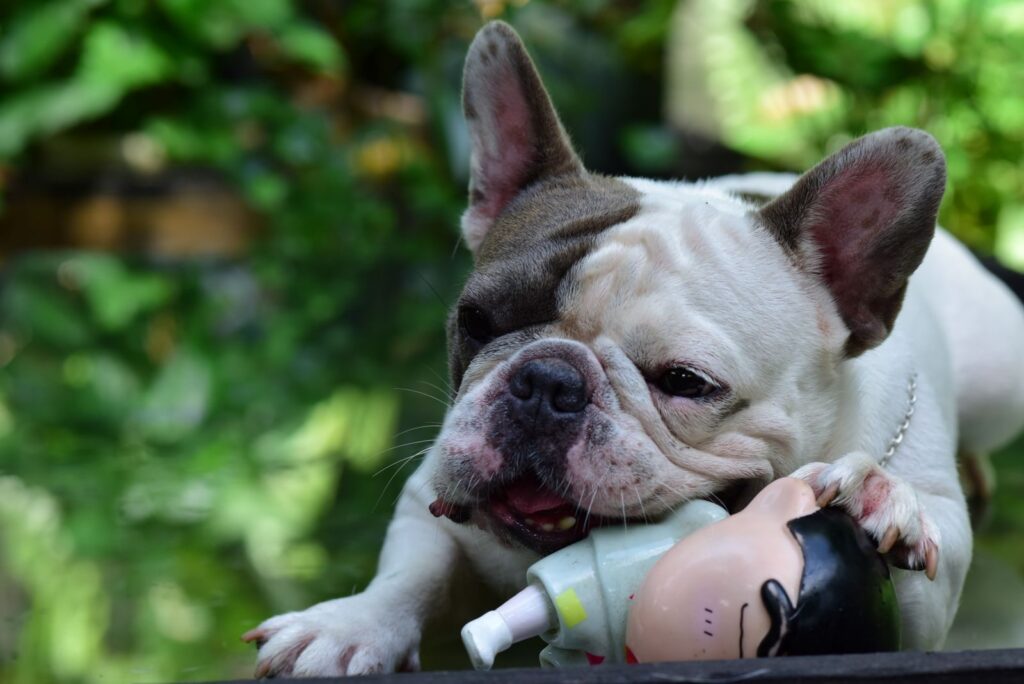
How to stop French Bulldog biting: a step-by-step plan
- Keep a toy within reach at all times. Stash soft toys and chews in every room. When your puppy goes for your hand, offer the toy instead and make it interesting. The SF SPCA suggests waving or squeaking it so it beats your fingers.
- Make hard bites end the fun. If teeth press too hard, say a short “ouch” and stop playing. Go still, turn away or stand up for a few seconds. The ASPCA suggests 10 to 20 seconds of no attention after a hard bite, and 30 to 60 seconds later, once any teeth on skin end play. Then calmly start again. If a yelp seems to wind your puppy up further, skip it and go straight to the pause.
- Step out if the biting continues. If your puppy keeps grabbing, leave the room or step behind a baby gate for a short break. This is a calm pause, not a punishment, so keep your voice neutral.
- Lower the bar each week. The SF SPCA recommends gradually reducing what you tolerate, so that harder bites end play first, then medium ones, until teeth on skin always stops the game. By about 5 months, any mouthing on hands should get the same response.
- Reward the behavior you want. Praise and treat your puppy for licking, sniffing, settling or chewing a toy instead of you. Teaching a simple sit before play starts, as VCA suggests, gives your puppy something polite to do.
- Be consistent. VCA stresses that the whole family needs the same rules. If one person lets the puppy chew their hands, the lesson gets muddled.
Redirecting to the right toys
Offer a few different textures: something soft to carry, something firmer to chew, and a tug toy. Controlled tug can be a great outlet. VCA recommends stopping the game the moment teeth touch skin, and the Merck Veterinary Manual notes that energetic games like tug don’t necessarily cause aggressive play. For a Frenchie, keep tug gentle and short. These are brachycephalic dogs who overheat and get breathless easily, so pause often and stop if breathing becomes noisy or labored.
Ending play calmly
Plenty of biting happens when play builds into a frenzy. Watch for the tipping point, when your puppy starts grabbing faster, zooming or snapping at clothes, and wind things down before you get there. Swap to a calmer activity, such as a chew, a sniffing game with scattered kibble, or a stuffed food toy, and let your puppy settle.

Rest: why overtired puppies bite more
A puppy who is “wild” in the evening is often simply exhausted. Like an overtired toddler, they struggle to calm themselves down, and their mouth gets busier. The AKC names being overtired as one of the main causes of puppy biting. Young puppies need a lot of sleep (see our first-week guide for what to expect), and many need help to actually switch off in a busy home.
Build regular naps into the day in a quiet spot. A comfortable crate or pen with a chew is ideal, as long as your puppy already sees it as a happy place. Our crate training guide explains how to build that association. Never use the crate as a punishment for biting: the aim is rest, not banishment.
Children and puppies
Kids and puppies can be great friends, but they need help. VCA points out that a child’s natural reaction to being nipped, such as squealing, running away or flapping their arms, often looks to a puppy like an invitation to chase and play harder. The SF SPCA’s advice is simple: always supervise children and puppies together.
- Teach children to “be a tree”: stand still, fold their arms and look away if the puppy gets mouthy, while an adult redirects the puppy.
- Give children a toy to offer, so their hands aren’t the main attraction.
- Keep sessions short and calm, and let the puppy retreat to their own space.
- Don’t let children pick up, chase or wrestle with the puppy, and never leave them alone together.
What not to do
Some old-fashioned advice still circulates, but veterinary and welfare organizations agree that it backfires. The American Veterinary Society of Animal Behavior (AVSAB) recommends reward-based training only, and lists methods such as shouting, shake cans, leash jerks and alpha rolls among the aversive techniques to avoid. Avoid:
- Hitting, slapping or tapping the nose. The ASPCA warns that physical punishment for playful mouthing can make puppies bite harder and may cause fear or aggression.
- Holding the muzzle shut. The SF SPCA specifically advises against this, along with shouting in your puppy’s face.
- Alpha rolls or pinning your puppy down. Mouthing is play, not a bid for status, and force teaches your puppy that hands can be scary.
- Waving fingers or jerking your hands away. The ASPCA advises against both, since quick, darting hands look like a game to a puppy.
- Encouraging “cute” biting. What’s funny at 10 weeks is much less funny in an adult dog, as VCA points out.
VCA also notes that harsh discipline can leave a puppy anxious, fearful, defensive or even more excited, because some puppies read it as rough play.
When biting is a concern
Most mouthing is relaxed and wiggly. The ASPCA describes the difference: in play, the puppy’s body and face look loose. Biting that comes with a stiff or frozen body, a hard stare, lifted lips, growling or snapping is different, especially if it’s linked to fear or frustration. Talk to a professional if you notice:
- Guarding: freezing, growling or snapping when someone approaches food, toys, chews or a resting spot. The Merck Veterinary Manual describes this as possessive aggression.
- Biting when touched or handled in a particular area, or a sudden change in a previously gentle puppy. Pain can cause defensive aggression, especially when a dog expects to be moved or touched.
- Biting that is getting harder, not softer, after several weeks of consistent training, or bites that break skin.
- Fearful biting around strangers, other dogs or handling.
Merck advises seeking help from a veterinarian as soon as any signs of aggression appear, because medical problems such as pain, neurological disease or hormonal disorders can play a part. Once health issues are ruled out, the ASPCA suggests a veterinary behaviorist, a Certified Applied Animal Behaviorist, or, failing that, a reward-based Certified Professional Dog Trainer experienced with fear and aggression.
Vet note: Mention your puppy’s biting at their routine checkups. If biting appears suddenly, gets worse, or happens when your Frenchie is touched in a particular spot such as the back, ears or mouth, book a vet visit before starting any new training plan. Pain is easy to miss, and treating it can change behavior. Your vet can also refer you to a qualified behavior professional.
FAQ
At what age do French Bulldog puppies stop biting?
There’s no exact date, but mouthing usually eases as puppies mature and lose their baby teeth. The SF SPCA notes that adult teeth are in at around 4.5 to 5 months, and by then your puppy should have learned to be gentle. Consistent training matters more than age.
My Frenchie puppy bites more in the evening. Why?
Very often it’s tiredness. Overtired puppies get wound up and mouthy. Try a quieter routine in the evening and a calm nap spot with a chew before the “witching hour” starts.
Should I yelp when my puppy bites?
A short “ouch” followed by a brief pause in play works for many puppies. If yelping makes your puppy more excited, skip it and simply stop the game, then redirect to a toy.
Is my puppy being aggressive?
Probably not if the body is loose and playful. Stiffness, freezing, growling over food or toys, or biting when touched are worth discussing with your vet and a qualified behavior professional.
Sources
- Mouthing, Nipping and Biting in Puppies — ASPCA
- Play Biting in Puppies — VCA Animal Hospitals
- Puppy Play Biting and Mouthing — San Francisco SPCA
- How to Stop a Teething Puppy From Biting You — American Kennel Club
- Why You Need To Reward Your Dog in Training, According to the Experts — American Veterinary Society of Animal Behavior
- Behavior Problems in Dogs — Merck Veterinary Manual