
French Bulldog theft is a real risk for owners of this breed, and it can happen in minutes. AKC Reunite, the American Kennel Club’s pet recovery service, warns that “it only takes a minute for your pet to be stolen in plain sight.” This guide explains why Frenchies are targeted, how to lower the risk, and exactly what to do in the first 24 hours if your dog is stolen.
Quick answer: French Bulldogs are a leading theft target in both the US and the UK because they are small, popular and valuable. Never leave your Frenchie alone in a car, tied outside a shop or unsupervised in the yard, and keep a registered microchip up to date. If your dog is stolen, report it to police and animal control immediately.
Key takeaways
- French Bulldogs top AKC Reunite’s list of common theft targets and were the UK’s most stolen breed in 2025.
- Never leave your Frenchie alone in a car, tied outside a shop or unsupervised in the yard.
- A registered microchip with current contact details greatly improves the odds of getting a stolen dog back.
- If your dog is stolen, report it to police and animal control right away, then spread the word widely.
- Never confront a suspected thief yourself; pass every lead to the police.
Why French Bulldogs are the most stolen dog breed
Frenchies are small, easy to carry, very popular and expensive. That combination makes them attractive to opportunistic thieves and to people who want to resell a dog quickly.
In the United States, AKC Reunite puts the French Bulldog first on its list of breeds most commonly targeted by thieves, and says its lost pet reporting data shows dog thefts in the US rose 34% over five years (2025 compared with 2020). Writing for the AKC, AKC Reunite president and CEO Tom Sharp said thefts often involve high-value dogs such as Bulldogs and French Bulldogs, and small breeds, because “these types of dogs are easy to grab and run with.”
Their high price is part of the appeal to thieves. If you want the full picture of what a Frenchie costs to buy and keep, see our French Bulldog cost guide.
The picture is similar in the UK. Blue Cross reports that, according to national data compiled by Direct Line Pet Insurance from police Freedom of Information responses, an average of four dogs were stolen every day in 2025, and French Bulldogs were the most commonly stolen breed. Blue Cross also notes that most dogs are stolen from their homes or yards, not from public places. The Pet Abduction Act 2024 makes abducting a cat or dog a criminal offense in England and Northern Ireland, with a penalty of up to five years in prison, a fine, or both.
| Data point | Figure | Source |
|---|---|---|
| French Bulldog rank among common theft targets (US) | First on the list | AKC Reunite |
| Change in US dog thefts, 2020-2025 | Up 34% | AKC Reunite reporting data |
| Average dogs stolen per day in the UK, 2025 | About four | Blue Cross (Direct Line police data) |
| Most commonly stolen breed in the UK, 2025 | French Bulldog | Blue Cross |
How dog thefts typically happen
Many thefts are opportunistic: a dog is left alone for a short time and someone takes the chance. The AKC warns that leaving a dog unattended, even for a moment, makes them vulnerable, and that a determined thief will smash a car window to get to a dog. Common situations include:
- Vehicles. A dog left in a parked car can be taken in seconds; AKC Reunite says not to leave a dog alone in a car even with the engine running and the AC on.
- Tied up outside a shop or school. A dog left on a leash outside is easy to unclip and carry away.
- Yards and gardens. A dog visible from the street, behind a weak fence or an unlocked gate, is at risk when no one is watching.
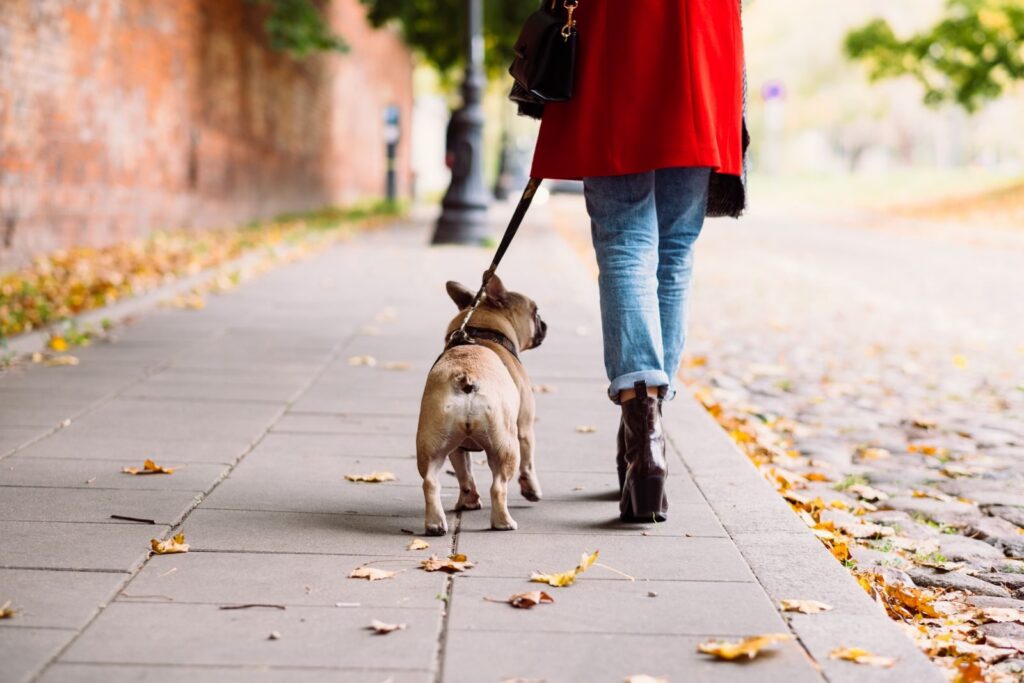
- Walks. Blue Cross advises keeping a close eye on your dog on walks and varying your route or walk times now and then, so your routine is less predictable.
- Online information. Posts that reveal your dog’s routine, walking routes or real-time location can help a thief plan.
How to prevent French Bulldog theft: a checklist
No single step makes a dog theft-proof, but layering several precautions makes your Frenchie a much harder target.
- Never leave your Frenchie alone in a car. Theft is one reason; heat is another. Flat-faced dogs overheat quickly, so see our French Bulldog heat safety guide.
- Do not tie your dog up outside shops. If you cannot bring your dog inside, leave them at home.
- Supervise yard time. Secure fences and gates, especially if your dog can be seen from the street. The Royal Kennel Club advises not leaving dogs outside unsupervised and keeping your yard and house secure.
- Microchip and register. The AVMA explains that a microchip only contains an ID number; it works only if you register it and keep your contact details current in the registry.
- Use a collar ID tag as well. The AVMA recommends that microchipped pets also wear a collar with current identification, and Blue Cross advises making sure your dog wears an ID tag on walks.
- Consider a GPS tracker as an extra. A tracker can help you locate your dog, but it can be removed, so treat it as a backup to a microchip, not a replacement.
- Keep your dog close in public. The Royal Kennel Club advises making sure you can always see your dog on walks. AKC Reunite notes that thieves can easily corral a dog that wanders too far off leash.
- Add cameras. Motion-activated or security cameras can deter thieves and give police useful footage.
- Be careful on social media. Avoid sharing your dog’s routine, walking routes or exact location in real time, and consider hiding location data on photos.
- Be wary of strangers’ questions. Friendly interest is normal, but trust your instincts. If someone asks unusual questions about where you live, what your dog is worth or whether they can buy them, keep details to yourself and leave if something feels wrong.
- Teach a solid recall. Blue Cross suggests teaching recall so your dog returns to you quickly if approached by a stranger. Use reward-based training only.
If you are still deciding whether a Frenchie fits your lifestyle, the security side of ownership is worth weighing too; our guide Is a French Bulldog right for you? covers the bigger picture.
The first 24 hours if your Frenchie is stolen
Act fast. The AKC advises reporting a theft to the police, calling your microchip company and local shelters, and getting the word out on social media. The ASPCA also stresses that swift action and getting the word out to as many people as possible improve the odds of finding a missing pet.
- Report it to the police and animal control. Make clear it is a theft, not just a lost dog, and ask for a report or case number. Give a recent photo, your dog’s microchip number and a description of any distinguishing marks.
- Contact your microchip registry. Report your dog as stolen and confirm your contact details are correct. If you do not know which registry holds the chip, the AVMA points to AAHA’s Microchip Registry Lookup Tool or your vet.
- Call local shelters, vets and rescues. The ASPCA recommends contacting animal control, veterinary hospitals, shelters and rescue groups, and visiting shelters in person with photos. Ask vets to scan any Frenchie that comes in and to check its chip number.
- Go public on social media and community groups. Post clear photos, the time and place of the theft, and the case number. The ASPCA notes that most communities have local lost-pet Facebook pages whose administrators may share your post.
- Put up flyers. Use a bold headline, a recent photo, key details and two phone numbers. Good spots include vet offices, pet stores, groomers, dog parks and busy shops.
- Ask for CCTV. Neighbors, nearby businesses and doorbell cameras may have captured the theft or a vehicle. Pass any footage to the police rather than acting on it yourself.
- Consider a reward, carefully. A reward can encourage people to come forward. Be cautious with anyone who asks for money before returning your dog, never go alone to meet someone who claims to have your Frenchie, and involve the police in any handover.
Never confront a thief yourself. Your safety comes first. Share names, vehicle details and locations with the police and let them act.
A theft is extremely stressful for people and dogs. Once your Frenchie is home, expect them to need some quiet time and routine; if they become clingy or anxious when left alone, our separation anxiety guide can help.
Vet note: The AVMA recommends asking your veterinarian to scan your dog’s microchip during routine checkups to confirm it is present and working. It is a quick check that makes sure your Frenchie can be identified if they are ever stolen or lost. If you do not know your dog’s microchip number, your vet can scan it for you so you can check the registration.
FAQ
What is the most stolen dog breed?
In the UK, French Bulldogs were the most commonly stolen breed in 2025, according to Blue Cross, citing Direct Line’s police data. In the US, AKC Reunite lists the French Bulldog first among common theft targets.
Will a microchip help if my French Bulldog is stolen?
Yes, if it is registered and your details are current. When a vet or shelter scans the chip, the ID number can be traced to you. A chip cannot be lost like a collar, but it is not a GPS tracker and cannot show where your dog is.
Should I report a stolen dog to the police or animal control?
Both. Report it to the police as a theft, and also tell animal control, your microchip registry, local shelters and vets so that anyone who comes across your dog knows to contact you.
Is a GPS tracker enough to protect my Frenchie?
No. A tracker is a useful extra, but it can be removed or run out of battery. Combine it with a registered microchip, a collar ID tag and close supervision.
Sources
- Pet Theft — AKC Reunite (American Kennel Club)
- How to Keep Your Dog Safe When Pet Theft Is on the Rise — American Kennel Club
- Pet Theft: How to Prevent Your Pet Being Stolen — Blue Cross
- Protecting your pet against dog theft — The Royal Kennel Club
- Microchips reunite pets with families — American Veterinary Medical Association
- Finding a Lost Pet — ASPCA