

Can French Bulldogs swim? The honest answer is: not well, and many cannot keep themselves afloat at all. The French Bull Dog Club of America states plainly that Frenchies are poor swimmers who can easily drown. This guide explains why the breed struggles and how to keep your Frenchie safe around pools, lakes, rivers and the ocean.
Quick answer: Most French Bulldogs cannot swim well, and many cannot keep themselves afloat at all because of their front-heavy build, short legs and narrow airways. Near deep water, use a well-fitted life jacket with a sturdy handle and stay within arm’s reach. Any dog that went under the water should see a vet straight away, even if it seems fine.
Key takeaways
- Most French Bulldogs are poor swimmers. Their front-heavy build makes it easy for them to sink.
- A well-fitted dog life jacket with a sturdy handle helps, but it never replaces close supervision.
- Never leave a Frenchie alone near a pool, pond or lake, and never jump in after a struggling dog.
- Keep dogs out of water that looks scummy, foamy or discolored. Toxic algae can make dogs seriously ill.
- Any dog pulled from the water after going under should see a vet, even if it seems fine.
Can French Bulldogs swim?
Some Frenchies can paddle briefly, but as a breed they are not built for swimming:
- The French Bull Dog Club of America says French Bulldogs “must never be left unattended around water, as they are poor swimmers and can easily drown due to their front-heavy structure.”
- VCA Animal Hospitals advises that stocky, short-legged breeds such as bulldogs and pugs will always need a life jacket whenever they go in the water.
- The AKC points out that it is a myth that all dogs are natural swimmers, and that short-legged breeds and those whose weight distribution works against them can struggle in the water.
So, are French Bulldogs good swimmers? Generally, no. The safest mindset is the one in our exercise guide: never assume a Frenchie can swim.
Why French Bulldogs struggle in the water
A front-heavy body on short legs
A Frenchie carries a large head and a broad, deep chest on a compact frame with short legs. That front-heavy structure, which the breed club specifically links to drowning risk, means the front end tends to sink while short legs have little reach to paddle the body level.
Flat faces and narrow airways
French Bulldogs are brachycephalic, meaning they have a shortened skull and flat face. An emergency veterinarian writing for VEG ER for Pets notes that brachycephalic dogs, including bulldogs, are at increased risk of drowning because of their narrow airways. If your dog snores or tires quickly on land, see our guide to BOAS and breathing problems, because those signs matter even more around water.
French Bulldog life jackets: what to look for
If your Frenchie will be anywhere near deep water, on a dock, a boat, a pool deck or a riverbank, a dog life jacket is the first piece of safety gear to buy. The AKC recommends choosing one that is:
- Durable and made of waterproof material.
- Adjustable for a snug fit. Check the straps around the Frenchie’s wide chest and thick neck.
- Fitted with a sturdy handle on the back. The AKC notes a handle lets you lift your dog out of the water, grab them if they’re struggling, and guide them while they learn.
- Brightly colored or reflective, so you can spot your dog easily.
Some vests also add flotation under the chin, which helps hold the head up. Let your dog wear the vest at home on dry land first, with treats and praise, so it feels normal before you add water.
Remember that a life jacket helps your dog float. It does not make them a strong swimmer, and it does not replace you. Stay within arm’s reach whenever your Frenchie is in the water.
Water safety by setting
| Setting | Main risks | Safety steps |
|---|---|---|
| Backyard pool | Falling in when nobody is watching, not finding the exit, swallowing pool water | Fence or gate the pool, never leave your dog unsupervised, teach the steps or ramp, offer fresh drinking water |
| Lake or pond | Toxic algae, deep drop-offs, cold water, fish hooks and wildlife | Check the water before going in, keep your dog on a leash, use a life jacket, rinse with clean water afterward |
| River | Currents that can sweep a dog away | Avoid flowing water; life jacket and leash if near the bank |
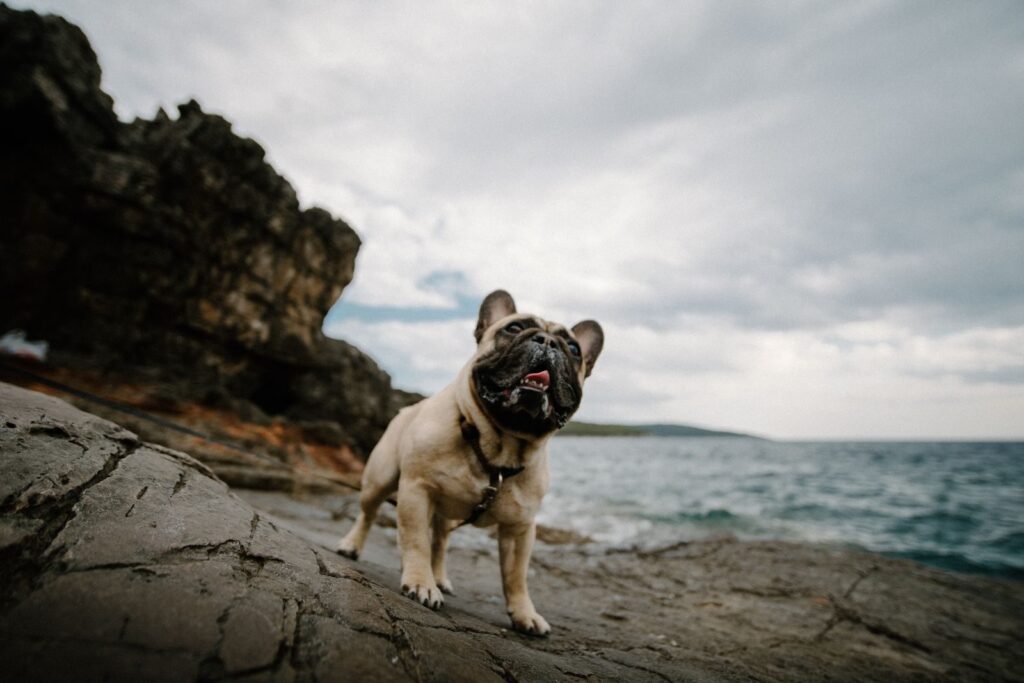
| Beach and ocean | Waves, currents, drinking salt water, hot sand | Stay in the shallows or out of the water, bring fresh water, rinse off salt afterward, check sand temperature |
| Boat or dock | Falling overboard into rough or deep water | Life jacket on at all times, handle within reach |
Pools
A dog can fall into a pool quietly and fail to find a way out along a smooth wall. VEG ER for Pets recommends pet-proof fencing around pools, pool alarms or wearable water sensors, and teaching dogs where the stairs or ramp are. VCA Animal Hospitals also advises fencing and covering the pool and teaching your dog to climb out unassisted. Practice the exit with your dog in a life jacket, rewarding them each time they climb out.
Don’t let your dog lap up pool water. VCA suggests offering plenty of fresh drinking water so they aren’t tempted, and rinsing your dog after a swim, since chlorine can irritate the skin.
Lakes, ponds and rivers
Natural water brings extra hazards. The AKC warns about strong currents, wildlife such as snapping turtles, and baited fish hooks. Dogs Trust adds hidden drop-offs, underwater debris and steep or slippery banks that can trap a dog. It also suggests a rule of thumb for cold water: the water temperature plus the air temperature should add up to at least 100°F before a dog swims.
The biggest hidden danger is harmful algal blooms, sometimes called blue-green algae. According to the CDC, these blooms can make water look discolored or appear as foam, scum, mats or paint on the surface. Dogs Trust explains that dogs are at risk if they swim in or drink contaminated water, or lick algae off their fur while grooming. The CDC’s advice is:
- If you suspect a bloom, keep your dog out of the water and away from the shore algae.
- If your dog goes in, wash them off right away with clean water so they can’t lick the toxins from their coat.
- Call a vet if your dog shows loss of energy or appetite, vomiting, stumbling, foaming at the mouth, diarrhea, convulsions, or any unexplained illness within a day or so of contact with water.
The beach
Waves and currents can easily overpower a small, heavy dog, so Frenchies are safest at the very edge or on the sand. Dogs Trust warns that swallowing salt water can cause vomiting, diarrhea and dehydration, so bring plenty of fresh water for your dog to drink. Rinse your dog after a swim, since sea salt can irritate the skin, and check that the sand isn’t hot enough to burn paw pads.
How to introduce your Frenchie to water
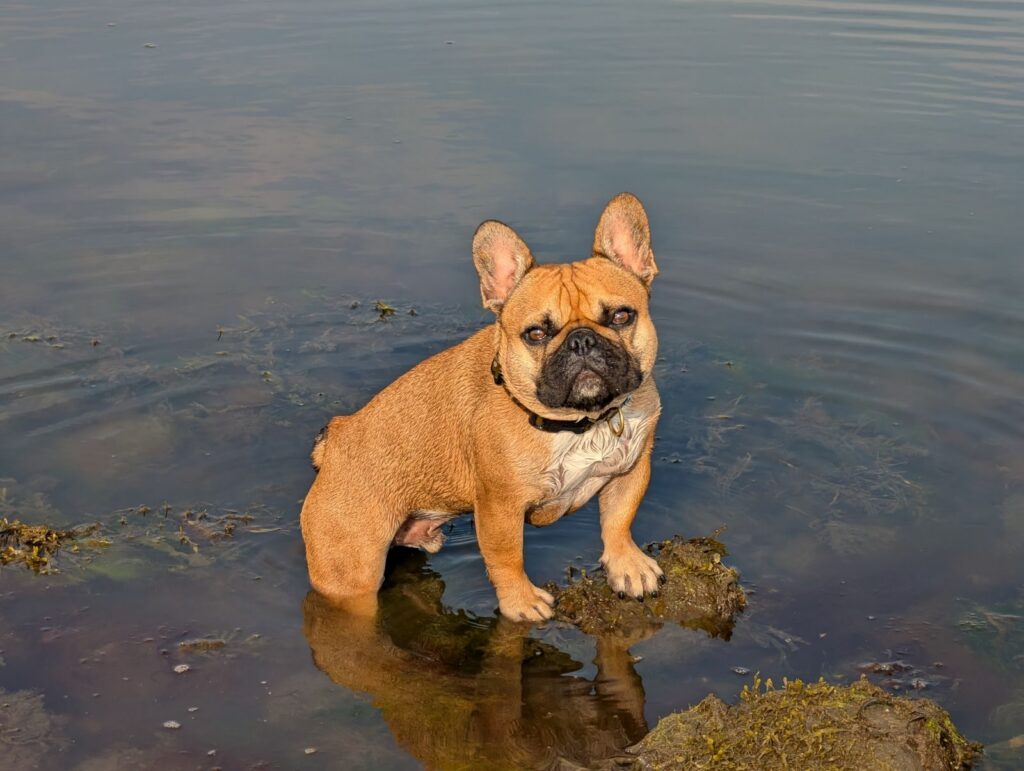
If you want your dog to be comfortable around water, go slowly and let them set the pace. The AKC is clear: never toss a dog into the water to “figure it out.”
- Start with the life jacket on dry land until your dog is relaxed wearing it.
- Choose calm, shallow water where your dog can stand, such as a pool step or a gently sloping shore.
- Use treats, toys and praise, and let your dog come to you. If they want to get out, let them.
- Stay close, with a hand on or near the vest handle.
- Keep sessions short. The AKC suggests a maximum of 10 minutes, partly to limit how much water a dog swallows.
Some Frenchies will never enjoy water, and that is fine.
Signs your dog is struggling, and what to do
Dogs Trust lists signs of exhaustion in the water: heavy panting, slow movement, resting the head on the water, loss of enthusiasm, and struggling to swim or stay afloat. For a Frenchie, also watch for noisy breathing or panic. Don’t wait. If your dog is within reach, lift them out using the vest handle, keep them calm, and let them rest in the shade.
Never go into deep or moving water after your dog. Dogs Trust strongly advises against it, because it puts both you and your dog at greater risk. Instead, stay calm, call your dog to you, reach with a long leash or stick, or throw something that floats, and call emergency services for help if your dog cannot get out.
If your dog went under the water, inhaled water, or needed to be pulled out, see a vet straight away even if they seem fine. VEG ER for Pets advises that any animal submerged, even for a few seconds, should go to the ER, because water in the lungs can lead to breathing difficulty, infection and pneumonia, and complications can appear 24 to 48 hours or more later.
After-swim care
- Rinse off chlorine, salt or lake water with clean fresh water.
- Dry the ears gently. VCA notes that moisture left in the ears can lead to ear infections; see our guide to French Bulldog ear infections.
- Dry the skin folds around the face and tail, where damp skin can quickly become irritated. Our skin fold care guide shows how.
- Watch your dog for coughing, unusual tiredness or vomiting in the hours and day after swimming.
Is water a good way to cool down in hot weather?
Water play is no substitute for avoiding heat. Swimming is hard work for a Frenchie, so a dog paddling in deep water on a hot day can tire and overheat at the same time. The safer option is a shallow paddling pool in the shade where your dog can stand, always supervised. For more ways to keep your dog cool, including what to do if heatstroke strikes, see our hot weather safety guide.
Vet note: If your Frenchie has a history of noisy breathing, collapse or exercise intolerance, ask your vet before any water activity. After any submersion, have your dog checked promptly, even if it seems normal.
FAQ
Can French Bulldogs swim with a life jacket?
A properly fitted life jacket helps a Frenchie float and keep its head up, and many dogs can paddle safely for short periods while wearing one. It is still not a guarantee, so stay within reach and keep sessions short.
Should I jump in if my Frenchie is struggling in deep water?
No. Stay on the bank, call your dog to you, reach with a long leash or stick, or throw something that floats. If that fails, call emergency services.
What should I do if my Frenchie swallowed lake water that looked green?
Rinse your dog with clean water right away and call your vet, especially if you notice vomiting, diarrhea, stumbling, weakness or seizures. Toxic algae can cause serious illness.
Sources
- French Bulldog Breed Information — French Bull Dog Club of America
- The Dos and Don’ts of Dog Water Safety — VCA Animal Hospitals
- Can All Dogs Swim? How to Teach a Dog to Swim — American Kennel Club
- Dog Drowning and Near-Drowning: What To Know — VEG ER for Pets
- Preventing Pet and Livestock Illnesses Caused by Harmful Algal Blooms — Centers for Disease Control and Prevention
- Keeping Your Dog Safe Around Water — Dogs Trust